Portuguese
  Spanish


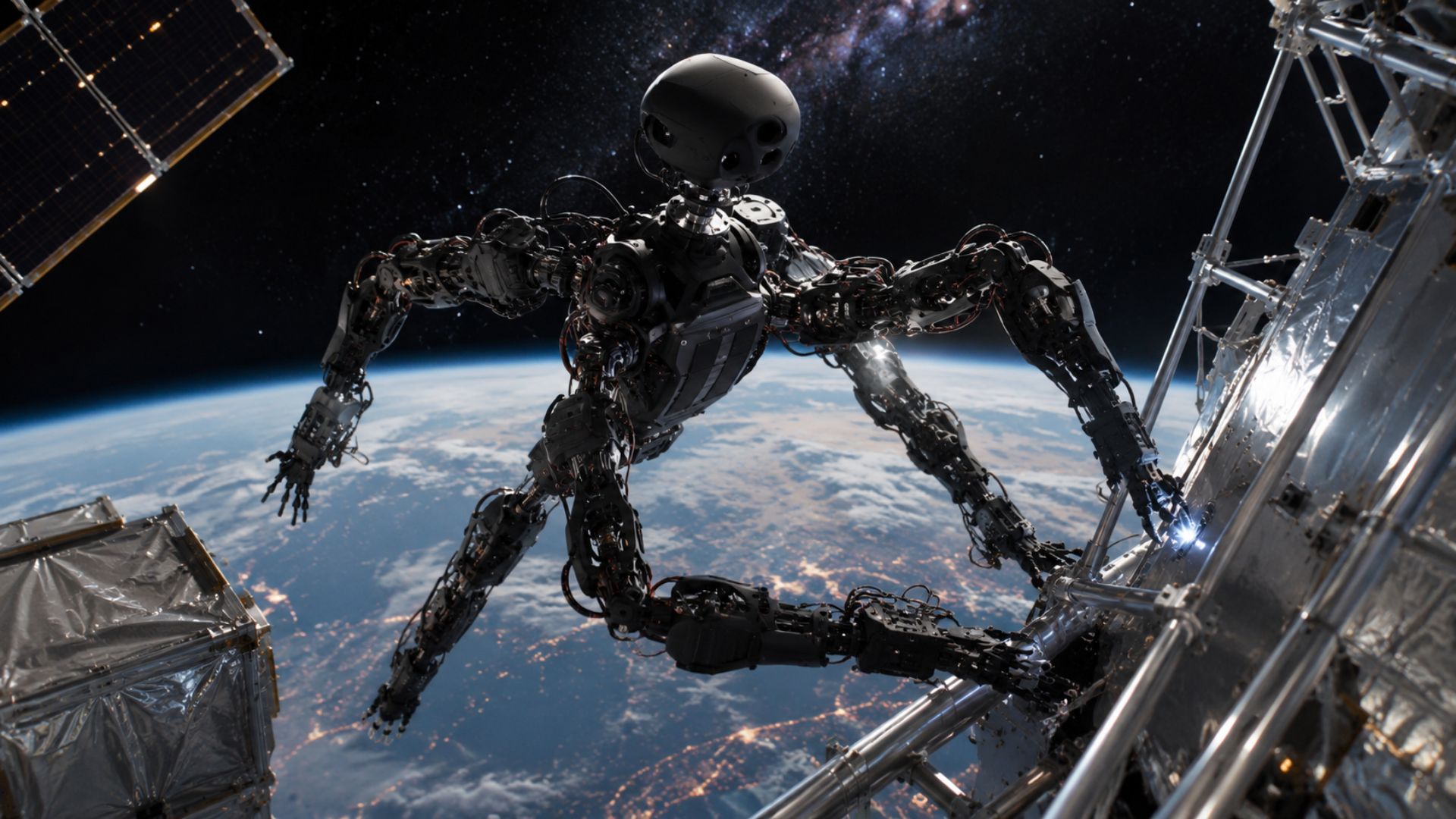

The Helios is a four-armed robot developed by Orbit Robotics to operate exclusively in microgravity, inside spacecraft and space stations. Helios uses two arms to attach to internal surfaces and the other two to perform tasks such as handling objects and equipment. Helios’ engineering uses motors concentrated in the shoulders and force transmitted by metal cables, reducing weight in the arms and preserving range of motion. The company projects that Helios can reduce the 35% of the time astronauts dedicate to maintenance, an activity that costs 140 thousand dollars per hour.
The Helios looks alien, and this appearance is intentional. The robot developed by Orbit Robotics completely abandons the logic of humanoid robots with legs and an upright torso, because in zero gravity this anatomy makes no sense. Instead, Helios has four specialized arms: two serve to grip internal surfaces of spacecraft and space stations, and the other two perform operations such as handling objects, tools, and equipment. Helios was designed to operate in conditions where there is no gravity, a scenario where any impulse can move bodies and tools uncontrollably, and its architecture solves this problem by fixing the machine to the environment before starting any task.
The goal of Helios is not to replace astronauts, but to reduce the time they spend on repetitive tasks. About 35% of work time in space stations is dedicated to maintenance, with an estimated cost of 140 thousand dollars per hour per astronaut, according to data cited by Orbit Robotics. If Helios can take over part of these activities, operational savings could be significant and astronauts could dedicate more time to science and exploration.
How Helios works in zero gravity

The engineering of Helios uses a tendon-driven model, where the motors are concentrated in the shoulder region and the force is transmitted by metal cables to the ends of the arms. This choice reduces the weight distributed by the arms and preserves the range of motion, allowing Helios to manipulate objects without generating reaction forces that would displace it in the zero-gravity environment.
-
The industrial waste that even recyclers didn’t want has gained value in the interior of Bahia: two entrepreneurs invested R$ 2.8 million to transform 350 tons per year of foam, rubber, and plastic into boards that can replace wood and MDF.

-
What is a red flashlight used for, after all? See why it is so commonly used at night.

-
He has never read a line of code, but he already knows how to work: the French company UMA presented in Paris the Northstar, its first AI-powered humanoid robot designed for factories and warehouses, capable of copying tasks just by observing an employee in action.

-
A young Kenyan engineer collects plastic waste from the streets and transforms it into robots that translate physics lessons into sign language in real-time, a machine made with old bottles that teaches what was missing to deaf children left out of science.




According to information released by the NewAtlas post, another central element of Helios is an elbow joint with rolling contact. This solution ensures smoother movements and avoids abrupt motions that could compromise the stability of the robot and the objects being manipulated. In zero gravity, an abrupt gesture can turn a tool into a projectile or push the operator away from the work surface, and Helios was designed to eliminate this risk.
What Came Before Helios
Before developing Helios, the Orbit Robotics team tested IKARUS, an experimental platform used to validate remote control techniques, imitation learning, and two-arm manipulation. The tests with IKARUS served as a basis for the design of Helios’s four arms, proving that the cable and joint architecture worked in simulated microgravity conditions.
The transition from two to four arms in Helios was not just a mechanical addition. It solved the fundamental problem of anchoring: with two arms, the robot would need an external anchoring system to hold itself while working. With four, Helios anchors itself using one pair of arms while the other pair operates, alternating functions as it moves through the station’s interior.
What Helios Can Do Beyond Maintenance

In addition to internal use in space stations, Orbit Robotics designs future applications of Helios in satellite maintenance and construction of structures in orbit. The advancement of launch programs and the reduction of space access costs increase the demand for robots capable of performing external tasks without exposing humans to radiation, bone mass loss, and visual alterations that prolonged exposure to the space environment causes.


In the future, Helios could be sent to repair satellites with mechanical or orientation failures, a task that currently requires expensive and risky manned missions or simply results in the abandonment of the equipment. Helios’s ability to attach to surfaces and operate with precision in zero gravity makes this application technically viable, although development for external use requires additional adaptations for thermal protection and radiation resistance.
Why Helios Doesn’t Have Legs
The decision to eliminate legs is a direct response to the operating environment. In zero gravity, walking doesn’t exist, and legs become dead weight that consumes energy and space without offering any function, while extra arms multiply the robot’s ability to attach and work.
Helios represents an approach opposite to terrestrial humanoid robots, which copy human anatomy because they operate in the same environment. In space, copying the human body is a design error, and Orbit Robotics bet on a form that seems strange on Earth but makes perfect sense when gravity disappears. For astronauts who will eventually work alongside Helios, the four-armed robot can be the difference between spending a third of the time on maintenance and dedicating that time to what really matters: science, exploration, and the objectives that justify sending astronauts to space.
Did you know there is a four-armed robot designed to work in zero gravity? What impresses you most about Helios: the absence of legs, the $140,000 per hour of astronaut time, or the possibility of repairing satellites? Tell us in the comments.