Portuguese
  Spanish


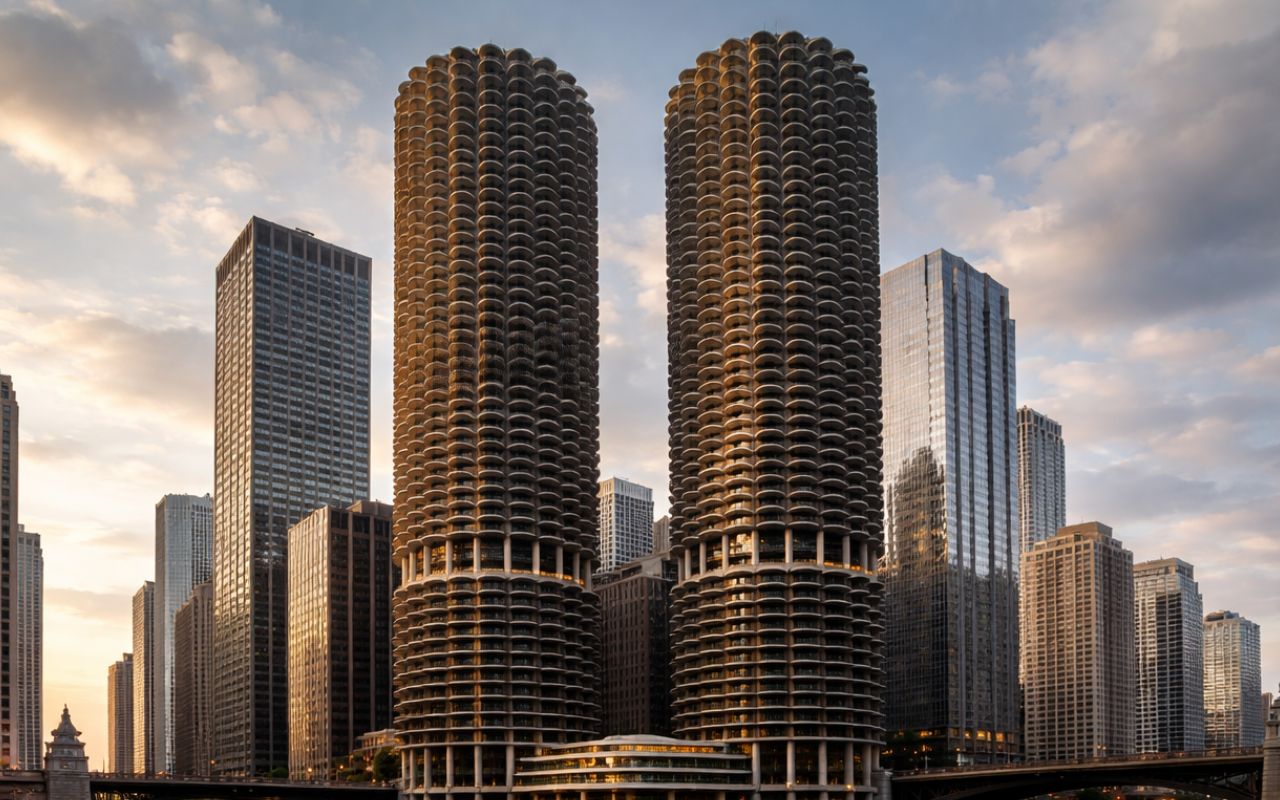

Circular Towers Shaped Like Corn On The Cob Transformed Marina City Into An Icon Of Modern Architecture In Chicago, Uniting Housing, Leisure And Urban Innovation Since 1964.
The circular towers of the Marina City complex have become one of the most recognized symbols of Chicago over the past few decades.
Located along the banks of the Chicago River in the United States, the architectural ensemble inaugurated in 1964 redefined urban living and changed the logic of modern residential planning.
The project was conceptualized by architect Bertrand Goldberg with the aim of bringing vitality back to the city’s downtown area.
-
For a Decade, a Young Sudanese Innovator Builds Robots from Electronic Scrap in a Makeshift Lab in Omdurman

-
Woman with no tech background uses AI to develop app, reaches 50,000 users and goes viral with 2 million views by turning conversations into an emotional support tool.
-
From Construction Helper at 12 to Leading Real Estate Ventures Worth $210 Million After Delivering Over 2,000 Homes
-
‘Solar Cat’ Technology Arrives in Brazil, Raising Concerns Among Energy Distributors Over Suspected Cost-Cutting Method


At the time, the center was facing population decline, and the proposal sought to attract residents through architectural innovation and integrated functionality.
What Are The Circular Towers Of Marina City?
The circular towers of Marina City each have 65 floors and were constructed of reinforced concrete.
The rounded shape completely deviates from the dominant rectangular standard of skyscrapers of the time, making the complex immediately recognizable.
The semicircular balconies repeat along the facade, creating a visual that resembles an ear of corn.
This feature led the buildings to receive this popular nickname, which remains to this day.
The decision to build circular towers was not only aesthetic. According to Goldberg, nature rarely presents right angles, and the rounded shape offers important structural advantages.
Among the main benefits are the reduction of wind resistance—an essential factor in Chicago—and the possibility of providing panoramic views for all apartments.
Additionally, the design facilitates the distribution of internal spaces and improves natural lighting.
A Functional Base That Supports The Whole Building
Unlike most residential buildings, Marina City starts in an unusual way.
The first 19 floors are occupied by an open spiral parking garage, integrated into the structure of the towers.
This solution eliminated the need for external garages and allowed for better utilization of urban space.
At the same time, the parking garage visually reinforces the concept of the circular towers, as it follows the design of the building.

Circular Towers And The Concept Of A “City Within A City”
Marina City is considered one of the first large-scale mixed-use projects in the United States.
The proposal was simple and ambitious: to allow residents to solve much of their daily lives without leaving the complex.
In addition to residential units, the complex includes a marina with direct access to the river, theater, restaurants, offices, leisure areas, and cultural spaces.
This model helped consolidate the concept of a “city within a city,” which is now widely adopted in large urban centers.
How The Circular Towers Differ From Other Buildings In Chicago
Chicago is known as the birthplace of skyscrapers. However, while buildings like the Willis Tower prioritize height and corporate use, the circular towers of Marina City were designed for residential life.
This difference made the complex a reference for human-centered urbanism, focused on community, mobility, and integration with the surroundings.
Complete Structure Of The Marina City Complex
The project features circular residential towers of 65 floors, connected to a spiral parking garage with 19 levels.
The complex also includes a marina along the banks of the Chicago River, as well as cultural spaces, restaurants, offices, and commercial areas.
This configuration solidified Marina City as a pioneering model of coexistence between housing, entertainment, and urban services.


Presence Of Circular Towers In Pop Culture
Over the years, the circular towers of Marina City have surpassed the realm of architecture and gained traction in popular culture.
The complex has appeared in films, series, and music album covers.
One of the most famous scenes occurs in the movie “Bullitt”, starring Steve McQueen, where a car falls from the spiral parking structure, immortalizing the building in cinema.
Even after more than 60 years, Marina City continues to be studied by architects and urban planners.
The innovative shape, mixed use, and enhancement of the urban center make the complex an example of how architecture can positively influence the dynamics of cities.
The circular towers prove that creative and well-planned solutions can transcend generations without losing relevance.
Source: BMCNews