





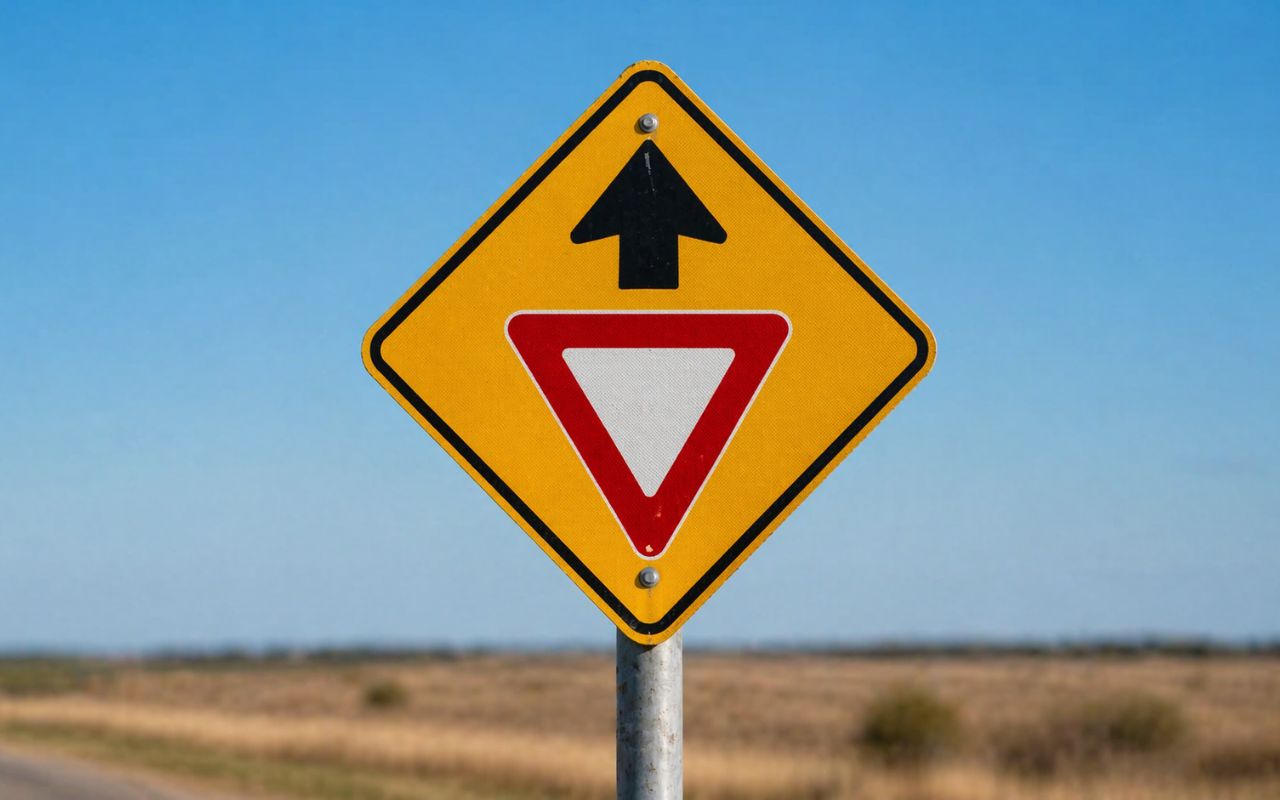

Understand the traffic sign with white triangle with red edges and upward arrow and know how to act before dangerous intersections.
Not all risks appear immediately on the road — some are announced in advance. This is precisely the role of the traffic sign with a white triangle with red edges and an upward arrow, common on roads in Argentina.
The sign appears before intersections to warn that the driver is about to enter a section where they will not have the right of way.
Thus, it serves as a preventive alert, allowing the driver to reduce speed and prepare for a possible stop ahead.
-
Workers renovating a playground in northern England uncover 176 World War II bombs buried underground; training artifacts still contained explosives.

-
Brazilian Architect Transforms Waste into Sustainable Homes with Solar Power and Rainwater Systems for 40 Years

-
Security Guard Becomes Doctor at Louisiana Hospital Where He Once Worked, Studied Chemistry Between Shifts

-
Woman Rescued from Luxury Complex in Brazil Worked Without Pay for 55 Years, May Be Entitled to Over $300,000




Traffic sign with white triangle with red edges and upward arrow begins sequence of warnings
The main message of this traffic sign is clear: attention, you will not have priority. The white triangle with red edges and upward arrow anticipates this condition.
This means that another flow of vehicles will have priority at the intersection. Therefore, the driver should adjust their driving even before reaching the critical point. This way, the risk of abrupt decisions decreases considerably.
This type of signaling does not act alone. The traffic sign with a white triangle with red edges and upward arrow is just the first step.
Further ahead, the driver will encounter the “Yield” sign, which indicates the exact spot where they must stop or reduce to the maximum. In many cases, there are also markings on the asphalt reinforcing the guidance. Therefore, it is an organized system in stages to ensure safety.
Difference between warning triangle and mandatory sign
An important detail is the position of the triangle. When it appears with the tip pointing upwards, as in this traffic sign, it indicates only a warning.
On the other hand, the inverted triangle, with the tip pointing downwards, represents a clear order to yield. This pattern follows international signaling standards. Thus, the correct interpretation depends on attention to visual elements.

The installation of this traffic sign occurs at strategic points. Generally, it appears before intersections with a higher risk of collision.
This includes locations with heavy traffic, reduced visibility, or a history of accidents. The goal is to ensure that the driver has enough time to react. Meanwhile, the early positioning avoids last-minute maneuvers.
How to act when seeing the traffic sign with an upward arrow?
Upon identifying the white triangle with red borders and an upward arrow, the driver should gradually reduce speed. This is the first safety measure.
It is also essential to observe both sides of the road before proceeding. This allows for the identification of vehicles that have priority.
Additionally, maintaining a safe distance and avoiding sudden accelerations contribute to more stable driving.
And in Brazil?
In Brazil, the logic of preference at intersections is similar, but the appearance of the traffic sign changes. The Brazilian standard uses a yellow background for warnings.
Even so, the goal remains to alert the driver about risks ahead. The rule of yielding remains the same. In other words, the difference lies in the visual aspect, not in the expected conduct.
Ignoring the traffic sign can lead to collisions
Disregarding this type of signaling is one of the main causes of accidents at intersections. Ignoring the traffic sign can result in serious side collisions.
This happens when the driver proceeds without realizing they do not have the right of way. The early warning exists precisely to prevent this type of situation. Thus, respecting the signage is essential for safety.
More than a simple warning, the white triangle with red borders and an upward arrow represents an invitation to responsible driving. It alerts to the need to anticipate decisions.
By understanding the meaning of the traffic sign, the driver drives more consciously. This reduces risks and improves coexistence in traffic.
Thus, attention to this type of signal can be decisive in avoiding accidents and ensuring a safe journey.
Source: Revista Oeste


