Portuguese


Six hundred trucks cross the BR-262 bridge over the Paraguay River near Corumbá every day, and all of them use one lane under a stop-and-go system, twenty-four hours a day. The construction project intended to remedy this has a budget of R$ 11.7 million (about US$ 2.1 million) and is scheduled to be completed by the end of the first quarter of 2027.
There are over six months to go. Until then, the ore leaving the Urucum Massif and the supply to two cities will continue to rely on an alternating queue over the river.
The data that put this number on the table is from September 7, 2026, and shows that Mato Grosso do Sul currently has five bridges experiencing delays simultaneously.
Corumbá and Ladário have a combined population of 120,000 on the other side of the bottleneck
The bridge is not only used for transporting ore. It serves as the road connection for 120,000 residents of Corumbá and Ladário with the rest of the country.
-
Brazilian Iron Ore Freight Rate to China Increases by 17% in November

-
Uruguay launches $102 million freight rail service on a 265-km line, aiming to bring southern Brazil cargo to the port of Montevideo via a route to Rivera on the Rio Grande do Sul border
-
CMA CGM removes Manaus from service via Panama Canal, rerouting Asia cargo to Free Trade Zone through Rio de Janeiro transshipment in 11 days
-
Brazil’s Sorghum Shipments to China Reach 1.64 Million Metric Tons from August to October, Boosting Demand for Panamax Ships as Santos Handles 46% of Cargoes


Everything that enters the region goes through this bridge: food, fuel, medicine, construction materials, and moving trucks for those relocating to the area.
Thus, the stop-and-go system is not just an inconvenience for drivers. It represents the logistical cost for two entire cities.
Residents have dealt with this long enough to know that crossing with restrictions raises the cost of their monthly groceries. Freight costs are included in shelf prices, and no one needs a spreadsheet to figure that out.

Stop-and-go 24 hours means a permanent queue, even at night
In the stop-and-go system, only one lane is open, and traffic is alternated in each direction, with signage controlling who passes and who waits.
In regular construction work hours, this system typically applies only during business hours. However, here, it is continuous.
This means that the truck driver who leaves at three in the morning to avoid traffic encounters the same wait as someone who leaves at noon.
The count of 600 trucks per day underscores the problem’s scale
Six hundred daily trucks equate to a crossing every two and a half minutes, assuming the flow is evenly distributed over 24 hours.
This is not what occurs. Traffic concentrates during peak periods, and during these windows, the queue grows quickly because each release cycle handles one direction at a time.
I confess it’s the kind of number that only makes sense to those who have waited in one of these lines with their engines running under the Pantanal sun.
R$ 11.7 million for a strategic crossing
The budget for the intervention is R$ 11.7 million. For a bridge that carries mineral production from Urucum, this is a modest sum.
It indicates structural recovery rather than new construction. Strengthening, reinstatement, and protection services typically fall within this range.
On the other hand, the lengthy timeline suggests that work will be phased, with the bridge partially operational at all times.
Recovering structure without closing the passage is always slower. The team works in half the width, releasing traffic for each interval and resuming when the signal allows.
The deadline pushes normalization past the rainy season
Completing the project by the end of Q1 2027 means crossing the rainy season in the Pantanal, which runs from November to March.
This is the worst period for construction over a river. Flooding, humidity, and difficult access can delay work at any site in the region.
Therefore, the announced deadline already factors in the risk of climate issues. Those familiar with this route know that this timeline often slips.
The Corumbá bridge is one of five in the state facing delays
The survey identifies simultaneous restrictions on MS-040, BR-163, BR-262, MS-345, and MS-168.
On MS-040, trucks are prohibited at two points, forcing drivers to divert to BR-163 until Nova Alvorada do Sul and then onto BR-267.
On MS-345, the structure over the Miranda River in Águas do Mirante district is not expected to be cleared until January 2027, with a budget of R$ 4 million. Additionally, BR-163 operates with nighttime closures on the crossing of the Paraná River.
Five Bridges Are Changing the Traffic Landscape in the State
When one bridge goes down, truck drivers reroute. When five are out of service simultaneously, the detour reverts to restrictions on the other bridges.
This is how a local problem turns into a statewide bottleneck. Each extra kilometer driven means more diesel, tolls, driver hours, and lost delivery time.
Those transporting grains, minerals, or cellulose calculate these costs precisely. They factor them into freight fees, ultimately affecting the final price.
There’s also the impact on drivers’ schedules. Waiting time doesn’t count as rest, and it eats into the journey, forcing transporters to reprogram the entire trip.
Urucum’s Minerals Rely on This Crossing to Reach the Market
The Urucum massif in Corumbá holds reserves of iron and manganese that have been exploited for decades. A significant portion of the production is transported via waterways, but truck access relies on this bridge.
Equipment, spare parts, supplies, and shift changes arrive by truck. Therefore, restrictions at the crossing affect mining operations even when mineral transport is conducted via the river.
This is why this section is included in all discussions about logistics in the Midwest. It connects a productive border to the rest of the country through a single route.
What to Follow While the Construction is Underway
The official tracking of interventions on federal highways is available on the DNIT portal, which publishes alerts on closures and restrictions by section.
The report that consolidated the overview of the five bridges is available in Correio do Estado, detailing the situation section by section.
Those tracking such bottlenecks can also check other blocked points in Brazil’s network.
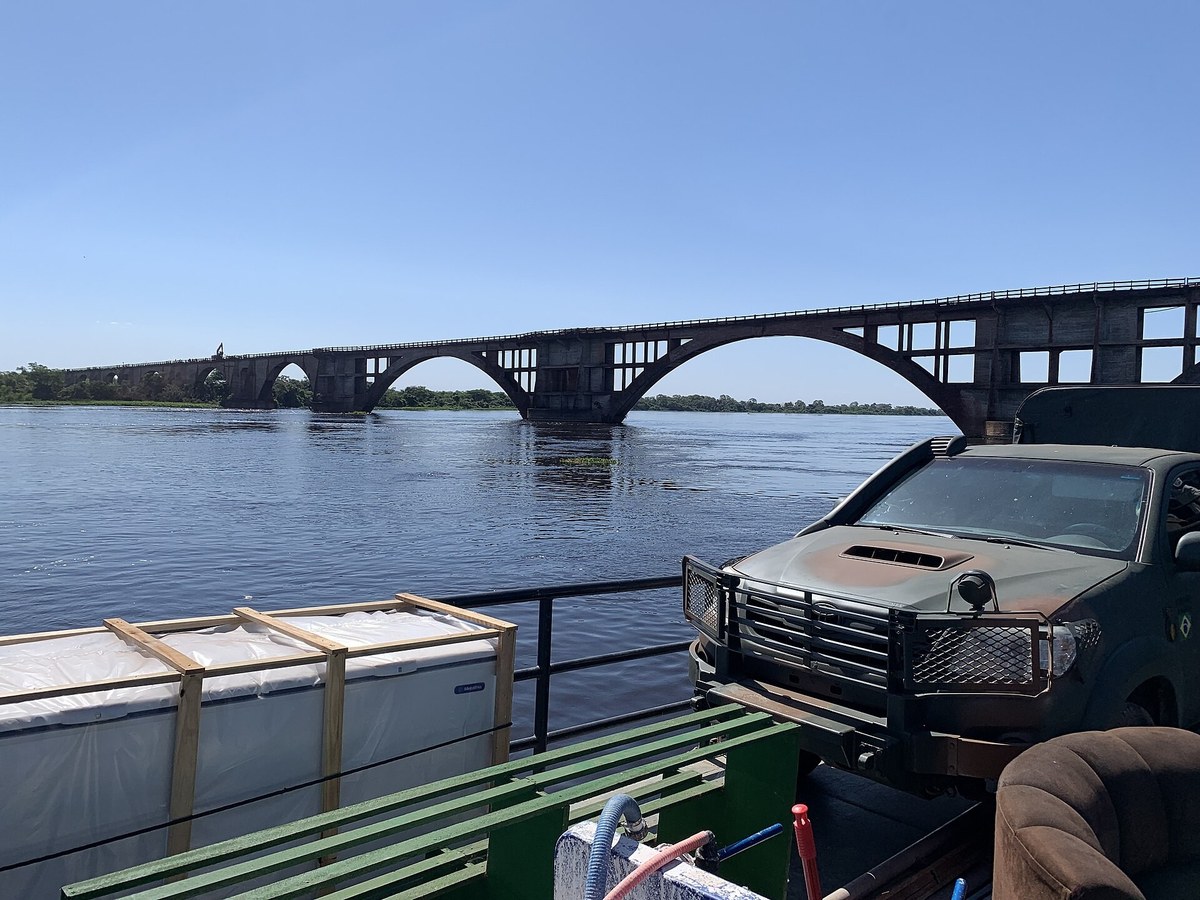
Six Months of Half-Lane on a Route Without Alternatives
What makes the Corumbá situation unique is the absence of a parallel route. There is no other roadway to bypass the crossing.
This is why stop-and-go is not merely an inconvenience; it is the only option. According to the official schedule, this will continue for two more quarters.
Until then, six hundred trucks per day will keep stopping, waiting, and proceeding, one at a time, across the Paraguay River. What do you think of this timeline?
Have you ever been stuck in a bridge work stop-and-go and how much time did you lose in line?