






 Portuguese
  Spanish
  4 min of reading
  0 comments


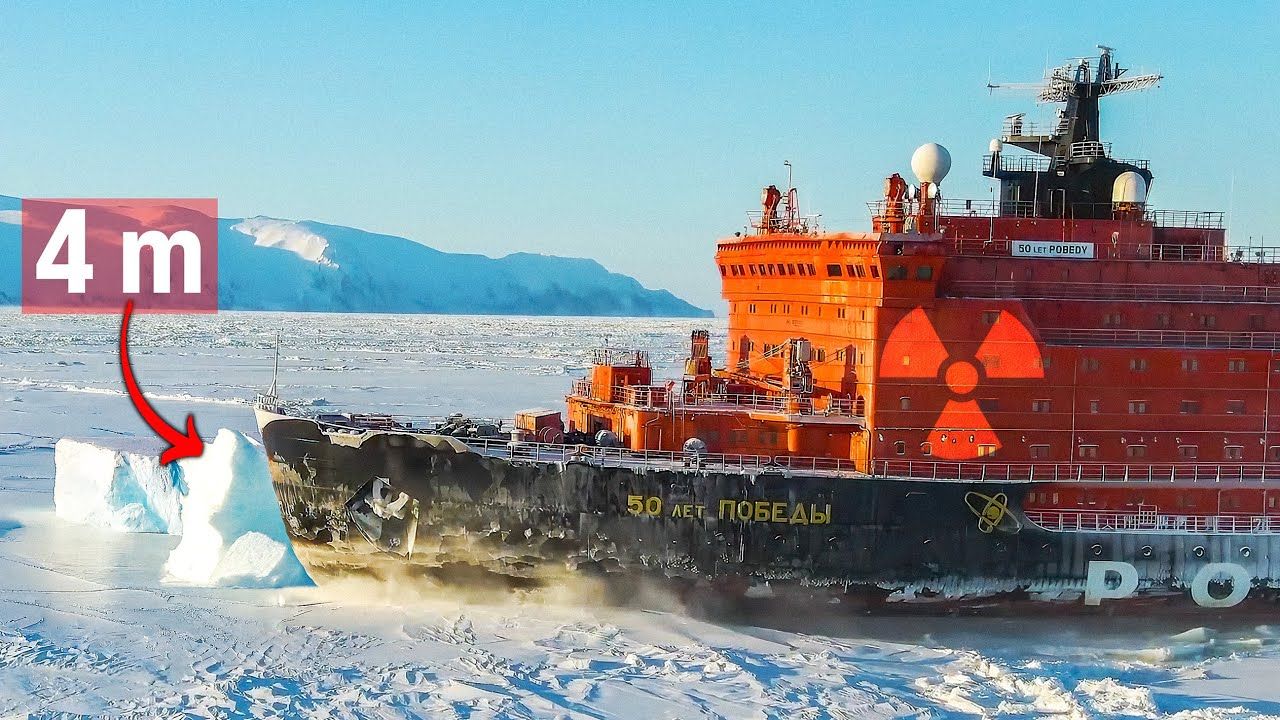
With Nuclear Propulsion, Russia Expands Its Colossal Fleet of Icebreakers to Open New Routes in the Arctic Ocean.
In the inhospitable Arctic Ocean, where ice nearly completely covers the sea during winter and reaches thicknesses over three meters, regular navigation becomes impossible. It is to master this hostile environment that a colossal fleet of icebreakers has been developed, utilizing robust engineering to rescue freighters, conduct patrols, and ensure flow on strategic routes. These vessels not only face physical barriers but also sustain the economy in regions where temperatures plummet to extreme levels.
Unlike conventional ships, these machines are designed to transform impassable ice into navigable paths. With the ambition to explore mineral resources and shorten travel time between Asia and Europe, a colossal fleet of icebreakers advances with nuclear propulsion and reinforced hulls, rewriting the rules of international trade and intensifying the race for sovereignty in polar waters.
The Engineering Behind The Break
The ability to destroy ice barriers relies on raw and calculated physics. A typical cargo ship has a bulb at the bow that, when colliding with thick ice, would merely hit it head-on without success. Icebreakers, on the other hand, employ two main tactics: axial force, which compresses the ice until it bends and breaks, and the weight of the vessel itself. For the thicker plates, the ship glides and climbs over the ice, using its massive weight to flex it downwards until it cracks.
-
Survivor of 1966 SS Daniel J. Morrell Shipwreck in Lake Huron Recounts 38-Hour Ordeal in Extreme Cold

-
The Greatest Hoax in World Cup History? The Film That Denied Brazil’s 1958 Victory and Exposed How Fake Evidence Can Seem Convincing on TV
-
Fake South Korean Online Stores Offer Shopping Thrill Without Spending Money or Receiving Products
-
The War of Jenkins’ Ear: How a Severed Ear Sparked One of the 18th Century’s Most Unusual Conflicts


The hull design is crucial for this operation. Unlike merchant ships, icebreakers do not have a bulbous bow, as this would increase resistance in these waters. Their hulls are rounded or spoon-shaped, allowing them to glide across the frozen surface. In addition, the structure is built with high-strength steel and double walls to withstand violent impacts and temperatures of up to minus 35 degrees.
Nuclear Propulsion and Extreme Autonomy

Russia holds the largest supremacy in this sector, heavily investing in nuclear technology. While a conventional ship would consume tons of diesel daily, a Russian nuclear icebreaker consumes less than half a kilogram of uranium to operate at its maximum limit. Nuclear efficiency allows for impressive autonomy, with ships able to remain at sea for over seven years without refueling, relying solely on the food supply for the crew.
A remarkable example of this capability is the ship that remained at sea for 357 days without entering a port, practically a year operating continuously. Currently, the Project 22220 vessels are the most powerful in operation, with 60 megawatts of power, capable of breaking ice three meters thick at a steady speed. However, the future holds something even greater: Project 10510, a “monster” with double the power, designed to break 4.1 meters thick ice without stopping.
The Contest for New Trade Routes
Global interest in the Arctic is not just scientific but financial. The melting of ice and the use of these vessels have made the Northern Sea Route and the Northwest Passage viable. The route through northern Russia reduces the distance between Yokohama, Japan, and Rotterdam, Netherlands, from 20,700 km (via the Suez Canal) to just 12,800 km. This means a travel time savings that drops from approximately 46 days to about 29 days.
Besides logistics, there is a race for natural resources. It is estimated that 13% of the world’s undiscovered oil and 30% of natural gas are in the Arctic, along with valuable minerals such as gold, silver, and uranium. Countries like China, the United States, and Canada are closely watching Russia’s moves, which already has 75 icebreakers in operation. To maintain the balance of power and ensure access to these riches, a colossal fleet of icebreakers continues to be expanded and modernized by the great powers.
Auxiliary Technology and the Brazilian Presence
To maximize efficiency, many of these ships use air bubble systems that lubricate the hull, reducing friction with the ice. Others have azimuth thrusters that rotate 360 degrees, allowing for precise maneuvers and even reverse navigation to crush the ice. There are also innovative oblique icebreakers that navigate sideways to open much wider channels, allowing for the passage of larger ships.
Brazil, although distant from the Arctic, maintains a presence in the polar waters of Antarctica. Currently, the country has the support vessel Ary Rangel and the polar ship Almirante Maximiano. However, they are not classified as pure icebreakers, dealing only with thin ice up to 80 centimeters. To expand its logistics and scientific capacity on the frozen continent, the Brazilian Navy is in the process of acquiring a new ship capable of facing ice up to one meter thick.
Would you have the courage to face months of total isolation in the Arctic aboard one of these nuclear machines?





-

-

-

-

-

-

22 people reacted to this.