






 Portuguese
  Spanish


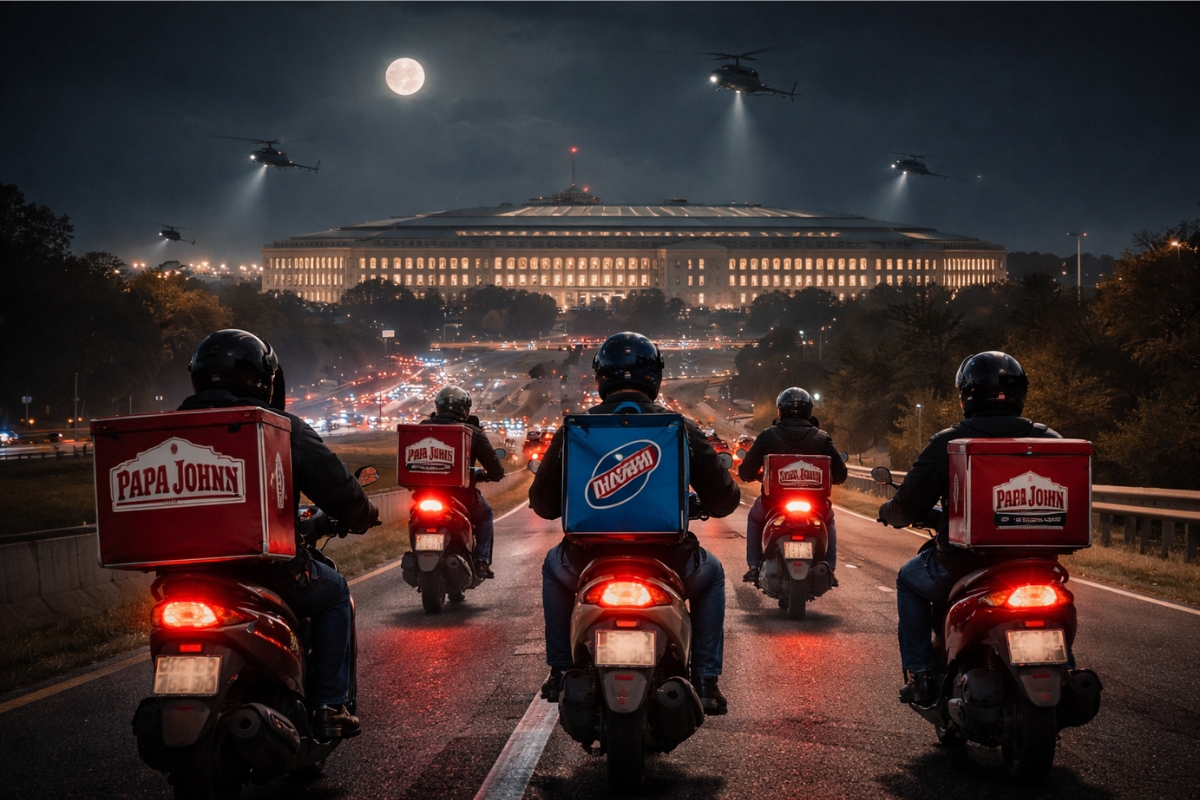
The Sudden Increase in Pizzerias in Virginia Became an Informal Sign of Intense Work Nights and Military Decisions in Washington
In the early hours of January 3, reports of explosions in Caracas, Venezuela, began to circulate as a different activity gained momentum thousands of kilometers away, around the Pentagon in Virginia. Pizzerias near the military complex reported a sudden surge in customer traffic, a behavior that tends to attract attention when it appears out of the ordinary.
Hours later, the United States confirmed a military operation in Venezuelan territory that ended with the capture of President Nicolás Maduro. The sequence of events fueled curiosity around the so-called Pentagon Pizza Index, a popular internet theory that attempts to link spikes in fast food orders to high-impact decisions.
The idea does not have scientific status and does not function as a formal intelligence method, but it has been discussed again due to its resemblance to an old script. The central point is simple: when teams from the Department of Defense and intelligence agencies work late, the demand for quick meals tends to increase, and this can be reflected in the business of nearby establishments.
-
Woman Turns Apartment into Storage with 158 Pairs of Shoes and 140 Pants, Accumulating $47,000 Debt Due to Compulsive Buying

-
Defying Medical Odds for 65 Years, 72-Year-Old Brazilian Acarajé Vendor Continues Family Legacy

-
Brazil’s Most Famous Fish Travels Over 600 km Against the Current, Overcomes Dams with Eco-Friendly Ladders, and Navigates Flooded Rivers in a Remarkable Migration for Reproduction
-
Revive Old Photos: Gemini’s Little-Known Feature Uses AI to Restore Damaged Images in Seconds with a Professional Six-Step Recovery Process



What Happened in the Early Hours of January 3 and Why the Pattern Attracted Attention
Update: Most pizzerias nearby the Pentagon are now reporting below average traffic.
Freddies Beach Bar continues to experiencing abnormally low traffic.
As of 10:17pm ET pic.twitter.com/7wfuTbWmiE
— Pentagon Pizza Report (@PenPizzaReport) January 4, 2026
The Increase in Customers at Pizzerias Near the Pentagon appeared during the night, with signs of behavioral changes in the area. There were indications of a drop in bar traffic and, almost simultaneously, an increase in the number of people at pizzerias open late, including a location of Papa John’s and Pizzato Pizza.
Around 2 AM, the traffic peaked and remained high for about an hour and a half. The official confirmation of the military operation came later, creating a time window in which the increase at pizzerias seemed to anticipate a significant decision.
This type of coincidence tends to gain traction on social media because it combines two elements that contrast well: an everyday signal, like a busy pizza night, and actions that can change the geopolitical landscape. When the timings align, the perception of pattern becomes even stronger.
How Monitoring Uses Google Maps’ Popular Times Graphs
The latest monitoring was driven by the profile @PenPizzaReport, created in 2024 to track public signs of activity in pizzerias around the Pentagon area. The focus is on detecting unusual traffic variations, especially during nighttime hours.
The reading does not involve access to orders, deliveries, or internal restaurant systems. The basis is the popular times feature from Google Maps, which estimates movement based on anonymous location data from cell phones and presents graphs by time slot.
Even with this limitation, the profile has gathered hundreds of thousands of followers and has been followed by journalists, open data analysts, and curious individuals. The interest grows because the measurement is public, quick, and easy to observe, facilitating real-time comparisons when any international event begins to take shape.
Why the Theory Links Long Nights in Government to More Pizza in the Neighborhood
The deduction behind the index is based on work routine and logistics. In times leading up to international crises or significant military decisions, teams may remain in buildings late, with little time to go out, increasing the demand for quick food in the vicinity.
In this scenario, pizza appears as a recurring choice for being practical, shareable, and available later at many locations. The result would be an unusual increase in traffic at pizzerias close to strategic government buildings, especially when other leisure spots, like bars, become emptier.
Over time, observers have also begun to look at the inverse effect, when leisure spots in Washington become unusually quiet on nights of intense government work. This combination feeds the impression that one can feel the pressure of the moment through the movement on the streets.
The Origin of the Index with Records from 1990 and the Order of 21 Pizzas for the CIA
The association between pizza and military decisions predates Google Maps. In 1990, franchisee Frank Meeks from Domino’s in the Washington area reported a record order of 21 pizzas for the CIA headquarters on the night of August 1.
The next morning, Iraq invaded Kuwait, marking the beginning of the Gulf War. Since this incident, similar reports have been recalled in other situations, such as before the American invasion of Grenada in 1983 and during the military operation in Panama in 1989.
The sequence of stories helped solidify the legend in the corridors of Washington, with mentions that spanned different political periods. In another phase, pizza deliveries to the White House and Congress also reportedly hit records during Bill Clinton’s impeachment and preparations for attacks on Iraq.
Why Experts Treat the Index With Caution and the Risk of Confirmation Bias
The main limit of the index lies in confirmation bias, when only the cases in which the coincidence works are remembered and shared. Nights with a lot of pizza and no international developments tend to disappear from collective memory, distorting the perception of accuracy.
Another point is the lack of a wide and systematic basis to turn the idea into consistent analysis. Without a robust set of data, it becomes difficult to separate coincidences from real and repeatable patterns, especially in a region with high circulation and varied consumption habits.
Even when traffic grows, the peak in restaurants does not, by itself, indicate an imminent strategic decision. The signal may reflect a sum of common factors, such as timings, local flow, and establishment operations, without a direct link to a crisis.
How the Pentagon’s Routine Changed and Why External Deliveries Became More Difficult
Practical changes also weaken the theory. Unlike the 1980s and 1990s, the Pentagon today offers several internal dining options, although most operate during business hours, reducing alternatives during the night.
Furthermore, security rules have made external delivery more complex. Deliveries must undergo rigorous inspections, and perishable items do not enter the building directly, which limits the idea that large orders would easily reach within the complex.
Still, the theory continues to attract attention because it mixes simple signals with large-scale decisions. When graphs, posts, and timings seem to align in the timeline of an event, the feeling that something was about to happen spreads quickly and gains strength on social media.
In the case involving Venezuela, the sequence between the peak in pizzerias and the confirmation of the military operation reinforced this fascination. For the public, the practical impact is understanding that these signals can indicate intense work nights, but they do not serve as a reliable alert, as coincidences and data limitations remain at the center of the story.





-

1 person reacted to this.