






 Portuguese
  Spanish


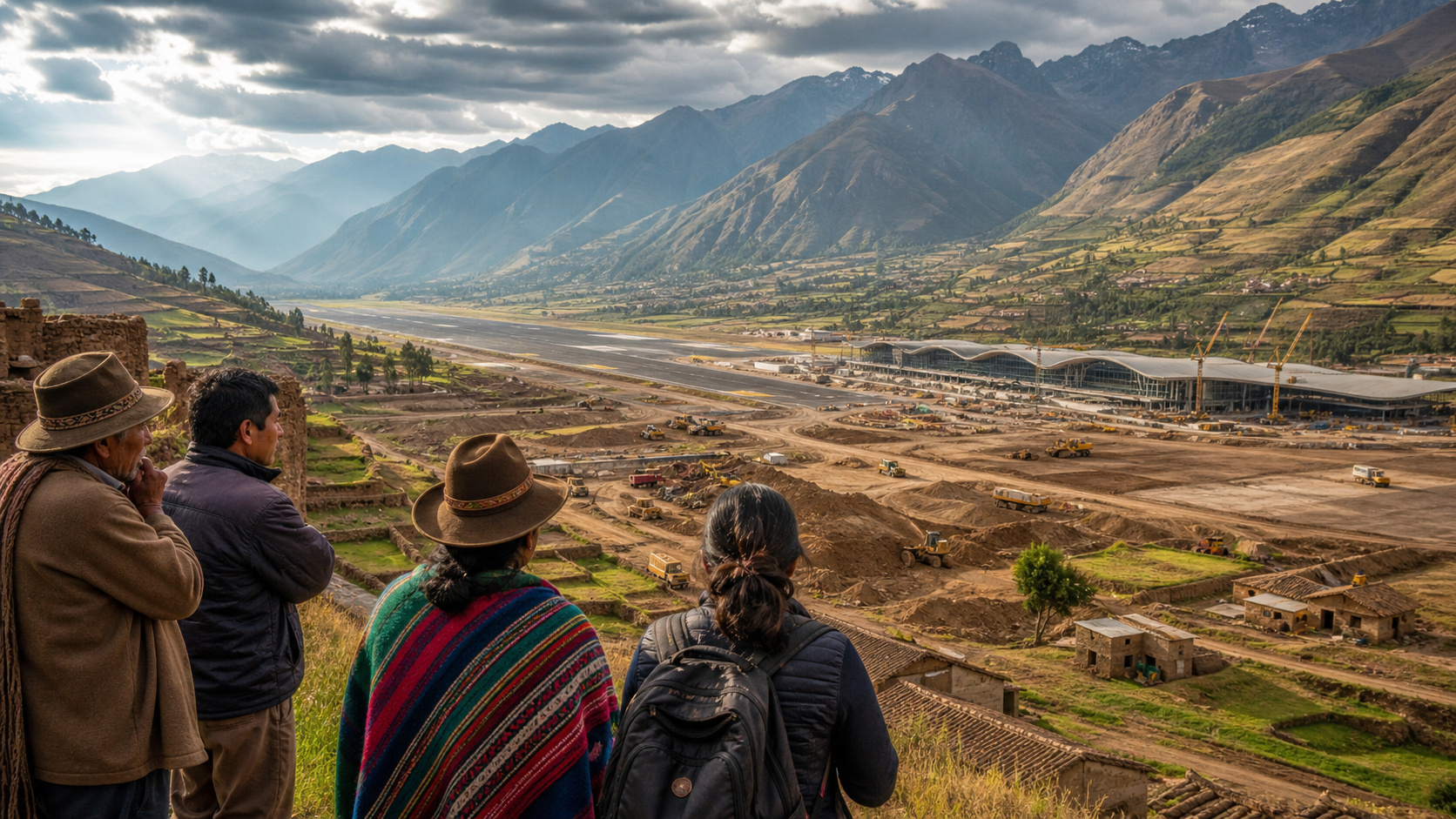

The Chinchero airport project reignites the debate on tourism in Peru, Machu Picchu preservation, pressure on archaeological sites, and the risk of altering a historical landscape that attracts visitors from all over the world
The international airport in Chinchero, Peru, has come to represent a conflict difficult to ignore: a project created to facilitate access to Machu Picchu could also increase pressure on the Sacred Valley of the Incas.
The investigation was published by El País, a Spanish newspaper with an international English edition. The project sparked protests and criticism from archaeologists, historians, residents, and international experts, who see a risk to a sensitive cultural landscape.
The official promise is to boost tourism in Peru and facilitate the path to Cusco and Machu Picchu. However, the most feared impact lies in the opposite effect: transforming a historical area into a space marked by heavy infrastructure, increased human flow, and pressure on archaeological sites.
-
The mansion in Flamengo, built in 1865 for the Baron of São Clemente and closed for 20 years, has become a spa, event hall, and gym for “Symphony,” a luxury condominium that sold 70% of its gross development value in the first month on the R$ 60 million land of the former Bennett College.

-
The Ipiranga convent, a 1924 building adjacent to the Museum that remained vacant for a decade and became home to dozens of cats, is reborn as “Alma Mater,” a luxury development worth R$ 130 million with a pool in the courtyard and a clubhouse in the former nuns’ chapel.

-
An empty pool of almost 3 meters turned into tilapia farming in the backyard after a family transformed the dangerous space for children into an urban greenhouse with eggs and organic food.

-
Danger of Technological Hyperstimulation: USP specialists warn that intense use of multiple screens and digital stimuli can gradually reduce essential cognitive abilities, while scientists analyze how technological overload affects memory, concentration, and intellectual performance over the years.



Chinchero Airport became a symbol of a dispute between tourism and historical heritage
Chinchero is located near the Sacred Valley of the Incas, a region linked to Peru’s memory, landscape, and cultural identity. Therefore, the construction of an international airport there ceased to be merely a transportation project.
The debate gained momentum because the structure promises to bring tourists closer to Machu Picchu, but it could precisely affect the landscape that makes the region so sought after. This is what makes the case so significant.
The criticism is not a rejection of tourism. The problem lies in the risk of using a major project to sell access to heritage and, at the same time, pressure that heritage with changes difficult to reverse.
For the common reader, the issue is simple: a project can improve access, but it can also profoundly change the destination. In historical areas, this type of change requires great care.
Over 111,000 signatures show that the reaction extended beyond Peru’s borders
Mobilization against the airport grew with an online petition initiated by historian Natalia Majluf. The movement gathered over 111,000 signatures and received support from academics at universities such as Harvard and Berkeley.


This number shows that the controversy is no longer just local. The construction has come to be seen as an example of conflict between development, tourism, cultural identity, and preservation.
Even with public pressure, the project moved forward. This progress amplified the concern of those who fear Chinchero’s transformation into a gateway for more intense and less careful tourism.
The case also raises a bigger question: to what extent should a historical region adapt to receive more visitors without losing what makes it special?
Sacred Valley of the Incas may suffer from increased pressure on landscape and archaeological sites
The Sacred Valley of the Incas is not just a tourist route. The region concentrates landscapes, traditions, indigenous memory, and archaeological remains that help explain its importance to Peru and the world.
Critics’ concern involves pressure on archaeological sites and on the local way of life. An airport does not arrive alone. It usually brings more construction, more movement, more services, and more occupation in the surrounding area.
This increase might seem positive for those who only think about visitor numbers. However, in areas of historical value, excessive circulation can cause wear and tear and alter the relationship of communities with the territory.
Therefore, the Chinchero airport has become a symbol. It represents the dilemma between facilitating tourism and protecting the cultural landscape that makes visitors want to come there.
El País detailed the warning from experts and residents about the impacts in Chinchero
El País, a Spanish newspaper with an international English edition, detailed the central points of the controversy involving the airport in the Sacred Valley of the Incas. The report recorded criticism from residents, experts, and cultural heritage advocates.
Historian Natalia Majluf stated that “everything that gave value to Chinchero is being destroyed with this construction.” The phrase summarizes the fear that the work will alter the landscape and weaken the identity of the place.
The criticism gains weight because Chinchero is not an empty space. The region carries history, ways of life, and cultural practices that depend on the preservation of the territory.
When a project of this magnitude enters a sensitive area, the impact is not limited to the construction site. It can affect how the region is seen, used, and marketed to tourism.
The paradox lies in building access to history and putting history itself at risk
The case draws attention due to the paradox. The airport was designed to bring tourists closer to Machu Picchu and the Sacred Valley of the Incas, but the same project could harm the historical landscape that attracts this public.
This contradiction explains the journalistic strength of the topic. Infrastructure created to enhance tourism may end up weakening the heritage that sustains this tourism.
In other words, the risk is not just in building an airport. The risk is in transforming a territory of memory into a transit corridor for visitors, services, and urban expansion.
This debate appears in several historical destinations around the world, but Chinchero has become an emblematic case because it involves Machu Picchu, one of the best-known cultural references in South America.
Tourism in Machu Picchu requires balance between access, preservation, and local community
Tourism can generate income and visibility for historical regions. However, growth needs to respect limits, especially when it involves archaeological areas and traditional communities.
In the case of Chinchero, the central point is to find balance. Facilitating the arrival of tourists cannot mean reducing the cultural value of the region or erasing the landscape that gives meaning to the destination.
For residents and experts, preservation needs to be at the center of the decision. It’s not enough to think about passenger movement, new services, and tourist expansion.
Cultural heritage needs to be treated as something living. It depends on the landscape, the people, the memory, and how the territory is cared for over time.
The international airport in Chinchero shows how a project can divide opinions when it promises development but also raises fears of cultural loss. The region near the Sacred Valley of the Incas has become the stage for a dispute involving tourism, history, and the future.
The big question is whether easier access to Machu Picchu outweighs the risk of transforming a historical landscape into a heavy tourism space.
Do you believe that large projects should proceed in cultural heritage areas when they promise economic growth, or do these types of places need stricter limits to be preserved?


