Portuguese
  Spanish


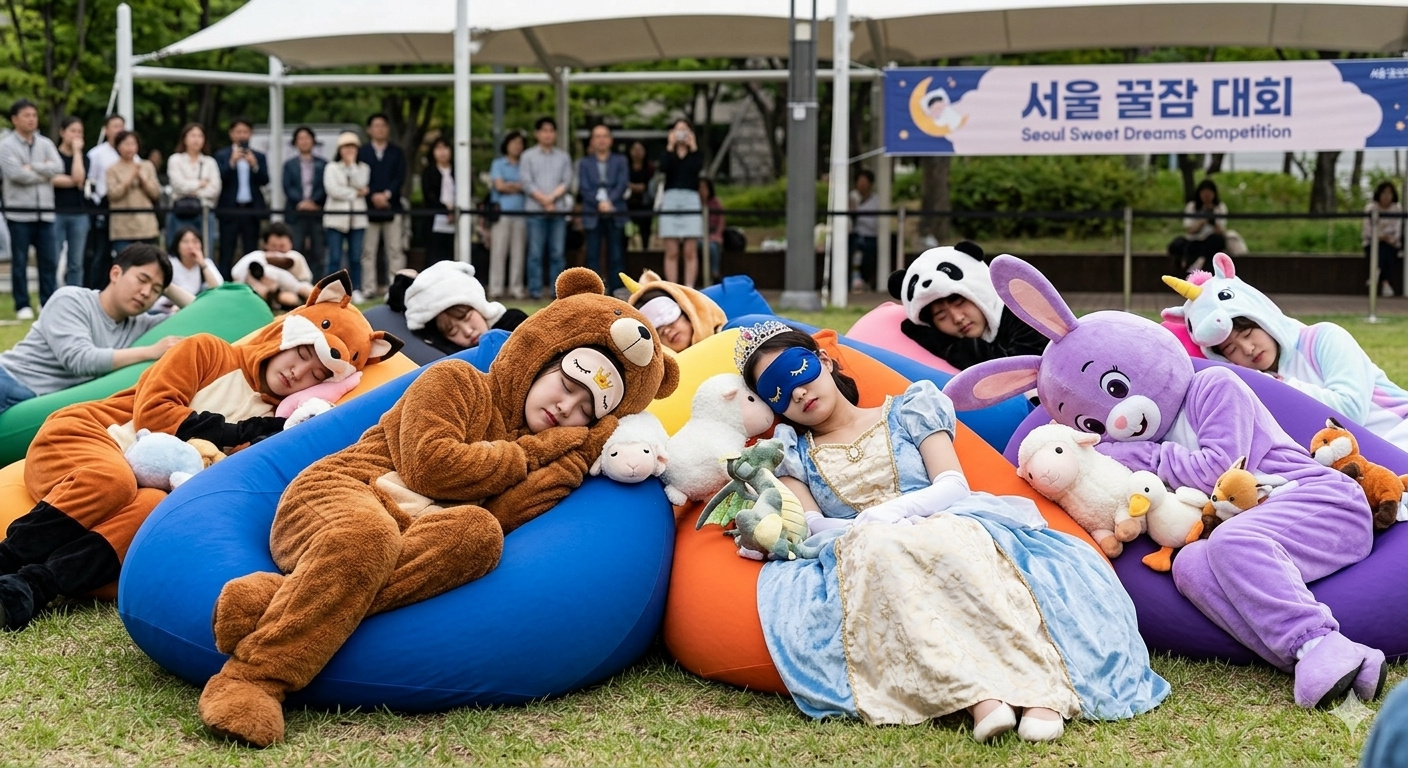

Creative event held in Seoul gathers young people in public park to encourage rest, draw attention to overwork, and discuss impacts of sleep deprivation in modern society
The information was released by “Associated Press,” with international coverage of the event, highlighting a worrying reality: chronic lack of sleep among the South Korean population. To draw attention to this growing problem, the Seoul Metropolitan Government organized the well-known “Invigorating Nap Contest,” popularly called the “Nap Contest,” which reached its third edition.
Right from the start, the event draws attention with its creative format. Instead of rewarding physical or intellectual performance, the competition values something increasingly rare in modern society: rest. Thus, participants gathered in a park on the banks of the Han River to do something simple but essential — sleep.
Furthermore, the contest also gained new requirements this edition. Participants were required to attend in costume, preferably as characters associated with sleep, such as princesses or classic figures of rest. In addition, they had to arrive tired and with a full stomach, increasing the chances of a deep nap.
-
Orphaned Youth Turns Dismissed Idea into Global Prestige with Innovative Wristwatch

-
English Skills Boost Career Opportunities in the Oil and Gas Industry

-
Brazil Secures Second Place at WorldSkills 2024 in Lyon, with 64 Young Professionals and 8 Medals, Including Gold from a Rio de Janeiro Hairdresser

-
3,000 Military Personnel from 10 Countries, Including US and Chinese Marines, Train Together in Brazil’s Savanna: Operation Formosa Becomes Largest Naval Ground Exercise Before First Cancellation Since 1988


Nap contest reveals exhausting routine and lack of sleep in the country
Throughout the event, it became evident that the initiative goes far beyond a simple competition. In practice, it exposes a reality faced by thousands of South Koreans daily: intense study and work hours that compromise rest.
During the event, participants shared accounts that reinforce this scenario. A 20-year-old university student, identified as Park Jun-seok, stated that he usually sleeps only three or four hours a night. According to him, his routine includes preparing for exams and part-time jobs, which forces him to compensate for sleep with naps during the day.
Meanwhile, another participant, Yoo Mi-yeon, 24, revealed facing constant insomnia problems. An English teacher in the Ilsan region, north of Seoul, she explained that she has difficulty sleeping and wakes up easily during the night. For this reason, she decided to participate in the contest dressed as a koala, an animal known for long periods of sleep, in a symbolic attempt to improve her quality of rest.
Furthermore, the atmosphere of the event clearly reflected collective exhaustion. In a city known for operating practically 24 hours a day, with high competitiveness and a fast pace, physical and mental wear became visible in the participants’ behavior.
Sleep evaluation and winners reinforce the seriousness of the initiative
Despite the relaxed atmosphere, the contest has well-defined technical criteria. As soon as the competition began, organizers distributed sleep masks and started measuring participants’ heart rates. This data was used as an indicator of relaxation and sleep quality.
Consequently, the winner was the one who showed the greatest physiological stability, demonstrating a state of deep and peaceful sleep. In this edition, first place went to a man in his 80s, while Hwang Du-seong, 37, an office worker, took second place.
Hwang himself reported that his routine includes frequent night shifts and intense work commutes, which leaves him constantly exhausted. Thus, he saw the contest as an opportunity to truly rest and recharge his energy, even if for a short period.
Lack of sleep in South Korea worries specialists and international data
Finally, the event also reinforces a structural problem in the country. Data indicates that South Korea is among the nations with the highest workload among members of the Organization for Economic Co-operation and Development (OECD).
As a direct consequence of this intense routine, the South Korean population has one of the lowest average hours of sleep in the world. This scenario raises serious concerns about physical, mental health, and long-term productivity.
Furthermore, experts warn that sleep deprivation can directly impact quality of life, increasing disease risks and reducing cognitive capacity. Therefore, initiatives like the Nap Contest go beyond entertainment, serving as an important social alert.
Thus, the event consolidates itself as a creative strategy to provoke reflection on modern habits and encourage a necessary cultural change: valuing rest as an essential part of life.
Have you ever felt that your routine is so hectic that sleeping well has become a luxury?