





 Portuguese
  English
  Spanish
  3 min of reading
  0 comments


Instant Noodles May Seem Like Just a Quick Meal, but Their Origin and Production Reveal an Impressive Story of Innovation and Efficiency.
Instant Noodles is the popular name for instant ramen, a pre-cooked and dehydrated food that is ready in just a few minutes when rehydrated with hot water.
It usually comes with a powdered seasoning packet and is known for its convenience, low cost, and quick preparation—typically in 3 minutes.
Right after World War II, Japan faced food shortages and a starving population. It was in this context that Momofuku Ando created the world’s first instant ramen in 1958.
-
Reports about the possible arrest of Diogo Defante in the USA during the 2026 World Cup are making waves on social media and raising questions about what really happened.

-
The 71-year-old Korean pastor who built a box in the wall to save abandoned babies and has already taken in more than 2,000 children without asking for the name of any mother.
-
Mother of four faces financial difficulties in São Paulo, swaps jobs outside the home for sweet and savory pies, and turns the kitchen into a source of income to support the family while studying nursing to change her children’s future.

-
Afghanistan has one of the largest untapped copper reserves in the world, and China wants to control all of it with a billion-dollar deal that could change the fate of Asia’s poorest country.




He sought a practical, nutritious, inexpensive, and quick-preparation solution. The result was Chikin Ramen, which would become one of the world’s most consumed foods.
The most important thing is that Ando discovered, after numerous home tests, a revolutionary method: frying the noodles in oil removed all moisture, allowing them to be rehydrated with hot water in just a few minutes. Success was immediate in Japan, and soon the product conquered the world.
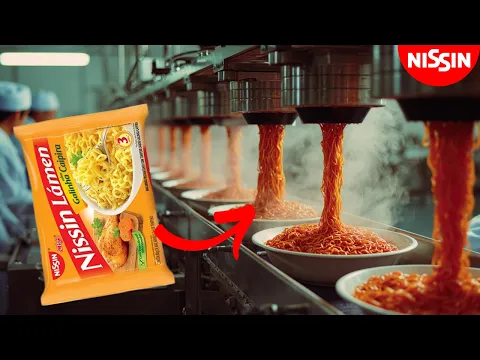
Today, billions of packages of instant noodles are consumed annually, and their manufacturing process is an example of industrial precision and food technology.
How Instant Noodles Are Produced
The process begins with a basic ingredient: highly refined wheat flour. To this, water, salt, and a special component: alkaline water, usually containing sodium or potassium carbonate, are added.
This substance alters the pH of the dough, making it more elastic, firm, and yellowish, without the use of artificial coloring.
This mixture is made in large industrial tanks, with mechanical arms that rotate until a uniform dough is formed.
The moisture point must be exact: dough that is too moist sticks; too dry breaks.
After resting, the dough is sent to rolling machines that flatten it to a uniform thickness. It then passes through a machine that cuts and shapes the dough into the classic wavy shape of instant noodles.
These curves are not just aesthetic: they increase contact with hot water and allow for faster rehydration. Moreover, they absorb the seasoning better.
With the noodles shaped, they are grouped into square blocks, usually between 40 and 60 grams. These blocks go to pre-cooking, where they are exposed to steam or hot water for 1 to 2 minutes. This gelatinizes the starch in the dough, making the inside soft and the outside firm.
Next comes one of the most important steps: quick frying in vegetable oil, between 140 and 160 °C. This reduces the moisture in the noodles to less than 10%, turning the pasta into a dry and crispy product.
This is what allows for a long shelf life and quick preparation with hot water.
Packaging and Quality Control
After frying, the instant noodles are cooled and go to automated packaging. Sensors check the weight, seal, and even whether the seasoning packet was inserted correctly. Some factories use X-rays or metal detectors to ensure food safety.
Finally, the packages are grouped, boxed by robotic arms, and sent for distribution. The most impressive part: the entire process takes less than 10 minutes.
Instant noodles may seem simple on the plate, but they are the product of precise engineering. A solution that was born out of necessity and has turned into one of the most popular foods on the planet.







Be the first to react!