Portuguese
  Spanish


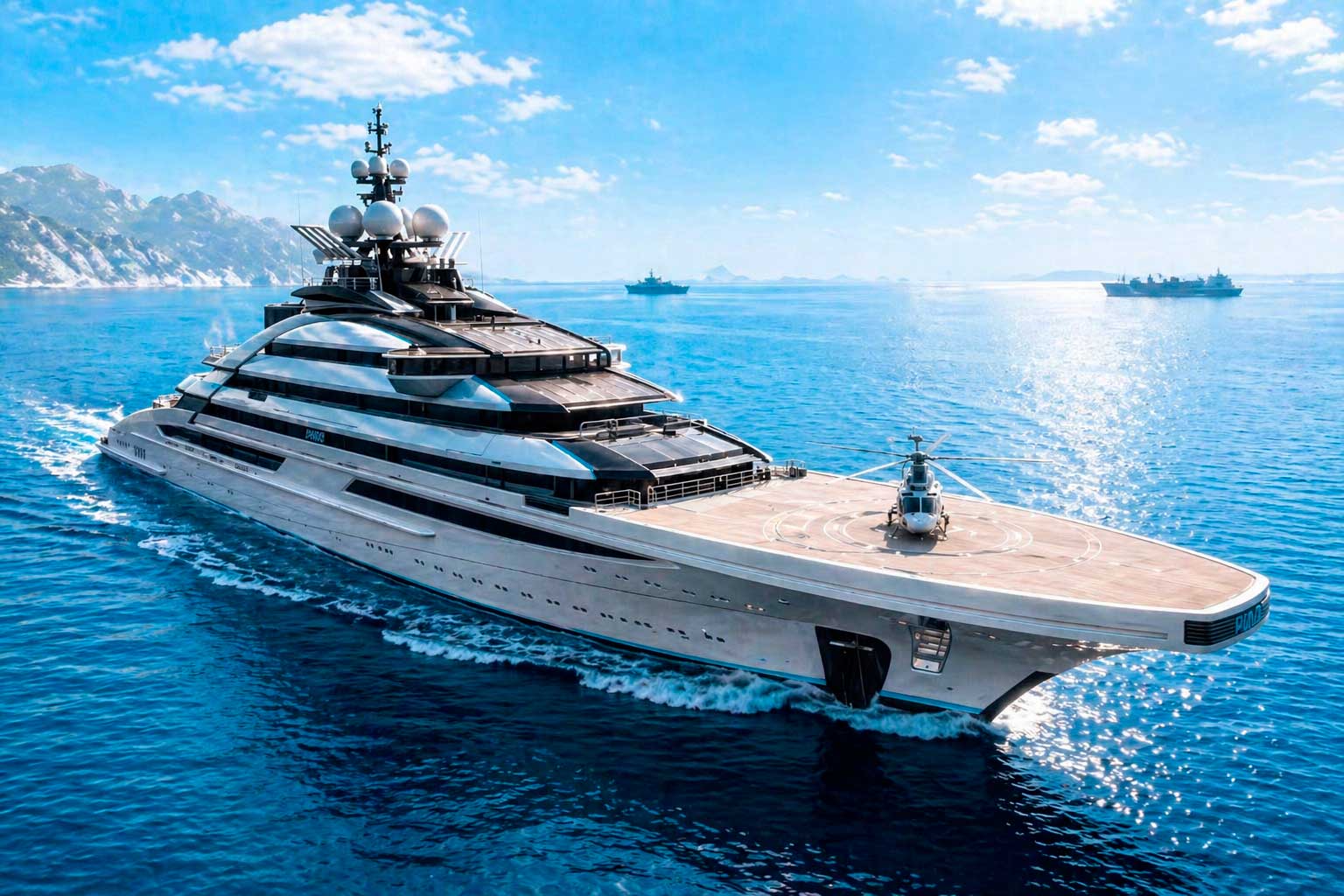

Nord vessel left Dubai, passed through the Strait of Hormuz, and arrived in Oman while tension between the United States and Iran keeps maritime traffic almost at a standstill
A superyacht linked to Russian billionaire Alexey Mordashov crossed the Strait of Hormuz on Saturday, April 25, in a passage considered unusual given the restrictions imposed on navigation in the region. The Nord vessel, valued at over $500 million, left Dubai, in the United Arab Emirates, and proceeded to Muscat, the capital of Oman.
The case is noteworthy because the Strait of Hormuz is one of the world’s most important maritime routes for oil and gas transport. With the escalating tension between the United States and Iran, ship traffic in the area has dropped drastically, while diplomatic negotiations continue without a definitive agreement.
The Nord’s passage gained attention because it involved a luxury vessel associated with a Russian businessman sanctioned by Washington and the European Union. Mordashov is known for his work in the steel and mining sector and was included in sanctions lists after Russia’s invasion of Ukraine.
-
Neon Blue Glow in Brazilian Waters Captivates Locals and Goes Viral, Unveiling Rare “Sea Fire” Phenomenon

-
Forgotten Map Leads Diver to Shipwreck with Gold, Rare Jewels, and Secrets Hidden for Nearly 350 Years
-
Furong: The 2,000-Year-Old Chinese City Built on a 60-Meter Waterfall Becomes a Global Tourist Phenomenon

-
YouTube Inventor Dubbed “Real-Life Tony Stark” Builds Robotic Legs for Father’s Day, Creating a Wheelchair That Conquers Stairs and Rough Terrain




Reuters reported that the yacht crossed the route after no objection from Iran and the United States, as it was considered a civilian vessel with no apparent military threat.
Superyacht Nord left Dubai and arrived in Muscat in a crossing shrouded in doubt
Maritime tracking data indicates that the Nord left Dubai on Friday, April 24, crossed the Strait of Hormuz on Saturday, and was located in Muscat on Sunday, April 26. The vessel sailed in an area where traffic is heavily restricted and where the movement of ships has come under close observation by governments, insurance companies, and energy sector firms.
The yacht measures about 142 meters in length and is among the largest superyachts in the world. Specialized publications describe the vessel as an ultra-luxury ship, with spacious cabins, a swimming pool, a helipad, and a structure capable of accommodating support equipment for long voyages.
The crossing raised a central question among naval industry analysts. How did a private vessel manage to pass through a route where even commercial cargo ships face severe restrictions and the risk of interception.
So far, there is no detailed public explanation about the authorization process. The most cited version is that the Nord followed an approved international maritime route, with no sensitive cargo, no Iranian destination, and no behavior considered hostile.
Alexey Mordashov is a target of sanctions and has assets linked to the Russian steel sector
Alexey Mordashov is one of Russia’s best-known businessmen and built his fortune primarily in the steel industry. He is associated with Severstal, a Russian steel giant, and has become a figure closely watched by Western authorities since the advance of sanctions against Russian billionaires close to the Kremlin.
The European Union included Mordashov on its sanctions list on February 28, 2022, just days after the start of the war in Ukraine. In the United States, measures against networks and companies linked to the businessman also became part of the package of economic restrictions adopted against the Russian elite.
The case of the Nord becomes even more sensitive because luxury yachts linked to Russian billionaires have become the target of seizures, blockades, and legal disputes in different countries. Since 2022, such vessels have been treated not only as symbols of wealth but also as strategic assets in the sanctions war.
Although international reports link the Nord to Mordashov’s circle, the formal ownership structure of superyachts often involves companies, registrations in different jurisdictions, and indirect ties. This makes public identification of the ultimate owner difficult and complicates any attempt at seizure.
Strait of Hormuz remains at the center of the crisis between the United States and Iran
The Strait of Hormuz connects the Persian Gulf to the Gulf of Oman and the Indian Ocean. A significant portion of global energy trade passes through it, making any disruption a problem capable of affecting freight, maritime insurance, oil prices, and international supply.
The current tension involves restrictions imposed by Iran and the United States amid the regional crisis. Iran seeks to pressure Washington to remove the nuclear program from negotiations and also wants an end to blockades against its ports. The United States, in turn, is trying to maintain pressure to obtain guarantees regarding the Iranian nuclear program.
In the days before the Nord’s passage, the flow of ships through the strait remained well below normal. Before the crisis, estimates cited by international media pointed to about 125 to 140 vessels per day crossing the region. In recent days, passage has been restricted to a few ships, mainly cargo and bulk carriers.
This contrast makes the superyacht’s crossing even more striking. While shipping companies avoid the route due to operational risk and political uncertainty, a luxury vessel linked to a sanctioned billionaire managed to complete the journey.
Yacht’s passage exposes the weight of diplomacy in blocked maritime routes
The Nord’s movement shows that maritime blockades do not always function as completely closed barriers. In conflict situations, authorization or tolerance for passage can depend on nationality, the ship’s flag, destination, cargo type, risk assessment, and the diplomatic interests involved.
In the superyacht’s case, the fact that the vessel was sailing under a Russian connection drew attention due to the relationship between Moscow and Tehran. Russia and Iran have expanded political and strategic cooperation in recent years, which reinforces the interpretation that the passage may have been handled with more care behind the scenes.
Still, there is no public confirmation of direct political favoritism. The most prudent explanation is that the Nord was treated as a non-threatening civilian vessel, on an exceptional crossing within a route that remains under heavy surveillance.
For the international market, the episode reinforces a greater concern. As long as the Strait of Hormuz remains unstable, any unusual movement will be interpreted as a sign of a power struggle, weakness in sanctions, or selectivity in navigation control.
A luxury yacht became a symbol of a crisis that goes beyond oil
The Nord’s crossing combines three themes of great international impact. The first is the dispute between the United States and Iran over one of the most important maritime routes on the planet. The second is the economic pressure against sanctioned Russian billionaires since the war in Ukraine. The third is the difficulty of controlling luxury assets registered through complex corporate structures.
The episode also shows how geopolitics can appear in seemingly isolated details. A superyacht crossing a blocked route does not single-handedly change the course of the crisis, but it exposes differences in treatment, the practical limits of sanctions, and the strength of diplomatic relations in strategic waters.
For energy-importing countries, attention remains focused on the Strait of Hormuz. Any stricter closure, military incident, or failure in negotiations could pressure global prices and increase insecurity in maritime transport.
The Nord’s passage, therefore, is not just a curiosity about luxury. It has become a portrait of how money, sanctions, oil, and military power intersect in one of the most sensitive regions of the world.
The crossing of the superyacht linked to Alexey Mordashov reignites an important controversy about sanctions, privileges, and maritime security. Do you think vessels of sanctioned billionaires should be authorized to cross blocked routes, even when commercial ships face restrictions? Leave your opinion in the comments.