






 Portuguese
  Spanish
  3 min of reading
  0 comments


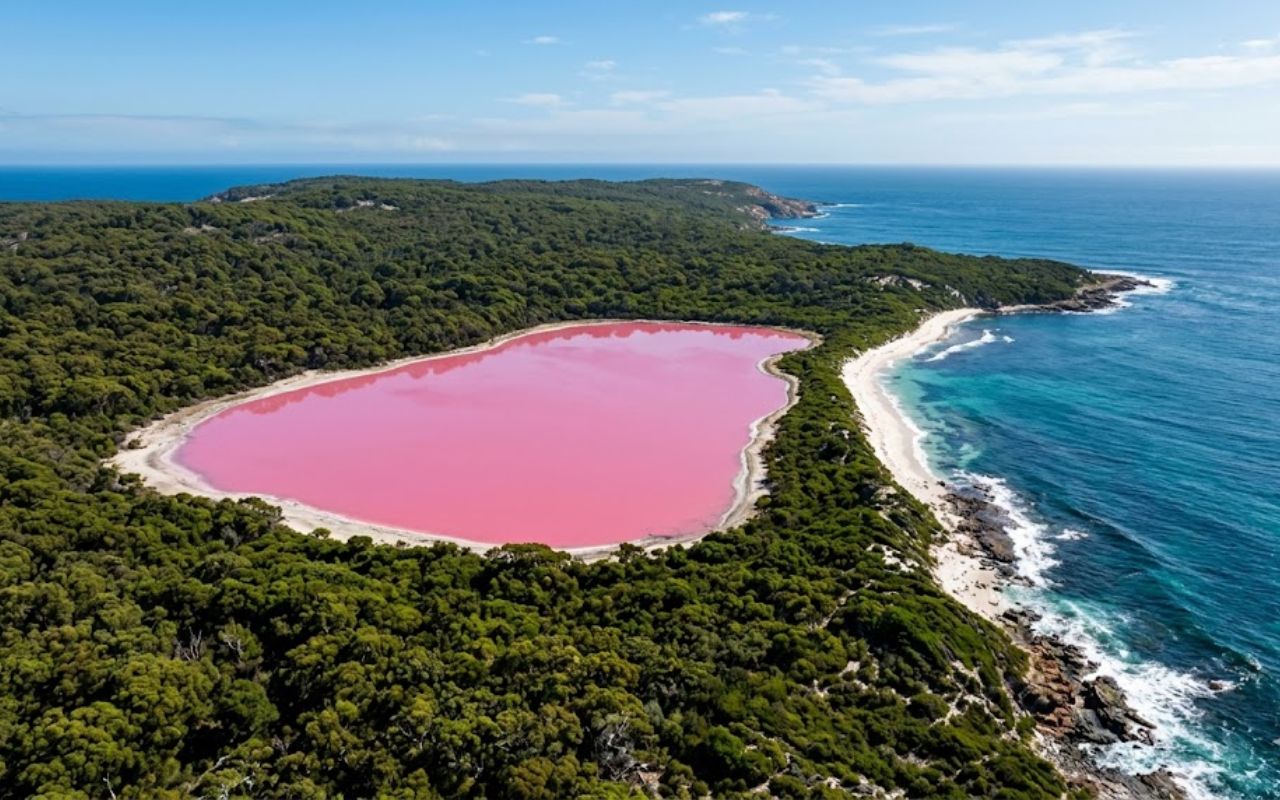
Discover Lake Hillier, the famous Australian pink-water destination that defies science. Understand the natural causes of this impressive phenomenon.
The city of Esperance, in Western Australia, serves as a starting point for those wishing to witness one of nature’s greatest enigmas: Lake Hillier. Located on the remote Middle Island, this 600-meter-long reservoir displays a vibrant pink hue that remains unchanged, even when the liquid is collected in vials.
Unlike other colored lakes that depend on light incidence, Hillier maintains its hue permanently, creating a striking visual contrast between the dense eucalyptus vegetation and the deep blue of the Southern Ocean that surrounds it.
Lake Hillier: Climate threats and sanctuary protection
Although situated on an uninhabited island, Lake Hillier is not immune to global environmental risks. Currently, the biggest concern for biologists monitoring the region is climate change. Severe alterations in rainfall patterns or sea level could dilute the salt concentration in the water.
-
Survivor of 1966 SS Daniel J. Morrell Shipwreck in Lake Huron Recounts 38-Hour Ordeal in Extreme Cold

-
The Greatest Hoax in World Cup History? The Film That Denied Brazil’s 1958 Victory and Exposed How Fake Evidence Can Seem Convincing on TV
-
Fake South Korean Online Stores Offer Shopping Thrill Without Spending Money or Receiving Products
-
The War of Jenkins’ Ear: How a Severed Ear Sparked One of the 18th Century’s Most Unusual Conflicts


Should this salinity decrease, the survival of the microorganisms that give the lake its color would be compromised, potentially leading to the definitive disappearance of the pink hue.
To mitigate these risks, Australian authorities have implemented strict conservation measures:
- Constant monitoring: Environmental agencies regularly monitor water quality to detect chemical changes.
- Non-invasive research: Scientists from the University of Western Australia use drones and minimal samples for their studies.
- Landing prohibition: It is strictly forbidden to land tourist aircraft on the island to prevent external contamination.
Why is Lake Hillier pink?
The lake water has salinity levels comparable to those of the Dead Sea, creating a hostile environment where few species can thrive.
The main contributors to the color are:
- Dunaliella salina: A microalga that produces carotenoids (reddish pigments) to protect itself from solar radiation and excess salt.
- Halophilic Bacteria: Microorganisms that inhabit salt crusts and also emit pinkish tones.
- Permanent Identity: The color is a property of the water itself, resulting from the biological interaction of these organisms, and not an optical illusion.

Visitation rules and water safety
Many curious people wonder if it’s possible to swim in these pastel waters. Although the water is not toxic, physical contact is not recommended.
The extremely high salt concentration can cause severe eye and skin irritation, in addition to providing extreme buoyancy that makes swimming difficult.
Furthermore, access to the sand of Middle Island is restricted to ensure that the chemical balance of the site is not altered by human presence.
The best way to admire Lake Hillier is through scenic flights or cruises that pass along the coast. These options allow you to contemplate the surreal gradient between shocking pink, the green forest, and the sea, without endangering the island’s fragile ecosystem.
For science, this lake is much more than a tourist attraction; it is a natural open-air laboratory. The study of how life manages to thrive in such extreme conditions offers valuable clues about biological resilience on Earth and even about the possibility of life on other planets.
Preserving Lake Hillier and its iconic pink water means protecting a unique biological database, ensuring that future generations can continue to unravel the secrets that Western Australia holds in its most isolated archipelago.


Source: Gazeta de SP





-

1 person reacted to this.