






 Portuguese
  Spanish
  5 min of reading
  0 comments


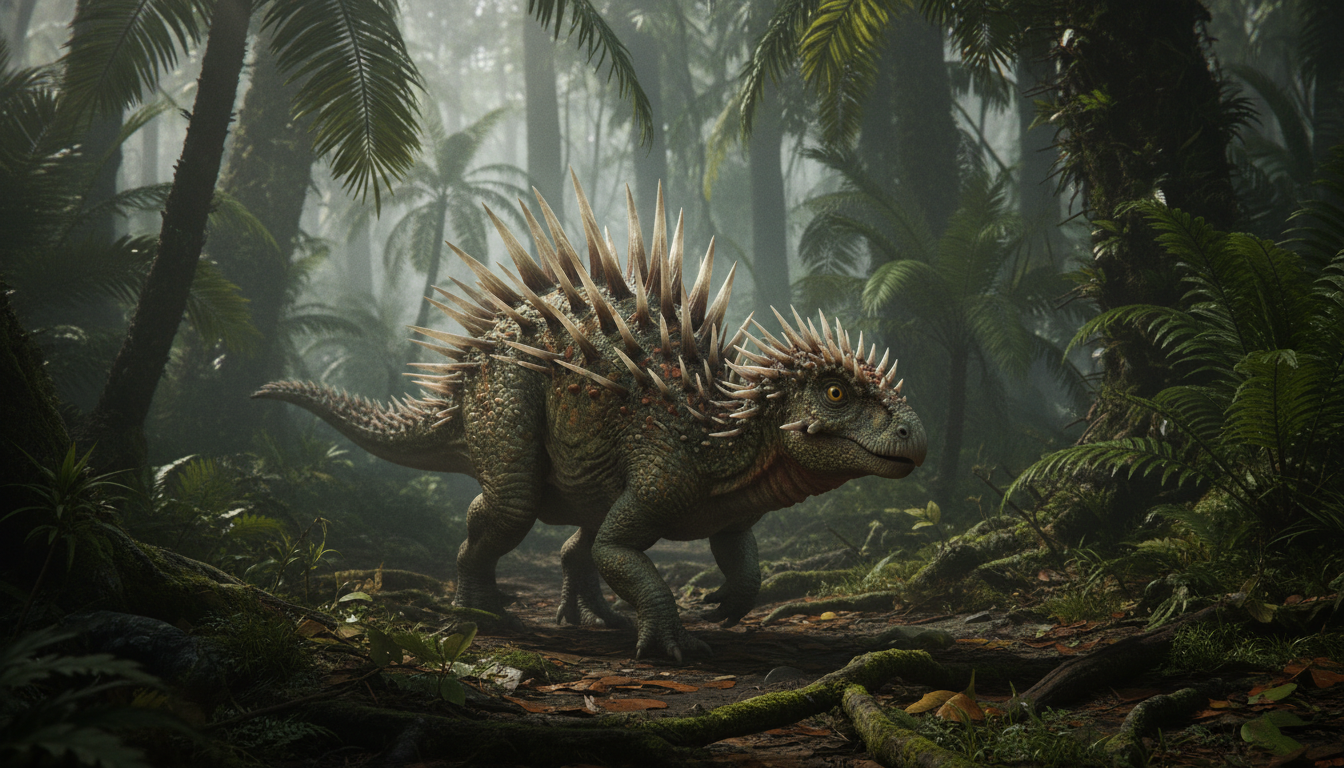
Paleontologists named a dinosaur found in China the “Spiny Dragon” which had armor never seen in 4 billion years of life on Earth
In February 2026, an international team led by the CNRS (French National Center for Scientific Research) published in the journal Nature Ecology & Evolution the description of a new dinosaur species with characteristics never observed in any vertebrate — living or extinct.
The animal was named Haolong dongi, meaning “Spiny Dragon,” in honor of Chinese paleontologist Dong Zhiming, one of the most important dinosaur researchers in Asia.
However, what really caught the scientists’ attention was not the name or the size of the animal — it was what they found growing directly on its skin surface.
-
Survivor of 1966 SS Daniel J. Morrell Shipwreck in Lake Huron Recounts 38-Hour Ordeal in Extreme Cold

-
The Greatest Hoax in World Cup History? The Film That Denied Brazil’s 1958 Victory and Exposed How Fake Evidence Can Seem Convincing on TV
-
Fake South Korean Online Stores Offer Shopping Thrill Without Spending Money or Receiving Products
-
Helicopter Drops 180 Tons of Sand and Gravel on Swedish River to Revive Ecosystem Damaged by Decades of Exploitation



The specimen is an almost complete juvenile, 125 million years old, from the Early Cretaceous period — older than most dinosaurs people are familiar with.
Thus, a fossil older than the T. rex by tens of millions of years held a secret that science had never even imagined.

The spikes grew directly from the skin and were HOLLOW inside — something that never happened in any vertebrate animal in history
According to the research published in Nature Ecology & Evolution, the Haolong dongi had hollow skin spikes that sprouted directly from the animal’s skin surface.
Unlike porcupine quills, which are modified hairs, or rhinoceros horns, which are compacted keratin, the Haolong’s spikes were unique skin structures with no equivalent in any known vertebrate — living or fossil.
Moreover, these spikes covered a large part of the animal’s body, forming a kind of spiky armor unlike anything ever recorded in the animal kingdom in over 500 million years of vertebrate evolution.
Consequently, researchers classified this feature as absolutely unprecedented in the fossil record — a type of protection that simply did not exist in the known catalog of evolution.
Therefore, the Haolong dongi is not just a new species added to the list of dinosaurs — it is the first concrete evidence of a biological defense mechanism that evolution invented, tested, and then abandoned forever.
To compare: it’s like discovering that there was a mammal that grew metal armor on its bones — and that no other animal ever repeated this.
High-resolution X-ray revealed skin cells preserved for 125 million years hidden inside the rock
According to a report by ScienceDaily, researchers used high-resolution X-ray and microscopic histological sections to analyze the internal microstructure of the fossilized spikes.
Similarly, the detailed scan revealed skin cells preserved for 125 million years — a level of conservation that allowed for precise reconstruction of how the spikes were organized on the animal’s body when it was alive.
The images showed that the spikes had thin walls and a completely hollow interior, a radically different architecture from the solid, heavy osteoderms of ankylosaurs and crocodiles.
In this sense, the discovery was only possible thanks to modern imaging technology — without the ultra-high-resolution X-ray, the spikes would have appeared as mere bumps on the surface of the sedimentary rock.
It’s like discovering that a book closed for 125 million years still has all its pages legible — and tells a story that no scientist knew.
Likewise, the preservation of skin cells opens the possibility that future studies may even identify the original chemical composition of the spikes — something unthinkable a decade ago.

Liaoning: the Chinese region that has already changed paleontology once — and has just changed it again with the Spiny Dragon
The Haolong dongi fossil was found in the Liaoning province, in northeast China — the same region that revolutionized world paleontology by revealing the first feathered dinosaurs in the 1990s.
As documented by Earth.com, the unique geological conditions of Liaoning — with volcanic eruptions that quickly buried animals in layers of fine ash — created an exceptional environment for the preservation of microscopic details impossible in other paleontological sites around the world.
On the other hand, it was precisely in Liaoning that scientists definitively proved that many dinosaurs had feathers, forever changing the image humanity had of these animals — from scaly reptiles to feathered creatures ancestral to birds.
Still, even after decades of systematic excavations in the region, Liaoning continues to surprise: every year, new fossils rewrite entire chapters of the history of life on Earth — like the train that operates at 5,072 meters altitude in Tibet, where nature itself imposes limits that engineering challenges.
Indeed, the quality of preservation in Liaoning is so exceptional that researchers can identify not only bones but skin, feathers, pigments, and even stomach contents of animals that died over 100 million years ago.
Above all, the discovery of Haolong dongi proves that even in one of the most studied regions on the planet, there are surprises waiting to be unearthed.
An armor that evolution invented, used for millions of years, and then discarded — without any living animal inheriting it
The most intriguing and disturbing aspect of Haolong dongi is that no living animal on planet Earth has hollow skin spikes.
However, 125 million years ago, at least one lineage of herbivorous dinosaurs developed this unprecedented structure — and apparently used it as effective protection against predators.
Despite this, at some point in evolution, this sophisticated defense mechanism was completely abandoned — and never reappeared in any vertebrate throughout the entire subsequent history of life.
Researchers still do not know why evolution discarded this biological innovation — whether the hollow spikes were too fragile to withstand attacks, too heavy for locomotion, or simply less efficient than other forms of protection that emerged later.
As a result, Haolong dongi remains a paleontological enigma: an animal that developed a unique defense technology in the history of life — and took the secret into the rock for 125 million years.

What the discovery of the Spiny Dragon reveals about what we still don’t know
The description of Haolong dongi is a powerful reminder that, even after more than two centuries of systematic paleontology, evolution still holds secrets we never imagined.
Moreover, the discovery raises an uncomfortable question for science: how many other biological innovations were invented, tested over millions of years, and completely discarded — without us ever finding a single fossil documenting them?
Consequently, each new fossil found in Liaoning is not just an addition to the catalog of known species — it is a window into biological mechanisms that can rewrite what we know about how life works.
A dinosaur that developed armor that no other animal in 4 billion years of life on Earth managed to replicate — and that died taking the formula into the rock.
The question the Spiny Dragon leaves us is simple and profound: if evolution has already invented things we never imagined, what else has it created and destroyed without leaving traces?


Be the first to react!