Portuguese
  Spanish


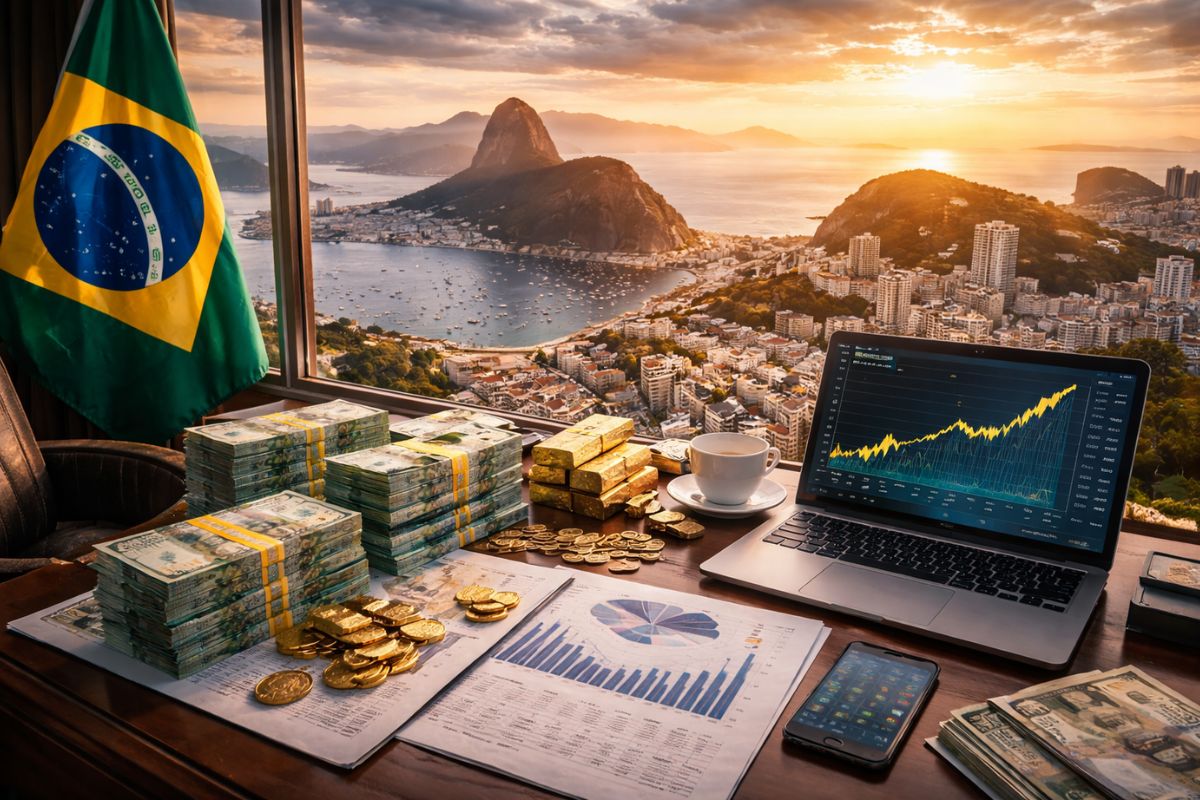

The IMF projects that Brazil will regain in 2026 the position of the 10th largest global economy with an estimated GDP of US$ 2.64 trillion, driven by the rise in oil prices caused by the war in the Middle East, and the forecast indicates that the country will surpass Russia in 2027 and Italy in 2028, reaching 8th place in the global ranking.
The International Monetary Fund published on Wednesday (15), in Washington, the World Economic Outlook (WEO) report with a favorable revision for Brazil: the GDP growth forecast for 2026 rose from 1.6% to 1.9%, partly driven by the country’s condition as a net energy exporter in a scenario of high oil prices due to the war between the United States and Iran. With this correction, Brazil reclaims the 10th position in the global GDP ranking, surpassing Canada, which held the position in 2025. The IMF itself attributes a net positive effect of approximately 0.2 percentage points to the conflict in the Middle East on Brazilian economic growth this year.
The surge in oil prices, a direct consequence of the fighting in the region, directly benefits Brazil due to its energy exports. The IMF cut the global economic expansion expectation for this year from 3.3% to 3.1%, but the opposite happened with Brazil, which gained momentum precisely where the rest of the planet lost. It is a window of opportunity that places the country on a trajectory of ascent in the ranking of the largest economies for the coming years, with projections indicating surpassing Russia as early as 2027 and Italy in 2028.
How the war in the Middle East pushed Brazil up in the IMF ranking
The mechanism that benefits Brazil is the combination of robust oil production and a global market where the barrel has become significantly more expensive. With the war between the US and Iran pushing prices, countries that sell more oil than they buy have started to earn more with each barrel exported. Brazil fits this profile of a net energy exporter, and the IMF explicitly recognizes this advantage in the document.
-
At 14 years old, she worked in a factory in Hong Kong, studied economics abroad, and then entered the Chinese real estate market, which helped change the landscape of Beijing.

-
While NATO secured more than $10 billion in missiles and space surveillance at a single forum, Brazil still spends 1.1% of its GDP on defense and is stalling its own anti-aircraft system.

-
Corn ethanol attracts R$ 23 billion in 21 new plants and prepares for a nearly 50% jump in Brazilian production by 2027, even with high interest rates.
-
A newly opened terminal in the middle of the Amazon has begun transporting soy and corn through Amapá, eyeing the queue of ships that is congesting the ports in the South.


The report estimates that the conflict added about 0.2 percentage points to Brazilian GDP growth in 2026. It may seem small in isolation, but it was enough to raise the projection from 1.6% to 1.9% and place Brazil ahead of Canada in the global ranking. The appreciation of exports in dollars also contributes to inflating nominal GDP, which is the criterion used by the IMF to compile the list of the largest economies in the world.
GDP of US$ 2.64 trillion: what the number means for Brazil
The IMF’s forecast places Brazil’s nominal GDP at US$ 2.64 trillion for 2026, a figure that secures the 10th global position. Ahead are the United States (US$ 32.38 trillion), followed by China, Japan, Germany, and the United Kingdom in the top five positions. Brazil enters the second tier, competing for space with European economies and Russia, which has been losing ground due to sanctions and the forced reorganization of its foreign trade.
For 2027, the IMF projects a growth of 2% for Brazil, above the 1.9% forecast for this year. This advance, combined with the expected slowdown of the Russian economy, would be sufficient for Brazil to take the 9th position, leaving Russia behind in the ranking. In 2028, the upward trajectory would lead the country to surpass Italy and reach the 8th place. These are projections, not guarantees, but the fact that the IMF publishes them in its main annual document gives considerable institutional weight to this scenario.
Growth slowed, but Brazil rose in the ranking
The data requires context. Although the projection of 1.9% for 2026 represents an improvement over the previous estimate, it indicates a slower pace than that recorded last year, when the Brazilian economy grew by 2.3%. The Central Bank projects an even more modest advance of 1.6%, according to its Monetary Policy Report. The difference between the estimates reflects distinct views on the impact of high interest rates and global slowdown on domestic activity.
Even with slower growth, Brazil rises in the ranking because other countries have fallen more. The global economy as a whole has lost momentum due to the war and the rising costs of energy inputs, and nations that depend on imported oil have been disproportionately penalized. Brazil has benefited, unlike Russia, which, despite being a producer, faces sanctions that limit its gains, and this has been decisive for the recomposition of Brazil’s position among the ten largest economies in the world.
Comparison with other emerging markets: India and China still grow much faster
The rise in the ranking does not erase the fact that Brazil’s expansion rate is lower than that of other major emerging markets. India is expected to record a growth of 6.5% in 2026, while China projects 4.4%, both well above Brazil’s 1.9%. The difference in speed indicates that, although Brazil is climbing positions in absolute terms of GDP, the gap to Asian economies in terms of dynamism remains significant.
The IMF predicts that India will surpass Germany in 2031 and reach the third global position. Brazil, in turn, will need to maintain its growth trajectory for several consecutive years to consolidate itself among the eight largest economies in a lasting way. Any reversal in oil prices or deterioration of the internal fiscal scenario could alter the projections.
High GDP, low per capita income: the contradiction that persists in Brazil
Climbing in the total GDP ranking is one thing. Distributing that wealth among the population is another. Brazil’s GDP per capita is projected to be US$ 10,685 for 2025, a figure that leaves the country behind much smaller economies, such as Albania. Nations with tiny populations, like Luxembourg and Liechtenstein, occupy the top positions in this indicator, which better measures the individual standard of living than absolute GDP.
This gap highlights that Brazil can be an economic powerhouse in terms of volume without this translating into proportional quality of life for its citizens. Being the 10th, 9th, or 8th largest economy in the world is relevant in geopolitical and commercial terms, but the impact on the daily lives of the population depends on how this wealth is generated, taxed, and redistributed. It is at this point that the debate about Brazilian growth gains complexity and ceases to be merely a matter of position in international rankings.
And you, do you think Brazil is really getting richer from the war in the Middle East or just riding a wave that could end at any moment? Does the rise in oil prices benefit the country or just the exporters? Leave your opinion in the comments.