Portuguese
  Spanish


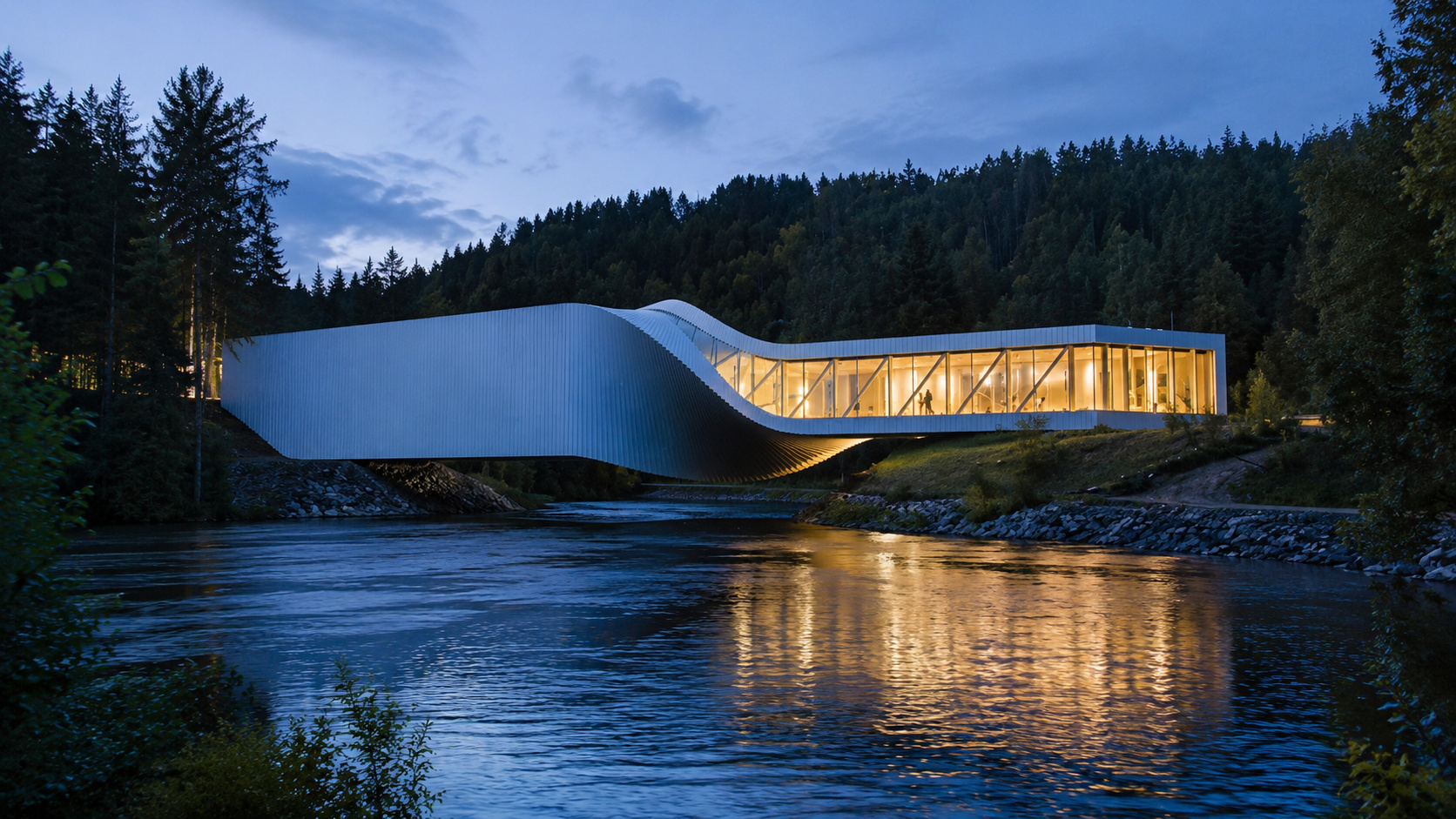

The Twist combines bridge, art gallery, and habitable sculpture in an unusual architectural work in Norway, created to cross the Randselva River, connect two banks of the Kistefos Museum, and transform a simple walk into a visual experience inside a twisted building
The visitor crosses a river inside a work of art. In Norway, the The Twist functions as an art gallery, bridge, and habitable sculpture, crossing the Randselva River within the Kistefos Museum.
The information was released by Kistefos Museum, a museum and sculpture park in Norway. The construction is 1,000 m², spans 60 meters over the Randselva River, and was designed by BIG, a Danish architecture firm.
The difference lies in how the building changes the visitor’s experience. Instead of just crossing a bridge, the person enters a white, twisted, and illuminated gallery, where the path between two banks becomes part of the artwork itself.
-
Thailand Converts 8 Tons of PET Bottles into 3,500 School Backpacks, Showcasing Circular Economy with Over 40 Factories Involved

-
Mysterious Bats Spotted in Paris’s Père Lachaise Cemetery, Drawing Tourists to the “Vampire Cemetery”

-
From Selling Street Food to Leading a $300 Million Construction Firm: The Journey of a Brazilian Entrepreneur

-
Abandoned Penthouse in Houston Reveals Million-Dollar Suite with 24-Karat Gold, Tiffany Crystals, and Opulence Even Elvis Might Have Snubbed



How a museum became a bridge over the Randselva River
The The Twist was created to solve a simple function, connecting two sides of the park. However, the solution went far beyond a common passage over the water.


The gallery crosses the Randselva River and allows the visitor to continue the journey through the Kistefos Museum without treating the crossing as an interval. The bridge becomes an exhibition room, and the exhibition room becomes a passage.
This mix creates a different experience from the traditional museum visit. The public not only enters a building to observe artworks. They walk through a structure that is also part of the landscape.
For this reason, the The Twist draws attention in the world of architecture. It does not separate practical function and visual impact. The same construction serves to cross, exhibit art, and mark the park with a sculptural form.
Why the structure rotates 90 degrees on its own body
The 90-degree twist is the most famous point of the project. Viewed from the outside, the gallery looks like a white ribbon spinning over the river. Viewed from the inside, the change happens gradually as the visitor walks.
This twist is not just a visual effect. It helps transform the passage from one end to the other into a sequence of different spaces.
At one entrance, the gallery has a more vertical feel. At the other, the environment opens up more horizontally. Between these two extremes, the twist creates a central area that seems to change the ceiling, wall, and floor positions.
The result is easy to understand even for those who do not follow architecture. The building makes the visitor feel the change of space with their own body, without relying on technical explanations.
The difference in elevation between the banks was incorporated into the design of the work
The crossing over the Randselva River also needed to deal with differences between the two banks. The project used the twisted shape to connect these points continuously.
This makes The Twist more interesting than a common bridge. The twist helps the building adapt to the terrain and, at the same time, creates a strong visual experience for those passing through.
The information was released by Kistefos Museum, a museum and sculpture park in Norway. The museum presents the building as a structure that combines gallery, bridge, and sculpture in a single work.
In practice, the construction shows how an architectural solution can arise from a real problem. It was necessary to cross the river, connect areas of the park, and maintain the visitors’ path. The project solved this with an unusual shape.
Vertical gallery on one side, panoramic space on the other
Inside, The Twist does not offer a common corridor. The experience changes along the way, with areas that have different heights, openings, and sensations.
In one part, the visitor encounters a more enclosed and vertical environment. In another, the space opens up to the landscape, allowing views of the river and the park surroundings.
The central area is the most striking. It is here that the body of the gallery twists and creates the sensation that the building is twisting around those walking through it.
This variation helps explain the visual appeal of the work. The visitor does not just cross 60 meters over the river. They pass through a construction that changes shape during the journey.
What makes The Twist different from a common bridge
A traditional bridge has a direct function. It takes people from one side to the other. The Twist also does this, but adds art, architecture, and landscape along the same path.
The person crosses the river while passing through a gallery. At the same time, they observe the light, the water, the vegetation, and the changing structure around them.
The building also stands out because it transforms a practical necessity into a cultural attraction. Instead of hiding the crossing, it places the passage at the center of the experience.
That is why The Twist works so well in images. The white shape over the river, the 90-degree twist, and the idea of a suspended gallery create a scene that is easy to understand and hard to ignore.
The bridge that became a full-scale work of art
The Twist shows that a construction can be useful and, at the same time, surprising. The gallery connects two banks, hosts exhibitions, and creates a crossing that feels like a habitable sculpture.
With 1,000 m², 60 meters over the Randselva river, and a 90-degree twist, the work does not draw attention for being the largest. The impact comes from the combination of function, landscape, and form.
By transforming a simple passage into an art and architecture experience, The Twist raises a curious question: when does a bridge stop being just a path and become part of the visit itself? Leave your opinion in the comments and share this work with those who appreciate unconventional constructions.