






 Portuguese
  Spanish
  5 min of reading
  0 comments


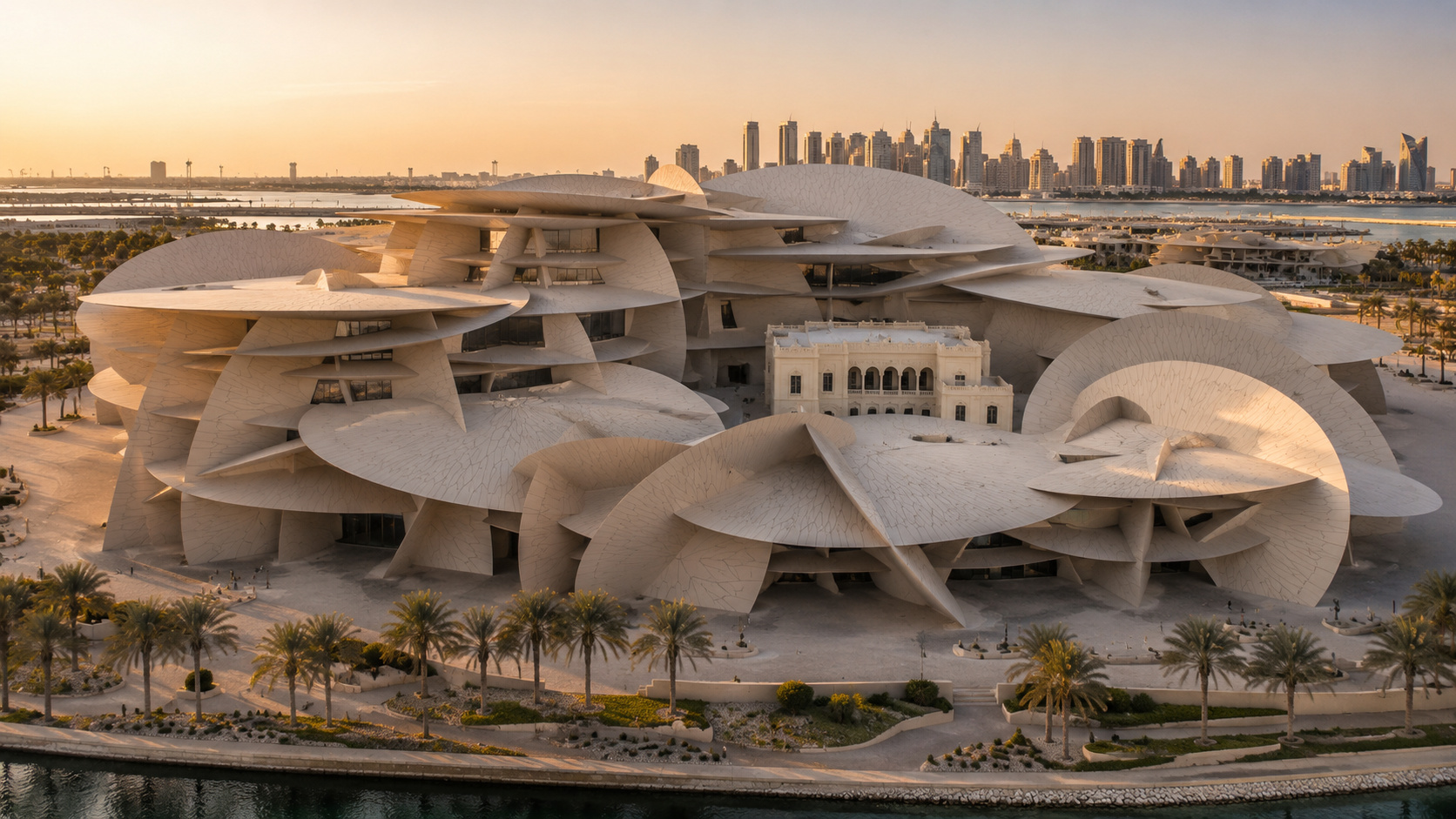
The National Museum of Qatar transforms reinforced concrete into a rare visual experience, with inclined discs, curved facades, irregular rooms, and a historic palace surrounded by Jean Nouvel’s architecture in the center of Doha
It looks like a giant mineral flower resting in the desert, but it is the National Museum of Qatar, a work inaugurated in 2019 that uses 539 curved concrete discs to form facades, coverings, rooms, and passages in Doha.
The information was published by Archello, an international architecture and design platform. The project created by Jean Nouvel draws attention because it transforms the desert rose into a real construction, with interconnected discs of various sizes and a historic palace preserved within the structure.
The impact lies in the way the building defies the norm. Instead of straight walls and predictable rooms, the museum creates a walk through inclined spaces, deep shadows, and curves that seem to have been shaped by Qatar’s own landscape.
-
Brazil’s Rio State Deploys 480 Hidden Cameras in Reserves to Track Jaguars, Tayras, and Peccaries After 27 Years Without Updating Threatened Species List

-
Brazilian City Revitalizes Nearly Extinct Ecosystem by Planting 11 Million Native Trees and Paying Residents to Restore Forests Over 40 Years

-
Victorian-era Glass Dumped into the North Sea Returns as Rare Multicolored Gems on Seaham Beach, Attracting Global Collectors.

-
Brazilian Researchers Develop Technology to Extract Drinking Water from Air Humidity Using Recycled Synthetic Fiber



What is a desert rose and why did it become an inspiration for the National Museum of Qatar
The desert rose is a mineral formation that resembles stone petals. It appears in dry regions when sand and minerals come together in irregular layers.


This natural form inspired the design of the National Museum of Qatar. The building does not attempt to look like a common box. It uses overlapping discs to create the sensation of a huge mineral flower open in the middle of Doha.
The choice also brings the museum closer to the local landscape. The light color, inclined volumes, and petal-like appearance reinforce the connection between architecture, desert, and cultural memory.
How 539 curved discs form facades, rooms, and passages in the museum
The most striking detail of the work lies in the 539 interconnected discs. They appear in different sizes, cross over each other, and create a structure that seems impossible at first glance.
These discs are not just decoration. They form important parts of the building, such as walls, ceilings, passages, and internal areas. Therefore, the external appearance and the visitor’s path are part of the same idea.
The structure extends for about 400 meters between the waterfront and the center of Doha. This scale makes the museum look like a set of giant connected petals, rather than a common building.
Archello, an international architecture and design platform, detailed the central points of the construction and recorded the 539 interconnected discs that shape the National Museum of Qatar.
Why curved concrete panels are difficult to construct
Building a structure with inclined discs is much more complex than erecting straight walls. Each piece needs to fit precisely because a curve changes the meeting with another.
BFT International, an international technical magazine on concrete construction, reported that the curved panels are made of fiber-reinforced concrete and reach diameters of up to 87 meters.
This material helps create curved surfaces and more resistant pieces. In simple words, the fibers within the concrete help the panel better withstand the difficult shapes of the project.
The challenge lies in the ensemble. Each disc affects the facade, the roof, the light entry, and the internal spaces. Therefore, the museum functions as a three-dimensional puzzle made of concrete.
The historic palace inside the National Museum of Qatar changes the meaning of the work
At the center of this modern construction is the old palace of Sheikh Abdullah bin Jassim Al Thani. Its presence makes the museum go beyond the futuristic appearance.
The project involves the historic palace and creates a strong contrast. On one side is the memory of Qatar. On the other, a contemporary structure formed by giant discs appears.
This encounter helps explain why the museum draws so much attention. It does not replace the past with a new work. It places the past within a new architectural landscape.
Thus, the National Museum of Qatar unites heritage, city, and engineering in the same journey. The visitor sees the preserved history while walking through a structure that seems to emerge from the desert.
How the desert rose shape changes the visitor’s experience
The shape of the museum is not just meant to impress from afar. It changes the sensation of those who enter the building, because the internal spaces do not follow the standard of straight corridors and square rooms.
The curves create shadows, irregular passages, and environments with a unique appearance. With each change of direction, the visitor encounters a new relationship between light, wall, and ceiling.
This experience makes the architecture part of the visit. The building guides the gaze and helps tell the story of Qatar through its very form.
For this reason, the National Museum of Qatar has become a work difficult to ignore. It mixes 539 curved discs, reinforced concrete, complex geometry, and a historic palace into a construction that looks like a sculpture but functions as a museum.
Why this work draws attention even outside the world of architecture
The curiosity is not just in the beauty of the building. After all, how can a construction made of intersecting discs stand upright?
The answer lies in the combination of design, calculation, fiber-reinforced concrete, and precise fitting of the panels. The appearance may seem free, but the execution depends on technical control in every detail.
The museum shows that engineering can transform a natural form into a real building. A desert rose, which normally fits in the hand, became a monumental work in the center of Doha.
The National Museum of Qatar brings together the most striking elements of a great construction: unusual form, technical challenge, preserved heritage, and immediate visual impact.
With 539 curved concrete discs, panels up to 87 meters, and a historic palace enveloped by the new structure, the museum has become an example of how architecture can unite memory and boldness.
Do you think such bold constructions help preserve a country’s history or end up drawing more attention to the modern work than to the heritage within it?


Be the first to react!