






 Portuguese
  Spanish


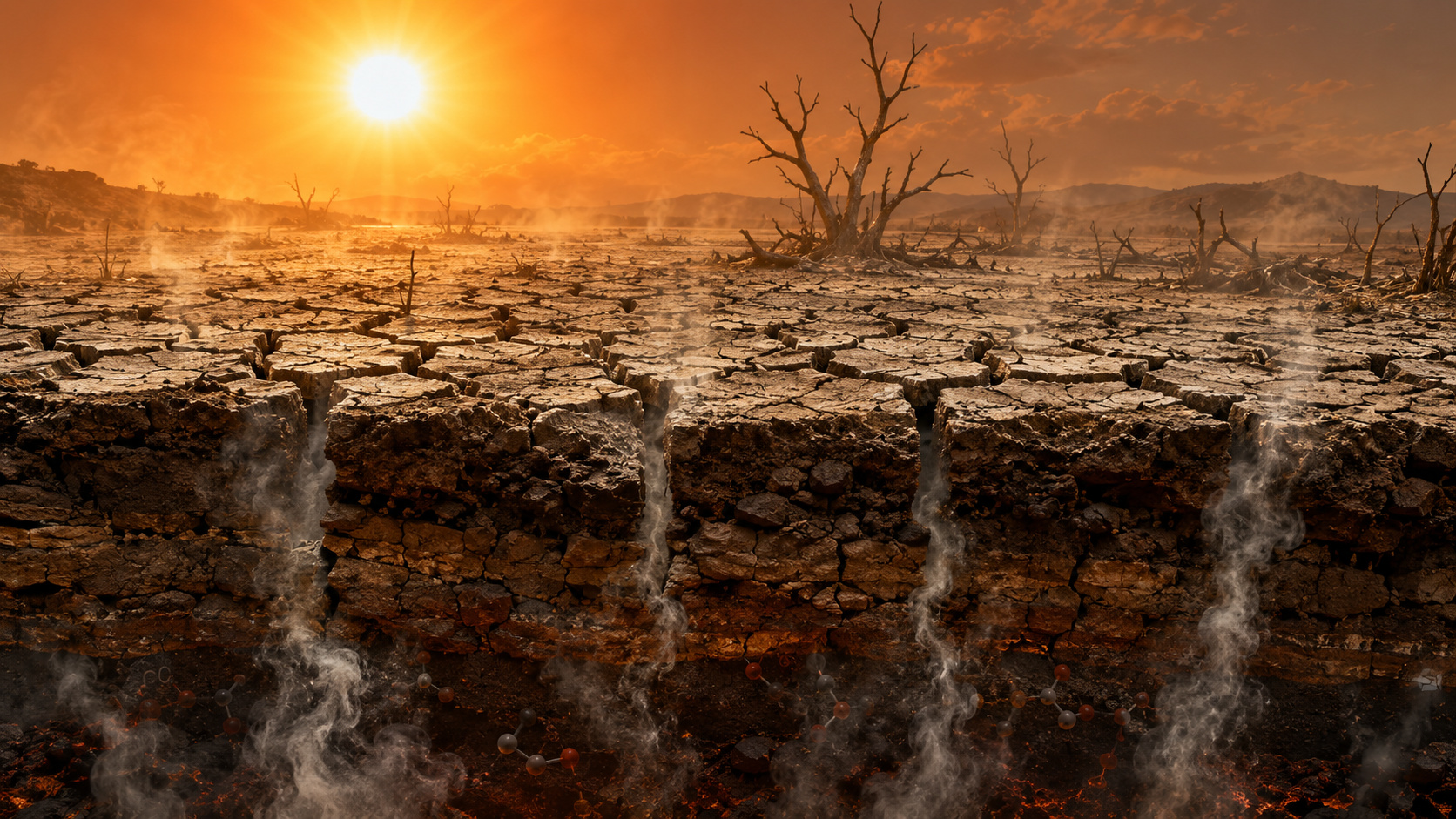

Study shows that intense droughts crack soils, expose deep carbon, and can release CO₂ in a climate cycle still outside global models.
According to ScienceDaily, a study published in March 2024 in the journal Environmental Research Letters by Farshid Vahedifard, a professor of civil and environmental engineering at Tufts University, identified a feedback cycle between drought, soil cracking, and greenhouse gas emissions. The central point is that soil stores about 80% of all the planet’s terrestrial carbon, more than the atmosphere. When an intense drought dries the soil to the breaking point, it cracks and exposes deep layers where organic carbon was protected.
These cracks allow air, heat, and microorganisms to reach ancient carbon, accelerating decomposition and releasing CO₂ into the atmosphere. CO₂ warms the climate, the warmer climate intensifies droughts, and more severe droughts crack the soil even further.
Intense droughts crack the soil and release deep carbon
The mechanism described by Vahedifard is concerning because it connects three processes that are usually studied separately: climate change, soil desiccation, and CO₂ emissions. Drought not only reduces available water; it also physically alters the soil structure.
-
James Webb Telescope Uncovers Unexpected Clues on Mysterious Moon, Potentially Redefining Planetary Origins

-
$1.5 Billion Sleipnir Vessel Transforms Ocean into Floating Construction Site with 12 Hybrid Engines and Capacity to Lift 20,000 Tons

-
23 Years After Tragedy, Brazil’s Alcântara Space Center to Launch New Suborbital Rocket in 2026 with South Korean SEBIT Project Targeting Near-Space Tests
-
Entrepreneur Turns Neighbor’s Coffee Grounds Waste into Eco-Friendly Pellets, Earning Up to $40,000 Monthly in Brazil


When the soil loses moisture extremely, especially in clay regions, it contracts and forms fissures. These cracks can penetrate layers that were previously isolated from the atmosphere.
The carbon that remained protected for decades, centuries, or even thousands of years can then come into contact with oxygen and microorganisms. This process transforms deep organic matter into carbon dioxide.
Desiccation cracks create a climate cycle ignored by models
Vahedifard stated that if the interaction between drought, desiccation cracks, and CO₂ emissions is not considered, climate projections may present significant inaccuracies.
The problem is that this cycle has not yet been sufficiently evaluated in the scientific literature nor incorporated into climate models. This means that part of the future warming may be underestimated.
The logic is straightforward: more heat generates more drought; more drought generates more cracks; more cracks release more carbon; more carbon warms the planet even more. It is a potentially dangerous feedback cycle.
Carbon in the soil is not distributed uniformly
The carbon stored in the soil is not a single layer spread equally from the surface to the depths. It forms a stratified structure, with different types of organic matter at different depths.
In the surface layer are decomposing leaves, recent roots, and fresh organic matter. This part already actively participates in the natural carbon cycle and continuously releases CO₂ through microbial respiration.
Further down, between 20 and 80 centimeters, is the stabilized carbon. This material can be bound to clay and iron minerals, remaining protected from rapid decomposition for long periods.
Deep soil holds ancient carbon that can be exposed by drought
Below 1 meter of depth, there may be layers of ancient carbon. This material has been preserved for a long time because it remained far from the surface, direct climate variation, and intense microbial activity.

Soil cracks act as vertical channels that connect the surface to these deep layers. When a fissure reaches 50, 80, or 100 centimeters, it opens a path for hot and dry air.
With this opening, microorganisms begin to access previously protected carbon. What took decades or centuries to accumulate can start to decompose on a much faster scale.
Why soil cracks were left out of climate models
Climate models depend on the inclusion of the main mechanisms that influence temperature, carbon, moisture, and greenhouse gases. The problem is that the cycle identified by Vahedifard lies at the intersection of different scientific areas.
The study of droughts mainly belongs to climatology. The study of desiccation cracks is usually in geotechnical engineering. Meanwhile, soil carbon emission is analyzed by biogeochemistry.
This division helps explain why the mechanism went unnoticed. None of these areas, in isolation, observed the entire process: extreme drought, physical soil rupture, and deep carbon release.
Geotechnical engineering revealed a hidden climate problem
Vahedifard arrived at the topic through an unusual path. He was studying how drought compromises the integrity of earth dams, a classic civil and geotechnical engineering problem.
While investigating how cracks form in dried soils, he realized that the same phenomenon that threatens structures can also expose deep organic carbon. The problem was no longer just structural.
The discovery shows how a physical soil failure can have a climatic effect. The ground cracked by drought is not just a visual sign of degradation; it can be a new source of CO₂ that is still poorly measured.
Soil stores more carbon than the atmosphere
The scale of the problem is enormous. The Earth’s atmosphere contains approximately 870 gigatons of carbon, while terrestrial soil holds about 1,500 gigatons just in the first meter of depth.
In deeper layers, up to 3 meters, this stock can exceed 2,300 gigatons of carbon. This means that soil functions as one of the largest carbon reservoirs on the planet.

For comparison, human emissions from fossil fuels amount to about 10 gigatons of carbon per year. The first meter of soil contains the equivalent of about 150 years of these emissions.
CO₂ emission from soil may increase with more severe droughts
If a significant fraction of deep carbon starts to be released through desiccation cracks, the atmospheric impact could be substantial. This process would occur alongside human emissions that the world is already trying to reduce.
Vahedifard’s study does not precisely quantify how much carbon would be released globally by this mechanism. This measurement is still among the next necessary steps to assess the real strength of the cycle.
Even without this final number, the research documents the mechanism and shows that its absence in climate models is a significant gap. The risk is projecting the climate future without accounting for part of the carbon that may come out of the soil.
Clay soils are more vulnerable to desiccation cracks
Desiccation cracks do not occur with the same intensity in all types of soil. They appear mainly in clay soils, which absorb water when wet and shrink when dry.
This behavior creates deep fissures during periods of intense drought. The greater the variation between concentrated rain and severe drought, the higher the risk of crack formation tends to be.
Therefore, regions with climates marked by extremes of drought and rain can be especially vulnerable. The risk increases when global warming makes droughts longer, hotter, and more frequent.
Northeast Brazil appears as a region vulnerable to the drought-soil-carbon cycle
Northeast Brazil is an important example within this logic. The region combines periods of severe drought, concentrated rains, soils with clay presence, and vegetation adapted to the semi-arid climate.

In caatinga areas, the soil can store significant carbon at depth. When long periods of drought dry out the land, cracks can open pathways for oxygen and heat.
The same pattern concerns other regions of the world, such as southern Europe, the southwestern United States, parts of Australia, the African Sahel, India, and Pakistan. These are areas where intense droughts already appear in climate projections.
Southern Europe, Sahel, and Australia are also in risk zones
Southern Europe, including Spain, Portugal, southern Italy, and Greece, has Mediterranean soils that are already facing increasing water stress. In many locations, the combination of extreme heat and low humidity favors desiccation.
The American southwest and parts of Australia also experience severe drought cycles, high temperatures, and soils susceptible to shrinkage. In these areas, deep cracks may become more frequent.
In the African Sahel and regions of India and Pakistan, the alternation between extreme drought and intense rains also creates favorable conditions for the problem. The common factor is the combination of vulnerable soil and increasingly unstable climate.
Climate change may intensify the cycle of drought and cracks
Global warming increases the likelihood of more intense droughts in various regions. With more heat, evaporation increases, the soil loses moisture faster, and the chance of deep cracks increases.
This process creates a dangerous feedback loop. The climate warms, the soil dries, the soil cracks, deep carbon is released, and the additional CO₂ reinforces the warming.
The cycle still needs to be quantified globally, but its physical and biogeochemical logic has already been described. The warning is that the soil may respond to extreme climate more aggressively than current models consider.
Carbon released from cracked ground has not yet been included in the Paris Agreement calculations
International climate policies depend on projections about emissions, carbon absorption, and ecosystem response. If a relevant mechanism is left out of the models, the calculations may lose accuracy.
As long as the cycle of drought, soil cracks, and CO₂ is not incorporated, part of the carbon released by cracked ground will remain invisible in climate accounts. This can affect temperature scenarios and mitigation targets.
The discovery does not change the main cause of global warming, which remains linked to human emissions. But it adds a concern: the very droughts caused by warming may unlock ancient carbon stored in the soil.


