Portuguese
  Spanish


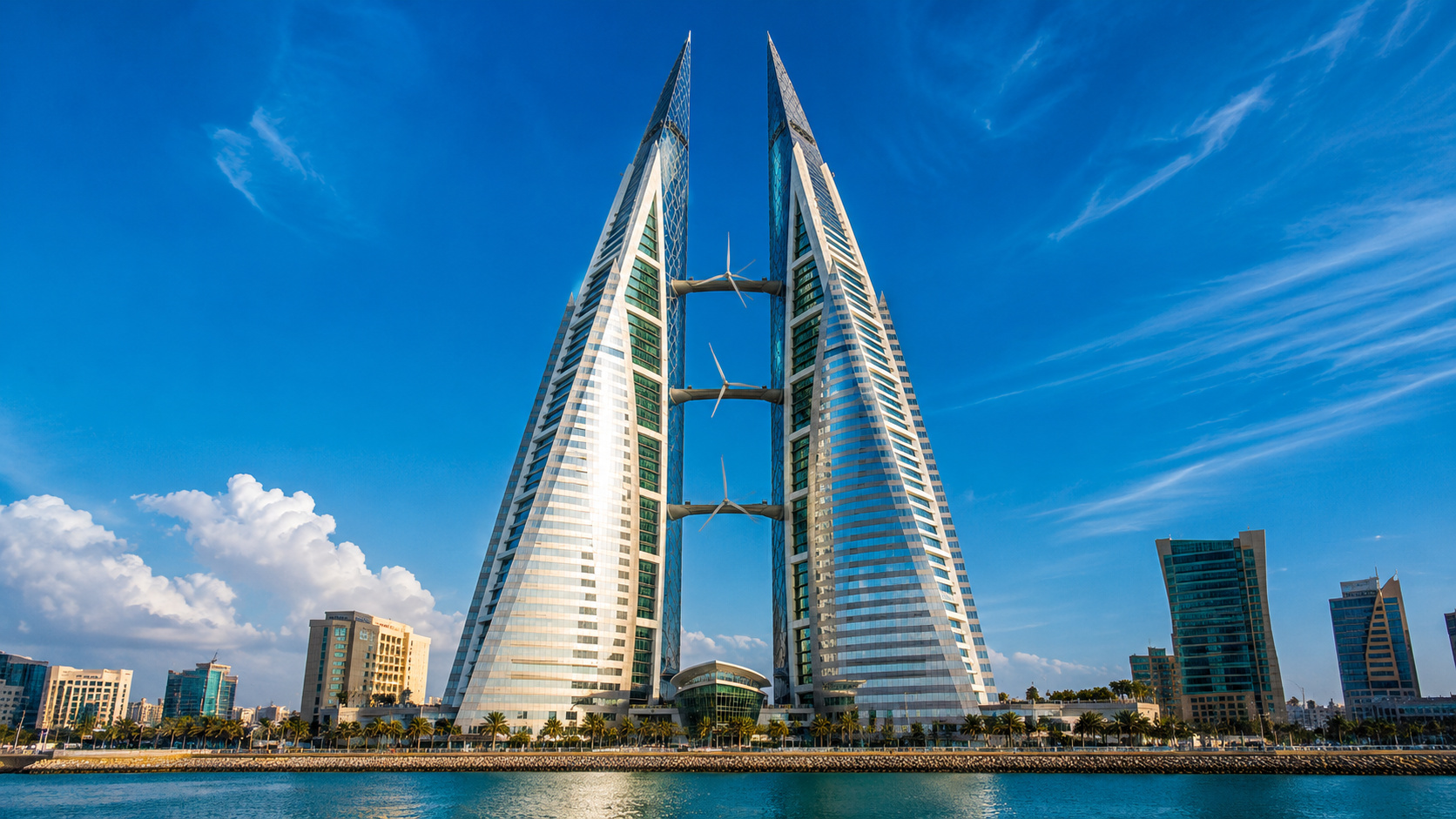


The Bahrain World Trade Center uses wind turbines between buildings, two sail-shaped towers and wind from the Persian Gulf to generate part of the energy for a commercial complex that has become a rare reference in sustainable urban engineering
While wind turbines are usually located in open fields or at sea, in Bahrain three blades were placed between two 240-meter towers to transform urban wind into energy. The project draws attention because it uses the buildings’ own shape to channel air to the turbines.
The complex is the Bahrain World Trade Center, consisting of two commercial towers of 50 floors. Between them, three bridges support three wind turbines, creating an unusual image for those who associate wind energy only with land or sea parks.
The information was released by Otis, an elevator and building technology company. The source details that the towers were opened in 2008 and were designed to channel offshore winds, that is, winds coming from the sea region, towards the turbines.
-
From Hotel Porter to CEO: Brazilian Entrepreneur Leads Travel Agency Serving Major Brands and Generating $270 Million in Revenue

-
From Selling Cleaning Products in Vans to Over 300 Franchises: Entrepreneur Targets $30 Million by Expanding into Professional Cleaning Services and Laundries

-
China Constructs 5.1 km Undersea Highway in Dalian Bay, Reducing Travel Time from 1 Hour to 5 Minutes
-
Massive Transporters Otto and Lore Move ALMA Radio Telescope in Chile’s Atacama Desert



Why the towers are sail-shaped and how this helps the wind reach the wind turbines
The shape of the towers is not just to make the building look beautiful on the horizon. The shape resembles sails and also helps guide the wind to the central gap where the turbines are located.


The two towers have a conical and elliptical design. In simple terms, this means they have curved lines and narrower parts, which helps the air move towards the middle of the structure.
This design makes the buildings function as guides for the wind. Instead of just facing the force of the air, the Bahrain World Trade Center tries to harness this force to move the blades.
The result is a project where architecture and renewable energy appear together. The building’s shape directly participates in energy generation, not just the external appearance.
How three blades were secured between two 240-meter towers without being next to the building
The turbines were not installed on nearby land. They are located in the space between the two skyscrapers, secured on walkways that connect one tower to the other.
Each walkway supports a turbine. Thus, the three blades are aligned in the central span, exactly in the path where the wind is channeled by the towers.
This solution makes the building different from most commercial projects. In many buildings, energy systems are hidden. In Bahrain, the wind turbines became a visible part of the construction.
The most important point is that everything needs to work together. Tower, walkway, wind, and turbine are part of the same idea, planned to function within the specific conditions of the location.
How much energy the Bahrain World Trade Center could generate with the turbines
The turbines were designed to provide between 11% and 15% of the commercial center’s energy needs. This number shows that the system helps, but does not replace all the electricity used in the complex.
Even so, the proposal draws attention because it shows a different way of capturing energy. The building does not rely solely on receiving energy from the grid; it also tries to produce part of what it consumes.
Otis, an elevator and building technology company, also reports that the complex has 26 elevators, including 12 elevators in the towers and 4 panoramic elevators. These data reinforce the scale of the enterprise.
The main lesson is simple. Turbines between buildings can generate energy, but they depend on adequate wind, correct orientation, and design thought from the beginning.
The challenges of placing wind turbines between tall buildings occupied by people
Installing turbines in a skyscraper is quite different from placing blades in an open field. The wind changes speed and direction when it encounters tall buildings.
Therefore, projects of this type need to consider vibration, noise, maintenance, and safety. A turbine secured between towers needs to operate without compromising the comfort and structure of the building.
There is also the challenge of access. Since the blades are suspended between the buildings, any maintenance requires careful planning.
This is one of the reasons that make the Bahrain World Trade Center so rare. It is not enough to place a turbine on any facade. The building needs to be designed with this function in mind from the project stage.
Why this skyscraper model with turbines hasn’t become a standard worldwide
The image of the propellers between the towers is striking, but the model hasn’t spread as a common solution for large cities. The reason lies in the difficulty of replicating the same conditions elsewhere.
Not every urban center has constant wind, favorable direction, and adequate space between buildings. Moreover, the building’s shape needs to assist the wind, not hinder the movement of the propellers.
Another point is that the projected generation covers only part of the demand. In the case of the Bahrain World Trade Center, the system was designed to supply between 11% and 15% of the commercial center’s energy.
Therefore, the project should not be seen as a universal solution. It serves as a specific example of how a construction can use the wind when architecture, location, and engineering align.
What makes this work so curious for the Brazilian public
In Brazil, wind energy usually brings to mind large towers installed in open areas, mainly in regions with strong winds. Therefore, the idea of placing three turbines between skyscrapers seems unusual.
The Bahrain World Trade Center draws attention because it changes this logic. The turbines are located between two commercial towers of 240 meters, and the very design of the buildings helps direct the wind to them.
The work shows that engineering can turn a problem into an opportunity. The wind, which is often a challenge for tall buildings, became part of the complex’s operation.
Even with limitations, the project remains one of the best-known examples of wind turbines integrated into tall buildings. It proves that renewable energy can also appear within the urban landscape when the project is designed for it.
The Bahrain World Trade Center combines two 50-story towers, three wind turbines, and a sail-shaped design to capture wind from the Persian Gulf. The construction shows that a building’s appearance can have a real function when engineering is at the core of the idea.
The model is not suitable for every city, but it raises an important question: if tall buildings already face wind every day, how many of them could be designed to harness this force instead of just resisting it?