Portuguese
  Spanish


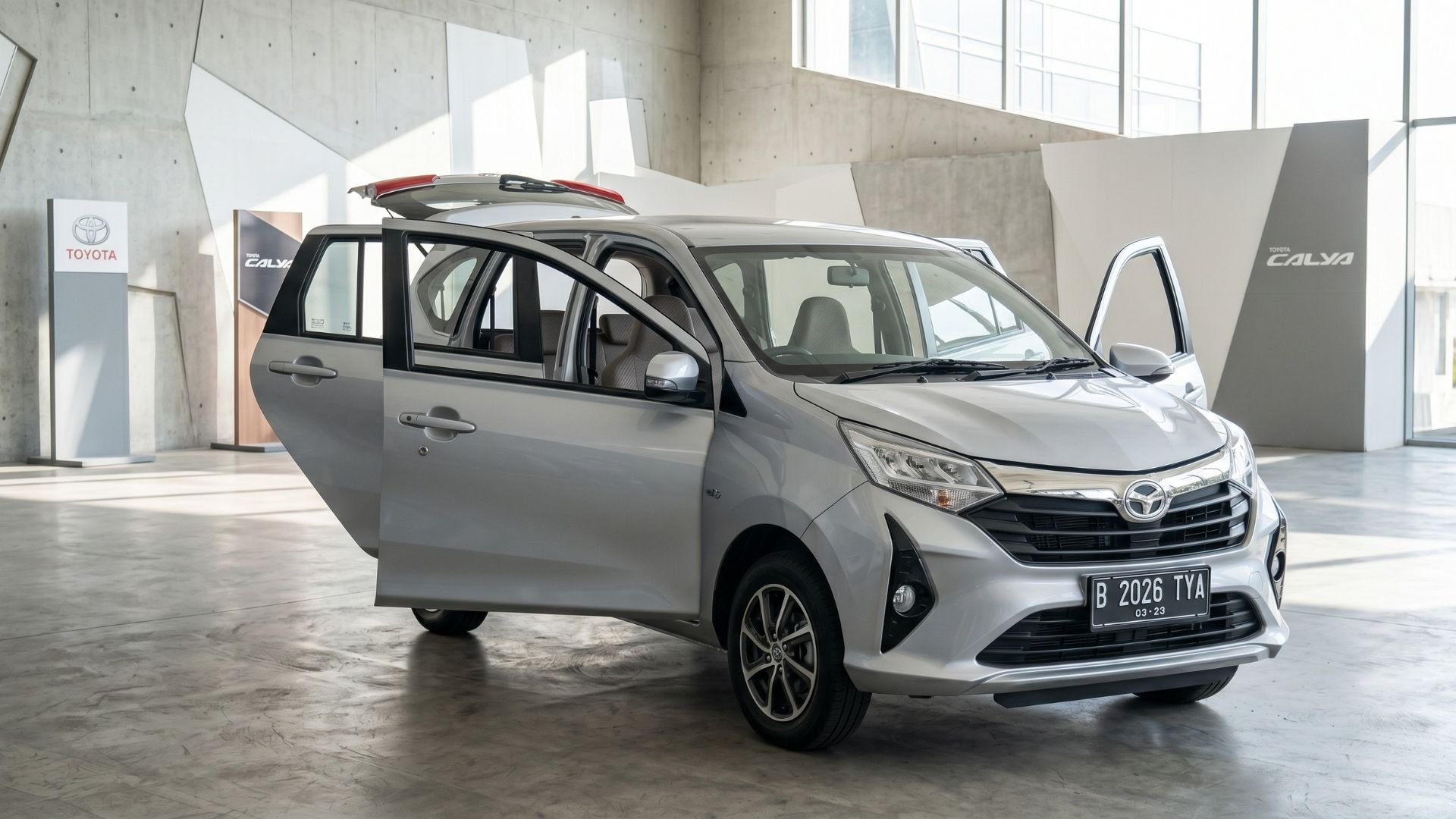


Toyota Calya 2026 costs around R$ 48,000 in Indonesia and showcases a 7-seater mini-MPV absent from Brazil.
Toyota sells in Indonesia a 7-seater mini-MPV that seems to have been designed to fill exactly the gap that the Brazilian market lost: a compact, simple, cheap family car with three rows of seats. The model is called Toyota Calya 2026 and starts at Rp 170,200,000, according to Auto2000, a network linked to Toyota Astra in the country. In direct conversion by the Xe exchange rate on May 23, 2026, of 1 Indonesian rupiah = R$ 0.000283746, the starting price is equivalent to R$ 48,293. Calculation: 170,200,000 × 0.000283746 = R$ 48,293. The value does not include Brazilian taxes, freight, import, homologation, dealership margin, or any cost for nationalization.
Toyota Calya 2026 sold in Indonesia shows a cheap family mini-MPV in a segment that disappeared from Brazil
The Calya 2026 is presented by Auto2000 as an economical and affordable MPV for young families, with OTR Jabodetabek price between Rp 170,200,000 and Rp 193,200,000. In direct conversion, the top version is about R$ 54,819, still below the cheapest compacts officially sold in Brazil.


The model has 7 seats, compact body, and family proposal, something rare in the current Brazilian market. Toyota Brazil itself lists Corolla, Yaris Cross, Corolla Cross, SW4, RAV4, Hilux, and Hiace, but does not offer the Calya in its official lineup in the country.
-
Chevrolet’s Parent Company to Invest Billions in Brazil to Modernize Factories, Update Cars, and Accelerate Hybrid Launch by 2028

-
Practical Driving Tests in Brazil Surge by 23.5%, Exceeding 2.2 Million by 2026, as New Rules Make the Process Cheaper and Simpler
-
Brazil’s Lula Government Allocates $463 Million Quota for Electric Car Parts, Waives Import Tax Until December, Sparking Competition Among BYD, Automakers, and Unions as Consumers Question Impact on Prices and Local Industry

-
Thinking of Installing LED Headlights? Why Replacing Halogen Bulbs is Still Banned, the Glare Risks Authorities Worry About, and How a New Proposal Could Allow Certified, Safe Installations


Toyota maintains an entry-level mini-MPV in Indonesia, while in Brazil the brand focuses its lineup on sedans, SUVs, pickups, sports, and larger commercial vehicles.
1.2 Dual VVT-i engine, manual or automatic transmission, and 7 seats form the technical package of the Toyota Calya
The technical sheet released by Auto2000 reports a 1.2 four-cylinder inline engine, 16 valves, DOHC, and Dual VVT-i, with 1,197 cm³. The set delivers 88 PS at 6,000 rpm and 11 kgfm at 4,200 rpm, with a fuel tank of 36 liters.

The version displayed by Auto2000 features a 5-speed manual transmission, but the Calya 2026 lineup also appears in four variants in Indonesia, with manual and automatic options. Oto reports that the model offers manual or automatic transmission, with the automatic being 4-speed.
In terms of dimensions, the Calya is 4,070 mm long, 1,655 mm wide, 1,600 mm high, with a 2,525 mm wheelbase and 180 mm ground clearance. It is larger than a common urban subcompact but still compact enough to function as a city family car.
7-seater Mini-MPV costs less than popular Brazilian models, but cannot be compared as final import price
The converted price of about R$ 48,000 is just a direct exchange rate reference. It serves to show the difference in positioning between markets but does not represent the price at which the Calya could be sold in Brazil.
If officially imported, the mini-MPV would be impacted by taxes, international freight, homologation, adaptation to local regulations, logistical costs, commercial margin, and Toyota’s own pricing strategy.

Even so, the comparison draws attention because the product exists in an official Toyota operation in Indonesia, with an entry price far below the cheapest compact models sold in Brazil.
Toyota Calya 2026 has compact car dimensions but a cabin for a large family
The main feature of the Calya is trying to combine compact size with a family cabin. The technical sheet from Auto2000 states a capacity for 7 occupants, four doors, power steering, ventilated disc front brakes, and drum rear brakes.
The front suspension uses a MacPherson strut with coil spring and stabilizer bar, while the rear features a semi-independent torsion axle with coil spring. It is a simple architecture, common in compact cars aimed at low cost, robustness, and easy maintenance.

In the equipment informed by Auto2000, the listed version includes ABS, airbag, keyless entry in the local description, manual air conditioning, and 14-inch wheels. The page itself warns that specifications may change according to version and product update.
Technical specifications of the Toyota Calya 2026 sold in Indonesia
| Item | Toyota Calya 2026 |
|---|---|
| Country where sold | Indonesia |
| Category | Family Mini-MPV |
| Capacity | 7 seats |
| Engine | 1.2, 4-cylinder inline, 16V, DOHC, Dual VVT-i |
| Displacement | 1,197 cm³ |
| Power | 88 PS at 6,000 rpm |
| Torque | 11 kgfm at 4,200 rpm |
| Transmission | 5-speed manual or 4-speed automatic |
| Drive | Front |
| Length | 4,070 mm |
| Width | 1,655 mm |
| Height | 1,600 mm |
| Wheelbase | 2,525 mm |
| Ground clearance | 180 mm |
| Tank | 36 liters |
| Front suspension | McPherson with coil spring and stabilizer |
| Rear suspension | Semi-independent torsion axle with coil spring |
| Front brakes | Ventilated disc |
| Rear brakes | Drum |
| Wheels | 14 inches |
| Reported safety | Airbag and ABS, according to version/listing |
| Starting price in Indonesia | Rp 170,200,000 |
| Approximate direct conversion | R$ 48.3 thousand |
| Top version price | Rp 193,200,000 |
| Direct conversion of the top version | R$ 54.8 thousand |
Toyota Calya exposes the difference between the cheap family car from Indonesia and the current Brazilian market
The Calya is not a luxurious minivan, hybrid or technological. Its impact comes precisely from the opposite: it is a simple, compact 7-seater car, sold at a low price within Toyota’s strategy for Indonesia.

In Brazil, Toyota does not offer an equivalent mini-MPV. The closest commercial option in passenger capacity is the Hiace, but it belongs to another category, with a van proposal and positioning very distant from a compact family car.
This is the point that makes the Calya so intriguing for the Brazilian public: while the national market discusses popular cars above R$ 75,000, Indonesia has a 7-seater Toyota family car for less than R$ 50,000 in direct conversion.
The question that remains is simple: if there is a compact, affordable, 7-seater Toyota in another emerging market, why did the Brazilian consumer miss out on this type of car?