Portuguese
  Spanish


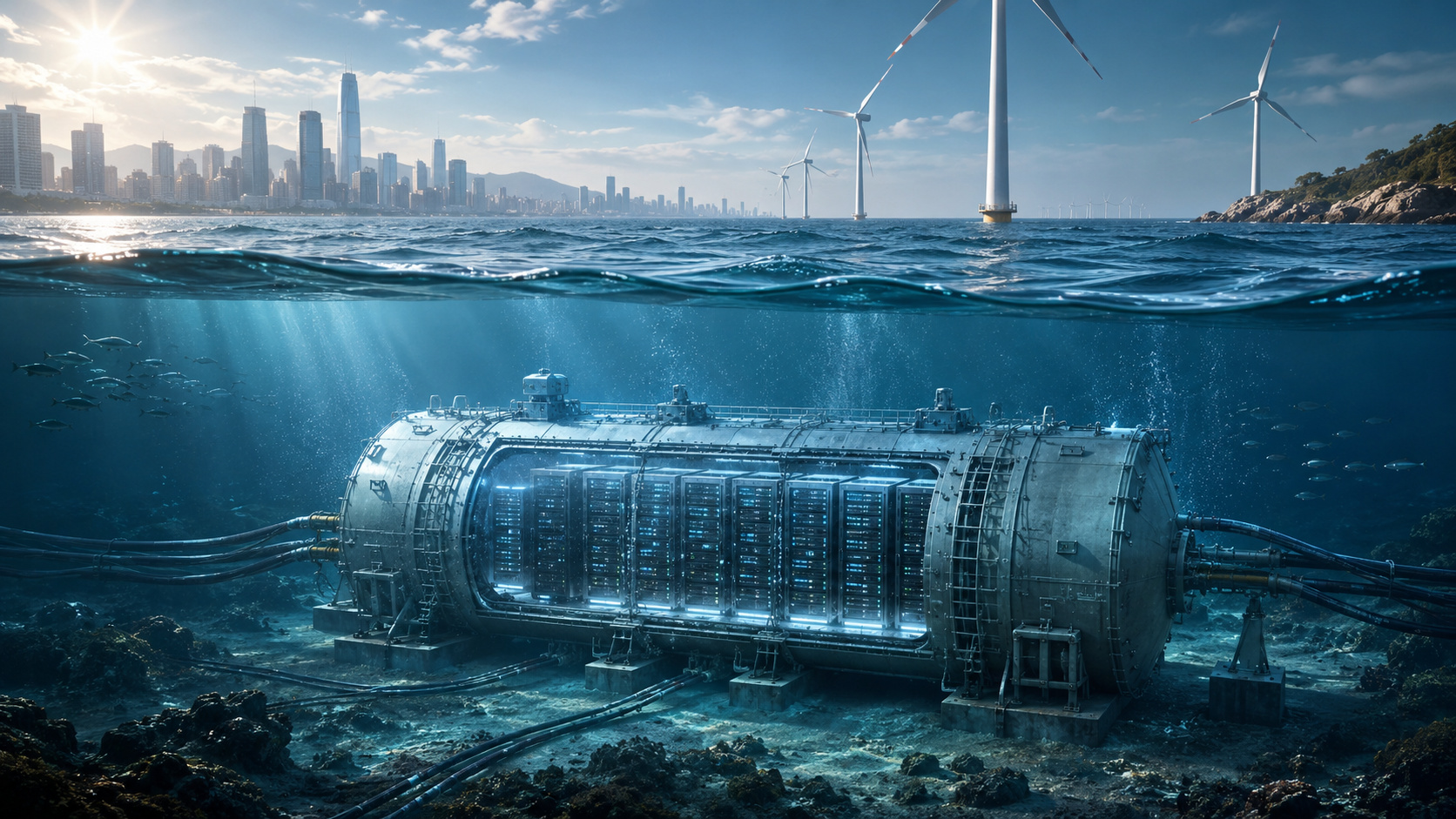


China’s underwater data center shows how submerged servers can reduce energy consumption, leverage natural seawater cooling, and transform internet infrastructure into a new focal point for security, maintenance, and artificial intelligence expansion
China placed servers 35 meters deep on the seabed to tackle one of the biggest problems for any data center: the heat generated by machines running non-stop.
The findings were published by Tom’s Hardware, a portal specializing in technology and hardware. The project is located near Shanghai, uses sealed modules in the sea, and relies on ocean water as a natural way to cool equipment.
The case is noteworthy because the so-called digital cloud seems invisible to the user, but it depends on enormous structures, constant energy, and physical machines. Now, part of this infrastructure can be submerged, supported by offshore wind energy and new security concerns.
-
Seen from space, an astronaut captures in Canada a geometric carpet of crops drawn over the backdrop of a ghost lake that disappeared 12,000 years ago, was once larger than all the Great Lakes combined, and left a scar of fertile mud that still sustains agriculture.

-
Billionaire says the most valuable skill will help overcome job elimination caused by AI, following Bill Gates’ fears

-
A Dutchman created a ‘box’ that makes trees grow in the desert almost without water and without irrigation: the invention has already brought seedlings to dozens of countries and achieves up to 90% survival where common planting did not exceed 10%.

-
Abandoned warehouse hid a giant collection of rare computers, with over 2,000 artifacts from the 1930s to the 1980s.




China turns the seabed into a server room to try and reduce energy consumption
A data center is a place full of servers. These pieces of equipment store data, process information, and keep digital services running. Applications, banks, social networks, business systems, and artificial intelligence tools depend on this type of infrastructure.


The problem is simple to understand: servers get hot. When many servers work together, the heat increases, and cooling becomes a significant part of energy consumption.
The Chinese solution attempts to use the sea itself as an ally. The modules are sealed and protected, installed at about 35 meters deep, where the water helps dissipate heat from the machines.
As a result, the ocean functions as a kind of natural cooling system. The idea is to reduce reliance on traditional land-based systems, which typically require a lot of energy to keep equipment at a safe temperature.
Ocean water becomes central to cooling submerged servers
The most curious point of the project is the change in logic. Instead of just building large buildings on land, China placed part of the digital infrastructure inside the sea, in sealed modules.
These modules protect the servers from direct contact with water. At the same time, the submarine environment helps control heat, as ocean water absorbs temperature more efficiently than air.
The initiative involves Shenergy and China Telecom, names linked to the mentioned project. There is also a forecast for the use of offshore wind energy, which is energy generated by turbines installed in the sea.
This combination shows an attempt to bring data centers closer to energy sources and natural cooling solutions. For a world increasingly using artificial intelligence, this type of proposal gains significance.
Project near Shanghai recalls Microsoft’s underwater server experiment
The idea of placing servers in the sea didn’t come out of nowhere. Microsoft had already carried out Project Natick, an experiment with submerged servers in Scotland.
The goal was to understand if computing equipment could operate efficiently underwater. The logic was similar: use the marine environment to help control heat.
Tom’s Hardware, a portal specializing in technology and hardware, highlighted the central points of the Chinese project and linked the initiative to the search for more efficient data centers. The case reinforces a trend: digital infrastructure is moving away from the traditional format.
Previously, a data center was imagined as a large building, full of cables, machines, and powerful air conditioning. Now, the sector is testing new spaces, including the seabed.
Sonic attacks against submerged data centers become an unexpected alert for digital security
The most unusual part of this topic involves the risk of sonic attacks. Researchers are studying whether underwater sounds could disrupt the functioning of submerged servers.
The academic study AquaSonic, research on underwater acoustic vulnerabilities, analyzed experimental scenarios in which sound in the submarine environment could affect disks, distributed systems, and computational performance.
Disks are components used to store data. Distributed systems are groups of computers working together. If one part fails or slows down, the service can be impaired.
This alert shows that placing servers in the sea creates different risks. On land, concerns involve energy, heat, physical access, and common failures. In the ocean, sound, water pressure, difficult maintenance, and maritime security are also factors.
Artificial intelligence expansion increases pressure for more efficient data centers
Artificial intelligence requires a lot of processing. The more such systems grow, the more servers are needed to train models, respond to users, and keep services active.
This increases the heat generated by machines. It also increases the need for energy. Therefore, cooling solutions have become an important topic for companies and governments.
The submarine data center near Shanghai appears within this scenario. It tries to answer a practical question: how to keep more servers running without further increasing cooling costs?
The Chinese answer bets on the sea. Water aids in cooling, while offshore wind energy is part of the project’s energy strategy.

Digital infrastructure at sea can become a strategic issue for governments and businesses
If these types of submarine data centers grow, the ocean could gain another function in the digital economy. In addition to submarine cables, ships, turbines, and platforms, the sea could also host structures that support the internet.
This changes the way security is thought about. A data center at the bottom of the sea does not only rely on technicians in refrigerated rooms. It requires submarine maintenance, protection against physical failures, and attention to the surrounding environment.
The main consequence is direct: submerged servers can help save energy, but they can also transform digital infrastructure into a critical maritime structure.
The case shows that the cloud is not as light as it seems. It needs machines, energy, cooling, and protection. In some projects, all of this can be below the surface.
Submarine data centers show a new phase in the race for energy and computing
The installation of servers at the bottom of the sea shows how the pursuit of efficiency is taking technology to unimagined places. The goal is to reduce heat, save energy, and maintain accelerated digital expansion.
At the same time, the warning about sonic attacks shows that every new solution carries new risks. The next stage of data centers may involve both energy innovation and submarine protection.
Would you trust an essential part of the internet operating at the bottom of the sea, out of public sight, but increasingly important for AI, banks, businesses, and everyday services? Leave your comment.