






 Portuguese
  Spanish


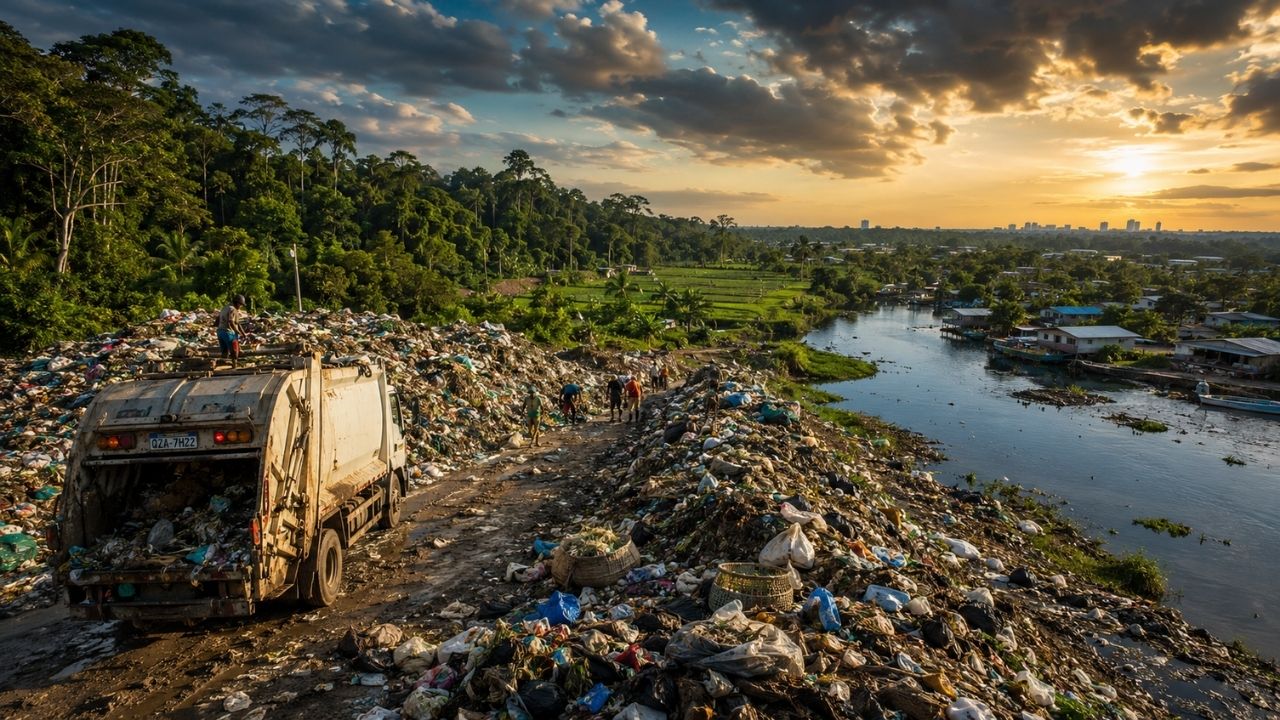

In Iranduba, about 20 km from Manaus, the open-air dump exposes residents, farmers, and tourist areas to risks associated with uncontrolled waste, while the debate over a landfill separates fear, misinformation, recycling, and the need to protect water, soil, and vulnerable Amazonian communities today.
An open-air dump in Iranduba, Amazonas, has become a symbol of a problem that goes beyond deforestation in the Amazon. The situation affects rural communities, farmers, bathing areas, and tourist spots near Manaus, in a region where irregular waste disposal concerns residents and local leaders.
In a video published on the Richard Rasmussen channel, the case involves residents, community associations, rural producers, waste pickers, visitors, and authorities responsible for waste management. The debate gained momentum with the possibility of replacing the dump with a landfill, an alternative that, when done with technical control, can reduce impacts on soil, water, and public health.
Dump in the Amazon shows a problem that doesn’t appear in forest photos

When talking about the Amazon, the most common image is of the standing forest, the rivers, and the biodiversity. But the region also houses cities, communities, farmers, tourism, and millions of people who produce waste every day. Waste stopped being just organic a long time ago.
-
Billionaire says the most valuable skill will help overcome job elimination caused by AI, following Bill Gates’ fears

-
A Dutchman created a ‘box’ that makes trees grow in the desert almost without water and without irrigation: the invention has already brought seedlings to dozens of countries and achieves up to 90% survival where common planting did not exceed 10%.

-
Abandoned warehouse hid a giant collection of rare computers, with over 2,000 artifacts from the 1930s to the 1980s.
-
Scientists warn that melting ice is triggering an alarming chemical transformation in preserved areas, and the first signs are already concerning researchers worldwide.




Plastic, glass, packaging, food scraps, metals, and other materials have become part of the Amazonian routine. Without proper disposal, this volume accumulates in open areas, forming dumps that attract vultures, generate bad odors, release smoke during burning periods, and increase the risk of environmental contamination.
Iranduba lives between agriculture, tourism, and pressure from irregular disposal
Iranduba is close to Manaus and has a strong presence of family agriculture. Small producers cultivate food that supplies markets and sustains local families. Therefore, the concern with water and soil is not abstract: it is directly linked to what is planted, harvested, and consumed.
Residents report discomfort with smoke, strong odors, and concerns about the water table. In rural areas, many depend on wells for domestic consumption and irrigation. When a landfill operates without adequate structure, doubts about water quality affect not only those living nearby but also those who purchase products from this region.
Resorts and tourism also enter the route of concern
The region of Iranduba does not live only from agriculture. Resorts, historical ruins, traditional communities, and cultural tourism experiences are also part of the local economy. Paricatuba, for example, receives visitors interested in history, nature, and Amazonian experiences.
The problem is that tourism depends on environmental perception. Clean water, preserved landscapes, and the absence of visible trash are decisive factors for visitors. If the region’s image becomes associated with plastic, bad odors, or contamination, the damage can go beyond health and reach the income of families who depend on the tourist flow.
Communities report lack of structure to separate and recycle waste
Local leaders argue that waste separation should begin before final disposal. When organized, selective collection can allow waste pickers to work with cleaner materials, reducing direct contact with leachate, organic waste, and contaminated residues.
This point is important because waste also generates income. Recyclables like plastic, cardboard, metals, and bottles can be sold, provided they arrive separated and in suitable conditions. The challenge is to transform an activity done in unhealthy conditions into a formal, safe, and economically more organized chain.
Sanitary landfill is not the same as a dump

One of the biggest confusions in the debate is treating sanitary landfill and dump as if they were the same. The dump receives waste directly on the ground, without adequate control, without waterproofing, without efficient leachate drainage, and without organized daily covering.
A sanitary landfill, on the other hand, is an engineering project. It requires licensing, entry control, soil waterproofing, gas and liquid drainage, compaction, waste covering, environmental monitoring, and technical responsibility. When well planned and supervised, the sanitary landfill reduces risks that the dump leaves scattered in the environment.
Fear of the population needs to be addressed with information and supervision
Part of the resistance to the sanitary landfill arises from the fear of exchanging one problem for another. This concern should not be ignored. Residents have the right to know where the structure will be installed, what technologies will be used, how the leachate will be treated, and how the groundwater will be monitored.
It is also necessary to ensure transparency about licenses, environmental conditions, truck routes, operational lifespan, and inclusion of waste pickers. The solution cannot be imposed only as a technical promise; it needs to be accompanied, explained, and supervised by society.
Poorly disposed waste is an environmental problem as serious as it is invisible


Deforestation often dominates the debate about the Amazon, but basic sanitation and solid waste are also environmental urgencies. When waste leaves the front of houses and goes to a distant point, the problem does not disappear. It just changes location.
In wet areas, with heavy rain and nearby rivers, the risk of spreading is even greater. Leachate can reach the soil, water can carry waste to streams and rivers, and irregular burning can affect air quality. In practice, the dump transforms a domestic problem into a collective problem.
The solution depends on landfill, recycling, and environmental education at the same time
Replacing a dump with a sanitary landfill can be an advancement, but it doesn’t solve everything on its own. Proper management needs to include regular collection, separation of recyclables, composting when possible, environmental education, and support for cooperatives or associations of waste pickers.
It is also necessary to reduce the volume sent to the landfill. The more recyclable material is reused, the less pressure there will be on the final disposal structure. Thus, farmers, communities, public authorities, companies, and residents enter the same process of shared responsibility.
Now the question remains: can the sanitary landfill, with strict supervision and the inclusion of waste pickers, be the best solution to replace the dump in Iranduba, or does the population still have reason to fear new impacts? Leave your opinion in the comments.





