Portuguese
  Spanish


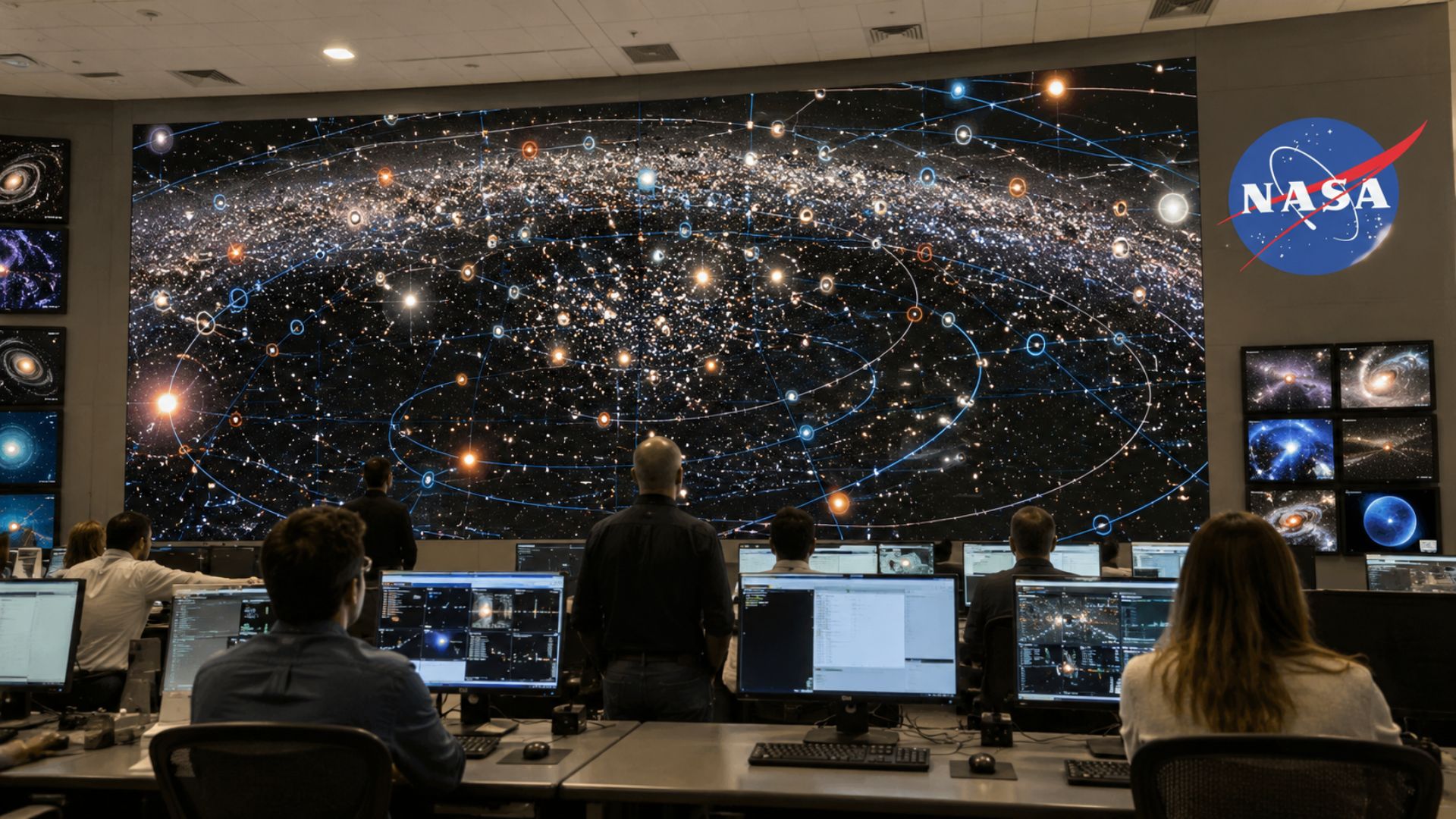


Most complete map of the TESS mission gathers almost eight years of observations and highlights thousands of possible worlds beyond the Solar System, with data that help scientists investigate planets in potentially habitable zones, cosmic collisions, and extreme environments near distant stars.
NASA released the most complete panorama ever produced by the TESS mission, gathering observations made between April 2018 and September 2025 to show the position of nearly 6,000 possible worlds outside the Solar System.
The survey includes about 700 confirmed exoplanets and thousands of candidates still undergoing scientific validation.
The map was constructed from images recorded by the space telescope over 96 sectors of the sky.
-
Sudden Sea Recession in São Paulo Sparks Tsunami Alert and Online Debate on Giant Wave Risks in Brazil

-
China Launches World’s First 307-Meter Floating Wind Platform to Supply Oil Rigs, Aiming to Cut 35,000 Tons of CO2 Annually

-
Japan Deploys Offshore Concrete Factory, Constructs Massive Caissons in 8 Days, Revolutionizing Port Construction with Industrial Efficiency

-
China Builds World’s Largest Power Grid, Generating Enough Energy to Supply 15 Times Brazil’s Needs, Surpassing the US, EU, and India Combined


Each area was observed for approximately one month, enough time for the instruments to identify small changes in the brightness of distant stars, the main clue used to locate transiting planets.
The material marks the end of the second scientific extension of the mission, concluded in September 2025, and expands the view on the diversity of known planetary systems.
The image gathers points indicating both already confirmed planets and objects that still require further analysis to be officially recognized as exoplanets.
TESS mission gathers almost eight years of sky observations
TESS, an acronym for Transiting Exoplanet Survey Satellite, was launched in April 2018 with the mission to search for planets outside the Solar System.

The satellite uses the transit method, which measures discrete drops in a star’s brightness when a planet passes in front of it.
This technique does not directly photograph the surface of these worlds, but allows their presence to be detected from the behavior of starlight.
When the drop in brightness repeats at regular intervals, scientists can calculate characteristics such as approximate size, orbit, and distance relative to the host star.
In the new mosaic released by the American space agency, the colored dots represent objects identified by the mission up to September 2025.
According to NASA, the set includes about 700 confirmed exoplanets and more than 5,000 candidates that still need to be examined by independent teams and complementary observations.
The difference between a candidate and a confirmed planet is relevant to astronomy.
Many signals may appear to be planetary transits, but they can also be caused by binary stars, natural brightness variations, or data interferences, making verification necessary before confirmation.
Transit method helps locate distant exoplanets
By monitoring large areas of the sky, TESS has managed to record indications of planets with very different characteristics from each other.
The mission identified everything from small bodies, comparable to Mercury, to giants larger than Jupiter, as well as worlds subjected to extreme environments near their stars.
Scientist Rebekah Hounsell, associated with the project at NASA’s Goddard Center, stated that the mission has become a constant source of data on exoplanets over the past eight years.

According to her, TESS has helped find planets of various sizes, including some located in zones where liquid water could exist on the surface.
The so-called habitable zone does not mean, by itself, that a planet harbors life.
The term only indicates a range of distance from the star where the temperature could allow liquid water, provided other conditions, such as atmosphere and planet composition, are also favorable.
Even so, locating these candidates is important because it guides future observations with other telescopes.
Instruments on the ground and in space can analyze some of these systems in more detail, searching for information about mass, atmosphere, and possible chemical signals associated with planetary environments.
Cosmic collisions appear in TESS mission data
In addition to possible worlds in habitable zones, TESS data also revealed scenarios marked by astronomical violence.
NASA highlighted the identification of planets destroyed or affected by the intense radiation of their stars, as well as worlds with signs associated with global-scale volcanism.
Another finding mentioned by the team involves evidence compatible with a collision between two planets.
According to the researchers, the impact would have left a cloud of debris in front of the central star of the system, producing detectable signals in the data collected by the mission.
This type of event helps scientists study processes that may have occurred in the early stages of planetary systems.
The very formation of the Moon is associated by scientific models with a major impact that occurred in the youth of the Earth, when a celestial body would have collided with the forming planet.
The comparison does not mean that the system observed by TESS is the same as the terrestrial case.
It does allow, however, the investigation of rare phenomena in other cosmic environments, offering clues about how large-scale collisions can alter the evolution of planets and natural satellites.

NASA data can still reveal new worlds
Scientist Allison Youngblood, scientific lead for the TESS project at the Goddard Center, stated that the analysis of the large volume of data continues to reveal surprises.
According to her, the use of automated algorithms has expanded the ability to find phenomena that could go unnoticed in manual inspections.
Although the mission is mainly known for the search for exoplanets, TESS has also contributed to studies on young stars, the dynamic behavior of the galaxy, and monitoring of near-Earth asteroids.
This variety occurs because the telescope records changes in brightness in large regions of the sky, capturing different types of astronomical events.
The new mosaic does not conclude the scientific work of the mission.
It organizes an important part of what has already been observed and helps researchers select targets for further studies, especially among candidates that still require confirmation.
The continuation of the analyses should expand the catalog of known worlds and refine the understanding of planetary systems outside the Solar System.
With thousands of candidates still under evaluation, TESS remains one of the main sources of data for the search for planets around other stars.