Portuguese
  Spanish


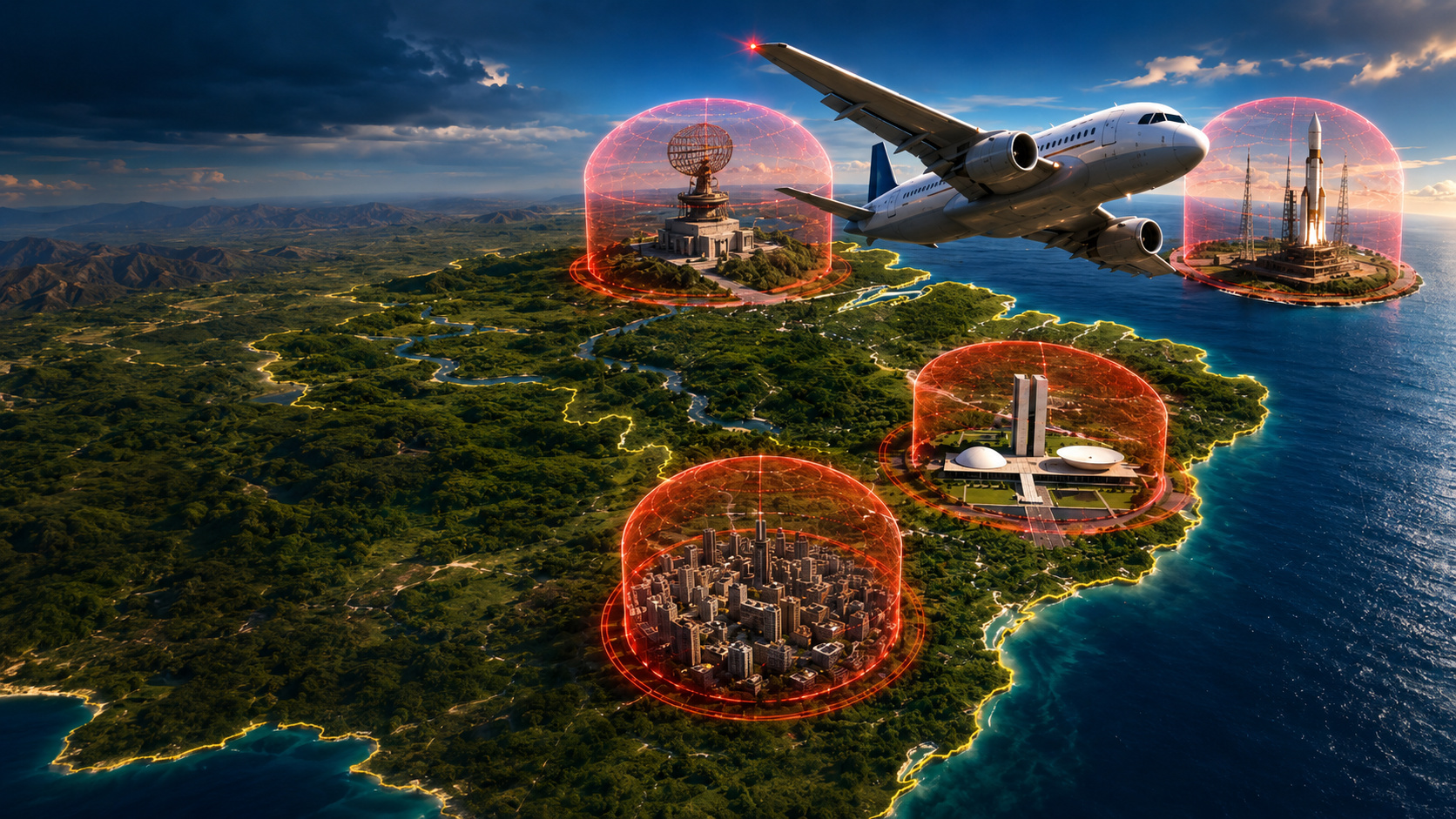

Discover the locations in Brazil where airplanes and drones face air restrictions due to military, political, and national security reasons.
Those who look at the sky might imagine that airplanes freely cross any point in Brazil, but the national airspace is divided by invisible and highly technical rules. In practice, there are prohibited, restricted, and dangerous areas, classified by AIP Brazil, the official publication of the Airspace Control Department, as zones where flight may be vetoed, authorized only under pre-established conditions, or associated with potential risks to air navigation, according to the current edition of ENR 5.1, updated on January 22, 2026.
This system is coordinated by the Brazilian Air Force, through DECEA, which reported on February 20, 2025, that it operates an integrated network of radars, control centers, communication, navigation, and surveillance systems to monitor aircraft in real-time throughout the national territory. The structure includes the CINDACTA units, responsible for air defense and traffic control in strategic regions, and allows irregular traffic to be identified, monitored, and, when necessary, subjected to aerospace defense measures by the competent authorities.
Brasília has one of the most protected airspaces in the country
The Brasília region concentrates some of the most sensitive air zones in the national territory.
-
How to Prevent Brown Recluse Spider Bites: Common Hiding Spots and Free Tips to Reduce Risks

-
Natto: The Unusual Japanese Superfood Gaining Popularity on Social Media and Driving Record Exports
-
Brazilian Mayor Goes Undercover as Homeless for 24 Hours to Assess Public Services

-
15-Year-Old Entrepreneur Malu Lira Publishes 20 Children’s Books on Financial Education, Earns $500,000, and Expands Her Project to the Amazon Rainforest




Areas near the Palácio do Planalto, National Congress, Supreme Federal Court, and Palácio da Alvorada receive reinforced monitoring.
During visits by heads of state or diplomatic events, the FAB may extend temporary restrictions. During large security operations, certain areas of the capital may have their airspace partially closed even to civilian drones. The objective is to prevent risks to the presidential and institutional security of the federal capital.
Itaipu Plant among protected strategic structures
The Itaipu Hydroelectric Plant is among the energy infrastructures considered sensitive. As it generates a significant portion of the energy consumed in Brazil and Paraguay, the region has special security protocols.
Unauthorized flights near strategic installations like Itaipu can generate operational alerts. In addition to the hydroelectric plant, other large power plants and dams also fall under the aerospace defense’s areas of attention.
Critical infrastructures are treated as strategic points for national security.
Brazilian airports have strict air restriction zones
Areas near major airports are among the most controlled locations in Brazilian airspace. Regions around airports such as Guarulhos International Airport, Santos Dumont Airport, and Brasília International Airport have strict rules for drones and small aircraft.
These restrictions exist primarily to prevent collisions during landings and takeoffs. According to DECEA, drones cannot operate in these regions without specific authorization. Even small recreational equipment can pose a serious risk to commercial aircraft.
Military air bases have reinforced protection
FAB military installations are also among the locations with the most rigorous air control. The Anápolis Air Base, where Gripen fighters and strategic defense systems operate, is one of the most important examples.
Other sensitive installations include the Natal Air Base and the Santa Cruz Air Base. These areas may have permanent or temporary restrictions depending on ongoing military operations.
Airspace control is part of the strategic defense of these installations.
Amazon concentrates zones monitored by aerospace defense
The Amazon region plays a central role in Brazilian air surveillance. Areas near the borders of Legal Amazon receive constant monitoring to combat illegal air traffic, clandestine mining, and transnational crimes.
Integrated centers like the CINDACTAs use radars and surveillance systems to track suspicious flights.
Regions near military bases and strategic corridors may experience specific restrictions during certain operations. Part of the Amazon functions as one of the most sensitive air areas from a strategic and military point of view.
International events create temporary “bubbles” of air exclusion
Large international events often temporarily transform certain Brazilian cities into reinforced control zones.


During **COP30** in Belém, for example, the **FAB created areas classified as white, yellow, red, and suppression to limit drone and aircraft flights.** In some of these zones, no aircraft could enter without special authorization.
Similar measures have already occurred during Olympics, G20 meetings, and international presidential visits. **These temporary “invisible shields” transform parts of the sky into areas controlled by air defense.**
Fernando de Noronha has special air rules
The Fernando de Noronha archipelago has specific rules related to both environmental preservation and air operations.
The region is subject to strict control due to the airport’s small size, environmental protection, and operational limitations. Additionally, drones also face specific rules due to their proximity to protected areas.
Not all air restrictions involve military defense; some exist for environmental and operational reasons.
Drones drastically increased the number of restricted areas
The explosive growth in drone use has completely changed the civil aviation landscape. Today, operators need to consult specific maps before flying.
According to DECEA, drones face limitations near airports, strategic installations, military areas, and public security regions.
Even small equipment can be barred in certain urban zones. **The Brazilian sky has become much more regulated with the popularization of unmanned aircraft.**
FAB can intercept aircraft in extreme situations
Brazil has air defense protocols for situations considered suspicious. Unidentified aircraft, clandestine flights, or invasions of critical areas can trigger the deployment of FAB fighters.
The country uses radar systems and integrated centers to monitor air traffic in real time. Depending on the perceived threat, military aircraft can perform visual interception and demand a change of route. **Much of this system operates silently and remains invisible to those on the ground.**

Unlike land borders, there are no signs or physical barriers indicating these areas. Everything operates through aeronautical charts, radars, GPS, and digital control systems. Nevertheless, pilots and drone operators must strictly respect these zones.
Brazil has a true invisible map in the sky, where some regions can be instantly closed for military, political, energy, or operational reasons.
Given this surveillance and control system, do you believe that Brazilian airspace will become even more restricted in the coming years with the advancement of drones and digital security, or will the sky remain one of the most difficult areas to control completely?