Portuguese
  Spanish


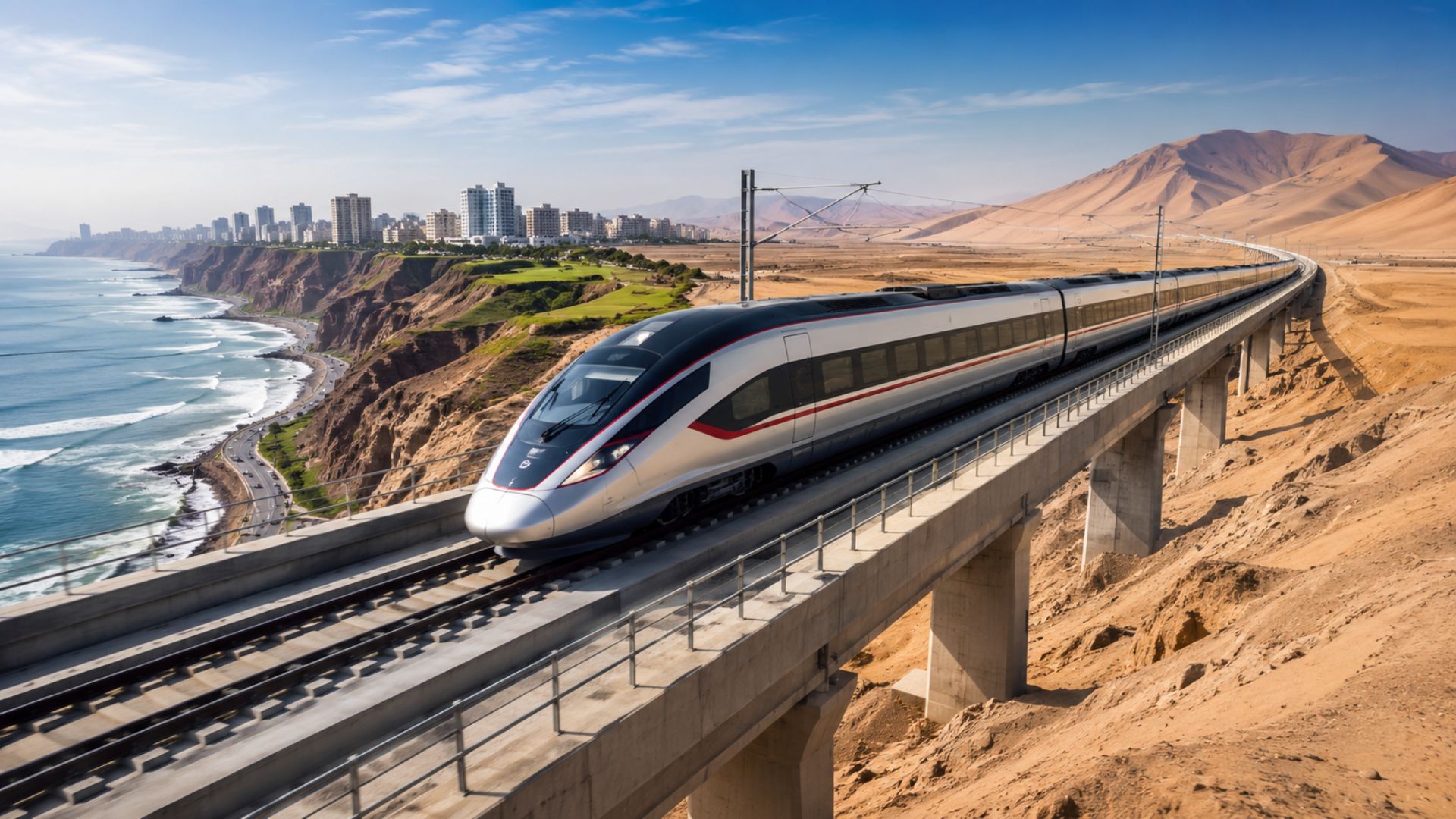

Beware of headlines claiming the train has already been inaugurated: nothing has been built yet. The project is in the planning phase, with the technical study scheduled for 2027 and construction estimated to take six to seven years. Only once completed would it dethrone the Chilean train, currently the fastest in the region.
Peru plans to build, with Chinese technology and capital, what aims to be the fastest train in South America: a high-speed line between Lima and Ica that should reach up to 200 km/h. It is important to clarify from the outset, however, that this train does not yet exist and is not in operation, contrary to what some headlines suggest: it is a project whose construction, budgeted at US$ 6.5 billion, is only expected to be completed around 2032.
The clarification is necessary because several publications incorrectly stated that the train had been “inaugurated” or “launched.” It has not. According to Peru’s Ministry of Transport and Communications, the MTC, and Infrastructure Management Director David Miranda, the technical dossier is only expected to be completed in 2027, execution will take six to seven years, and operation is scheduled only for 2032, possibly slipping to 2033. Construction itself has not even started yet.
What the Lima-Ica train will be

The future railway will connect Lima to Ica along approximately 280 to 323 kilometers of the central Peruvian coast, with 15 stations, passing through cities such as Villa El Salvador, Cañete, Chincha, Pisco, and Paracas, and will reduce travel time from the current four and a half hours by car to about two and a half hours, with an express route of up to one hour and forty-five minutes.
-
Brazil’s First Freight Railway Built from Scratch, EF-118 Connecting Espírito Santo to Rio de Janeiro, Goes to Auction in October Attracting Chinese Giant in Multi-Billion Dollar Bid for Southeast Rail Network

-
Trans-Siberian Railway’s New Sister Line, BAM, Stretches 4,300 km Through Permafrost and Seismic Zones in Northern Russia

-
180-Year-Old Bridge Disappears from Brazilian Farm, Found 180km Away, Sparks Investigation into Illegal Sale of Historical Heritage
-
Brazil’s Defunct Railway Network Leaves Over 100,000 Properties Abandoned for Nearly 30 Years, Facing Neglect and Safety Risks as Government Struggles to Regulate Assets Amid Degraded Stations and Unlawful Use





Designed to run at up to 200 km/h for passenger transport, the train is expected to carry between 40,000 and 45,000 people per day and benefit about 12 million inhabitants, according to the MTC. The project includes 47 kilometers of viaducts and 32 kilometers of tunnels to overcome the geographical challenges of the terrain, as well as a connection with Lima Metro Line 1 and better access to Pisco Airport.
The correction that changes everything: it’s still just a project
This is the point that deserves all the attention and that separates correct information from exaggeration. There is no bullet train in operation in Peru. What exists is a project in the planning phase, and saying that it “is in operation” or that it “is” the fastest in South America, at present, is misinformation. The correct approach is to treat everything in the future, as a promise that depends on several stages not yet completed.
As David Miranda explained to Agencia Andina, the execution of a project like this takes six to seven years, with the technical study scheduled for 2027 and the construction for 2032. The Minister of Transport, Raúl Pérez Reyes, indicated that construction would begin in 2026, with completion estimated between 2031 and 2032, always conditioned on the closure of the technical dossier. In other words, it is a long-term plan subject to delays, as often happens with large infrastructure projects.
The title of fastest would only come in 2032
The title of the fastest train in South America also needs temporal context. The Lima-Ica train would only become the fastest in the region when it is ready, around 2032, surpassing the current holder of the title, the Chilean train that connects Santiago to Chillán and operates at a maximum of 160 km/h. Today, therefore, the fastest train in operation in South America is the one in Chile, not the Peruvian one, which is still on paper.
This distinction is important to avoid selling a reality that has not yet arrived. Peru has the ambition to lead, and the project indeed has the potential for that, but claiming that the country already has the fastest train on the continent would be misleading the reader. The race for this title on the continent remains open and will depend on who actually delivers and puts their high-speed trains into operation first.
The strong presence of China
One of the most strategic aspects of the project is the Chinese participation. China, through the state-owned China Railway, leads the financing and technology negotiations, within its Belt and Road Initiative, the ambitious infrastructure program with which Beijing expands its influence around the world. The negotiation model adopted is the so-called G2G, government to government.
Even so, the competition is not entirely closed. Peru reported having received non-binding technical proposals from eight other countries, including Germany, Canada, South Korea, Spain, France, India, Japan, and the United Kingdom, in addition to the interest from the Inter-American Development Bank. The project also connects to a broader strategy, that of the bioceanic railway corridor, linked to the newly inaugurated port of Chancay, also with strong Chinese capital, which reinforces China’s weight in South America’s logistical infrastructure.
A 100% electric train and its impacts
Sustainability is one of the central arguments of the project. The Lima-Ica train will operate exclusively on electricity, which, according to its creators, will help reduce the emission of polluting gases and alleviate road congestion, aligning with global efforts to transition to cleaner energy.
Besides the environmental gain, the railway is expected to boost tourism in famous destinations in the Ica region, such as the Huacachina oasis, the Ballestas Islands, the Paracas National Reserve, and local wineries, as well as strengthen the agro-industry and the flow of production to the capital. The promise is to generate jobs and stimulate the economy along the entire route, although all these benefits, it is worth repeating, depend on the project coming to fruition.
The mirror with Brazil
For the Brazilian reader, the Peruvian case serves as an interesting mirror. Brazil has also dreamed for decades of a high-speed train, especially the famous connection between Rio de Janeiro and São Paulo, a project that has been announced, postponed, and relaunched numerous times without coming to fruition, hindered by billion-dollar costs and financing obstacles.
Following how Peru attempts to make its bullet train viable, with strong Chinese support, and what challenges it faces along the way helps to understand the obstacles surrounding this type of mega-project in Latin America. The increasing presence of China in financing infrastructure in the region is, in fact, a topic that Brazil closely monitors, given the weight of these investments in ports, railways, and energy across the continent.
The high-speed train project between Lima and Ica is undoubtedly ambitious and could transform mobility in Peru, with the potential to become the fastest in South America. But it is essential to see what it really is at this moment: a plan in the study phase, with construction expected to be completed only around 2032 and still dependent on financing and technical stages. Between the announcement and the tracks, there is a long way to go, and the best thing to do is to follow the progress with enthusiasm, but also with a grounded perspective.
And you, do you believe that Peru will manage to bring the fastest train in South America to fruition by 2032? Would you like Brazil to also invest in high-speed trains like this? Leave your comment, share your opinion on the future of railway transportation in the region, and share the article with those interested in infrastructure, trains, and major projects.