Portuguese
  Spanish


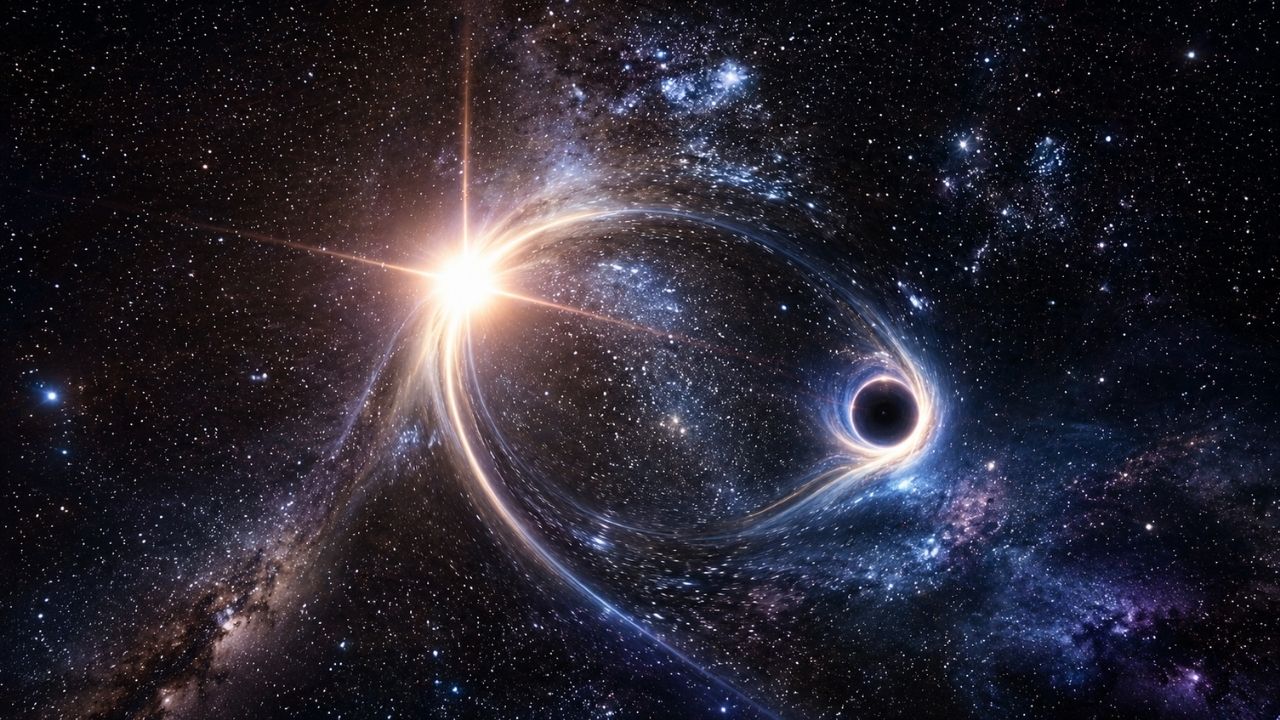

Event recorded in 2019 in the Large Magellanic Cloud may have been caused by a primordial black hole: researchers analyzed the gravitational microlens, calculated mass equivalent to three moons, and considered the scenario linked to dark matter more likely, without definitively confirming the nature of the black hole called Phoebe.
A possible primordial black hole with a mass equivalent to approximately three moons may have caused the brightness increase recorded in a star observed in the direction of the Large Magellanic Cloud. The phenomenon occurred on December 18, 2019, and was identified in data from the Dark Energy Camera, installed on the Víctor M. Blanco telescope at the Cerro Tololo Inter-American Observatory in Chile.
According to the Spanish portal Xataka, the invisible object was nicknamed Phoebe and returned to the spotlight in May 2026, after researchers presented an analysis of the episode. The study treats the gravitational microlens as a possible sign of an object linked to dark matter, with a probability about 100,000 times greater than scenarios associated with modeled stellar populations, without stating that the black hole was confirmed.
Brightness observed in the Large Magellanic Cloud raised a rare hypothesis

The observation began with an unusual variation in the brightness of a star in the direction of the Large Magellanic Cloud. Instead of a sudden explosion, researchers identified a gradual increase followed by an approximately symmetrical reduction, a pattern compatible with the passage of a compact object in front of the light source.
-
She spent 73 years breathing inside an iron lung, survived the aftereffects of polio, and became the last woman in the United States dependent on the equipment before dying at 78 years old.

-
Brazilian students created a $1 filter using pine bark, cotton, and 3D-printed parts to clean cassava wastewater, reduce the toxicity of a hazardous waste, and transform contaminated water into biofertilizer.

-
Astronaut from Artemis II steps down after mission to the Moon and decision surprises after a record of 406,771 km, a historic 10-day journey, and an unprecedented achievement for Canada.

-
A fossil kept for years in a small museum in Montreal concealed 450-million-year-old soft tissue, a discovery that has only happened once before in history.


The episode lasted about 60 minutes, a short interval in astronomical terms. The duration helped scientists estimate that the object could have very low mass and opened up the possibility of a primordial black hole, a theoretical category of body formed in the early stages of the universe.
Gravitational microlensing allows detection of what does not emit light
Gravitational microlensing occurs when a massive object passes through the alignment between Earth and a distant star. The gravity of this body bends the path of light and temporarily increases the brightness of the background source, even when the object itself remains invisible.
In the case of Phoebe, the gravitational microlensing was recorded in data obtained from high-frequency observations. The possible black hole would not have emitted the perceived light: it would have magnified the brightness of a star located in the direction of the Large Magellanic Cloud for approximately one hour.
Mass of three moons does not correspond to a common stellar black hole

The calculations presented in the study indicate an approximate mass of 0.032 times the mass of Earth, equivalent to about three moons. This estimate is too small for a conventional black hole formed from the collapse of a massive star, which is usually associated with much larger masses.
For this reason, if Phoebe is indeed a black hole, the favored interpretation is that of a primordial black hole. These hypothetical objects would have formed in dense regions of the early universe and could exist in much smaller mass ranges than those observed in stellar-origin black holes.
Dark matter appears as the most likely scenario in the study
Dark matter is not observed directly, but its gravitational effects are essential to explain the behavior of galaxies and cosmic structures. One hypothesis investigated in astrophysics is that part of dark matter could be composed of primordial black holes, still without conclusive demonstration.
When comparing scenarios, the authors calculated that Phoebe would be more than 100,000 times more likely as an object belonging to the dark matter halo than to the modeled stellar populations of the Milky Way and the Large Magellanic Cloud. The difference is significant, but it does not equate to the definitive identification of the object.
Candidate for primordial black hole still depends on new detections

The hypothesis of a primordial black hole depends on the repetition of similar signals. A single gravitational microlens can point to the presence of a compact object, but it does not allow for determining the composition of dark matter on its own nor completely eliminating alternatives like rogue planets.
The search for new events will need to observe areas rich in stars and sensitive to the distribution of dark matter, including fields in the direction of the Large Magellanic Cloud. Observatories capable of capturing rapid changes in brightness could reveal whether Phoebe was an isolated case or part of an invisible population.
Discovery may open a window to the first moments of the universe
If Phoebe is confirmed as a primordial black hole, the discovery could provide clues about conditions existing before the formation of the first stars. Such a lightweight object would also expand the catalog of compact phenomena capable of interfering with light without being seen directly.
For now, the recorded gravitational microlens remains an indirect piece of evidence. The study strengthens the possible relationship between a low-mass black hole and dark matter, but scientific confirmation will require new events, independent analyses, and compatible patterns in future observations.
If a gravitational microlens of just one hour can help explain one of the greatest mysteries of the cosmos, the discovery will have historical reach. Do you believe this black hole could be a real clue about dark matter or does the interpretation still require caution? Leave your opinion in the comments.