Portuguese
  Spanish


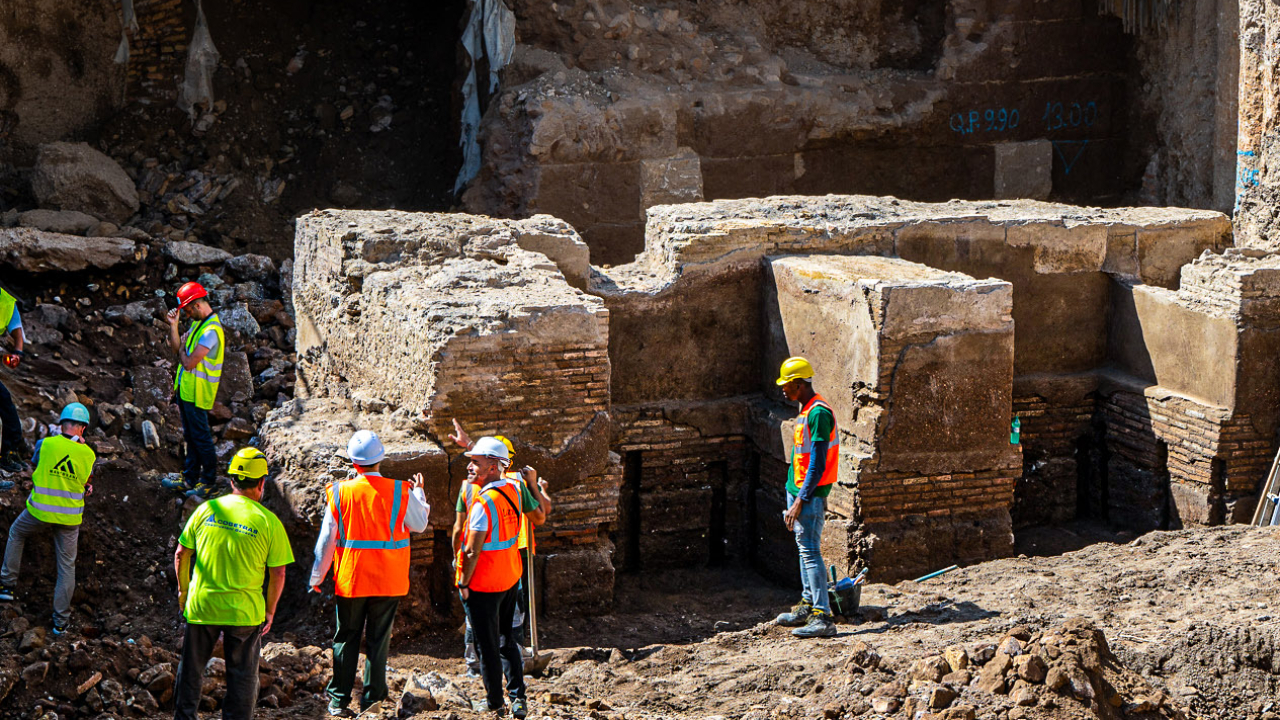

Jubilee works in Rome revealed a monumental garden linked to Caligula at Piazza Pia, near the Vatican, identified by a lead pipe.
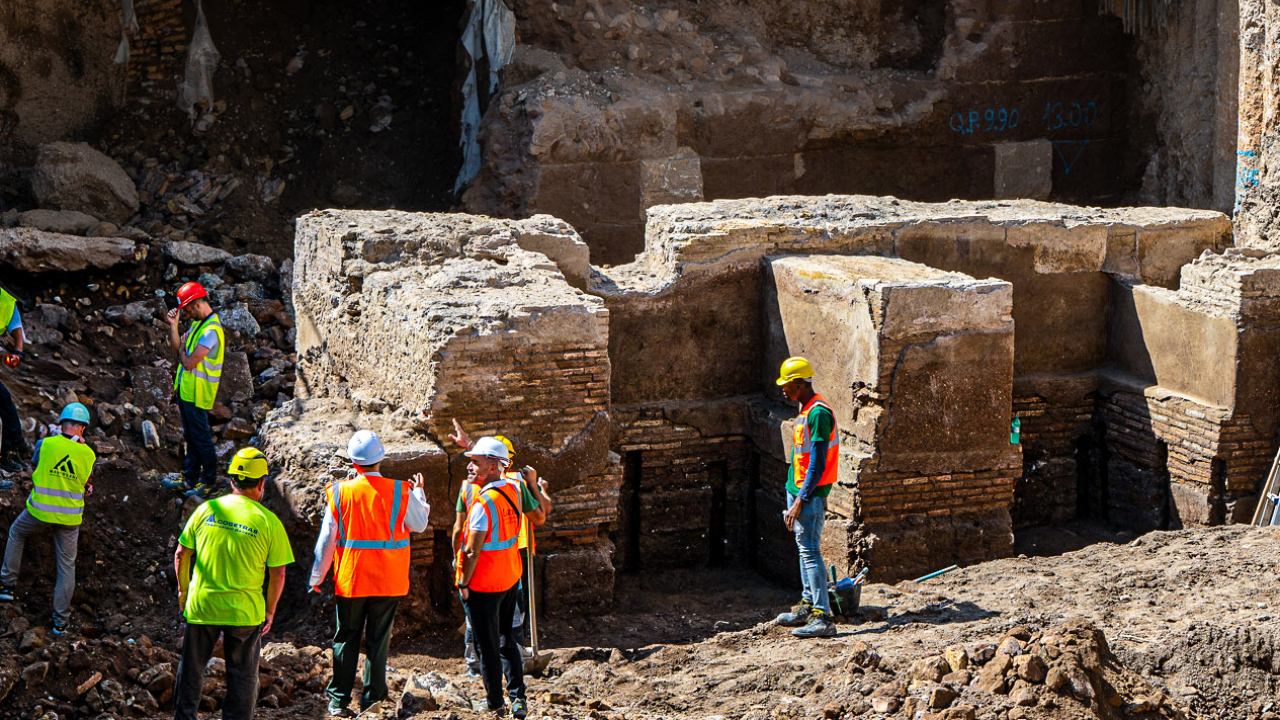
The redevelopment works of Piazza Pia in Rome, prepared for the Jubilee of 2025, brought to light the remains of a monumental garden from the Julio-Claudian era on the right bank of the Tiber River, in an area close to the Vatican. At the site, archaeologists identified a travertine wall, the foundations of a columned portico, and a large open area organized as a garden.
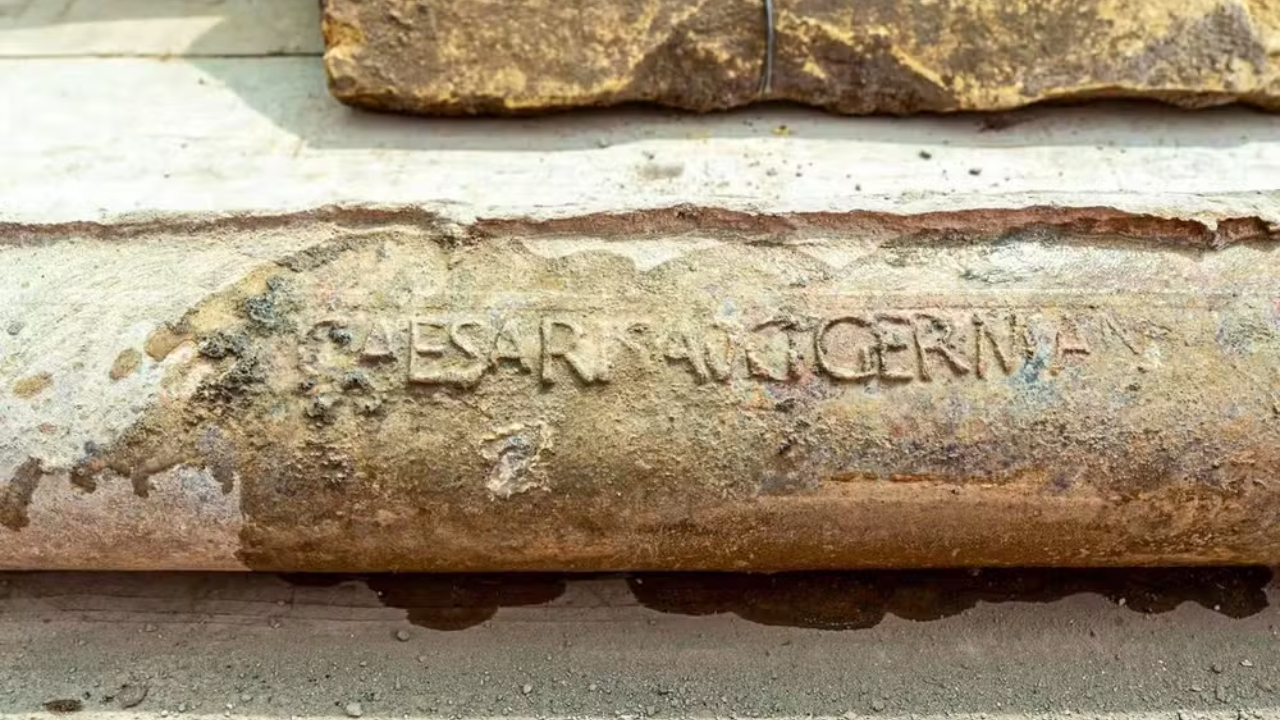
The discovery gained historical significance due to a much less imposing find than the architectural ensemble: a lead pipe with the inscription “C(ai) Cæsaris Aug(usti) Germanici”, the official name of Caligula, the Roman emperor who ruled between 37 and 41 AD. The inscription allowed the space to be linked to the imperial circle and reinforced the identification of the area as part of the Horti of Agrippina.
Monumental garden discovered at Piazza Pia puts Caligula back at the center of Rome’s archaeology
The Italian Ministry of Culture reported that the find appeared during stratigraphic excavation and delocalization work of a fullonica, an ancient Roman facility related to fabric treatment, at the site of the new underground of Piazza Pia. It was in this process that the remains of the garden directly facing the Tiber bank emerged.
-
Workers renovating a playground in northern England uncover 176 World War II bombs buried underground; training artifacts still contained explosives.

-
Brazilian Architect Transforms Waste into Sustainable Homes with Solar Power and Rainwater Systems for 40 Years

-
Security Guard Becomes Doctor at Louisiana Hospital Where He Once Worked, Studied Chemistry Between Shifts

-
Woman Rescued from Luxury Complex in Brazil Worked Without Pay for 55 Years, May Be Entitled to Over $300,000




The official description indicates that the structure was composed of a travertine wall that acted as a containment for the riverbank, followed by a columned portico now preserved only in the foundations, as well as a large open surface organized as a garden area. The ensemble was dated in phases ranging from the time of Augustus to Nero.
The context of the work also helps to dimension the discovery. Piazza Pia is part of a large pedestrianization and road reorganization project linked to the Jubilee, created to better connect the area of Castel Sant’Angelo, the Via della Conciliazione, and the region of Saint Peter.
Lead pipe with the name of Gaius Caesar Augustus Germanicus was the decisive piece for identification
The element that allowed the garden to be associated with Caligula was a fistula plumbea, the lead hydraulic pipe used for water supply in ancient Rome. According to the Italian ministry, these pipes could bear the name of the water supply holder, which makes them direct evidence of ownership or use of the property.


The inscription found at Piazza Pia bore the abbreviated form of Gaius Caesar Augustus Germanicus, officially identified as a reference to Caligula, son of Germanicus and Agrippina Major. This detail moved the find from the realm of generic hypothesis to the field of concrete historical attribution.
The significance of the object lies precisely in the contrast between appearance and historical value. It was not a monumental statue or a facade inscription that revealed the owner of the space, but a technical component of the hydraulic infrastructure, preserved underground and capable of directly linking the excavated area to the emperor.
Horti of Agrippina and the imperial succession help explain how the garden came to Caligula
The ministry also highlighted that ancient excavations carried out in the same area, at the beginning of the 20th century, had already found other lead pipes with the name of Iulia Augusta, generally associated with Livia Drusilla, wife of Augustus and grandmother of Germanicus. This set of evidence helped reconstruct the possible line of transmission of the property within the imperial family.
The hypothesis presented by archaeologists is that the residence first passed to Germanicus, then to Agrippina Major, and finally to the couple’s son, Caligula. This reinforces the interpretation that the area of Piazza Pia was part of the so-called Horti of Agrippina, a noble zone on the banks of the Tiber linked to the Julio-Claudian dynasty.
In addition to the garden structure and the inscribed piping, the excavation also recovered Lastre Campana, figured terracottas used in coverings, with unusual mythological scenes. According to the ministry, these pieces may have originally belonged to some structure of the garden itself, possibly the portico.
Philo of Alexandria’s Account Reinforces the Connection Between the Tiber Garden and a Historical Scene from the 1st Century
The archaeological identification gained even more strength by dialoguing with a literary source from Antiquity. The Italian Ministry of Culture stated that the discovery finds a parallel in a passage from Legatio ad Gaium, by Philo of Alexandria, which describes Caligula receiving a delegation of Alexandrian Jews in the Horti of Agrippina, in a vast garden facing the Tiber and separated from the river by a monumental portico.
The similarity between the ancient text and the remains found in Piazza Pia was pointed out as one of the main arguments for associating the location with the scene described by Philo. The meeting between literary account and material evidence strengthens the value of the discovery because it brings archaeology closer to a datable historical episode from the 1st century AD.

This transforms the find into something greater than a simple excavated garden. The area is now read as a space of political representation and circulation of power, linked to the presence of an emperor and a diplomatic audience recorded by a contemporary witness.
Jubilee 2025 Works Show How Rome Continues to Reveal Unprecedented Layers of the Ancient City
The discovery occurred in an especially sensitive point of the Italian capital, where large urban interventions need to coexist with a subsoil loaded with ancient structures.
The fullonica itself found before the garden had already demonstrated the archaeological potential of the site, and the remains of this installation should be preserved and displayed in the area near Castel Sant’Angelo.
According to Wanted in Rome, the Rome city council maintained at the time that the discoveries would not compromise the project schedule, expected to be completed by December 2024 before the opening of the Jubilee. The case became another example of how infrastructure projects in Rome often end up also becoming fronts for archaeological research.
In the end, the finding at Piazza Pia reinforces a central characteristic of Rome: the past remains embedded in the urban fabric and reappears whenever the modern city advances a few meters underground. This time, what emerged was not just an ancient structure, but a concrete piece of the imperial environment linked to Caligula, the Tiber, and the political topography of the empire’s capital.