Portuguese
  Spanish


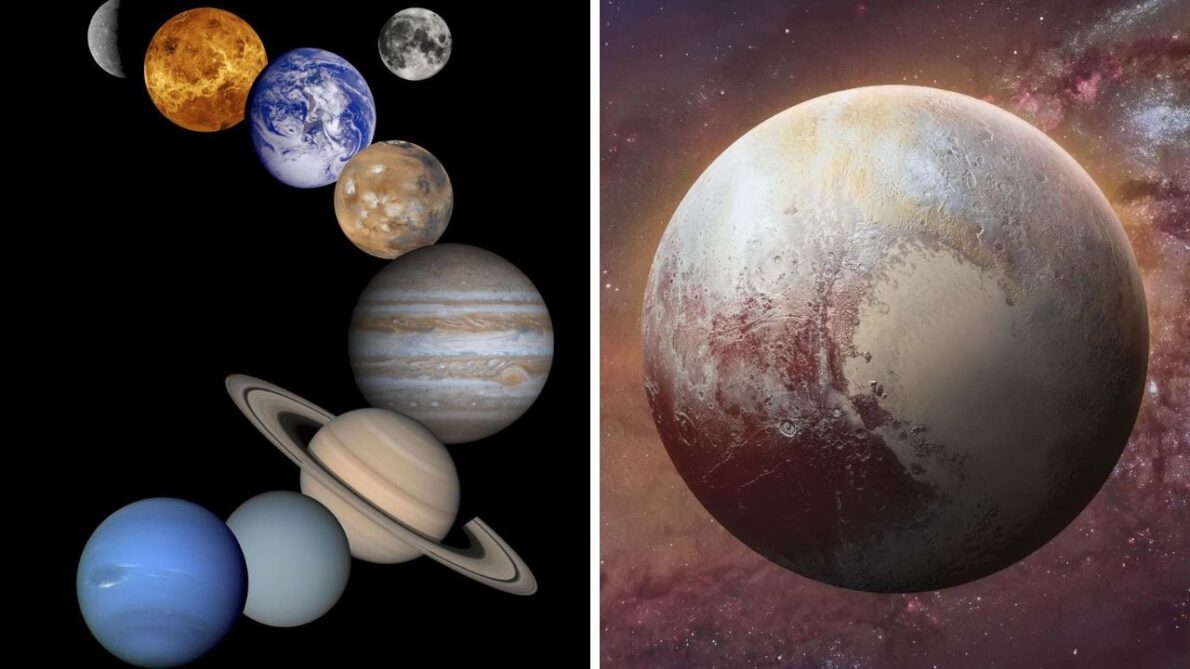


On August 24, 2006, Pluto Was No Longer Considered a Planet, Generating Debates That Continue to This Day.
On August 24, 2006, the International Astronomical Union (IAU) made a decision that shook the world of astronomy and touched the hearts of many enthusiasts: Pluto, until then the ninth and most distant planet of the Solar System, was reclassified as a dwarf planet. This change, which still sparks intense discussions, made it clear that the definition of a planet is not as simple as it seems.
Exactly 18 years ago, the IAU, an organization that brings together astronomers from around the world, decided that Pluto could no longer be considered a planet. The decision was based on a new definition: to be classified as a planet, a celestial body must, among other criteria, have “cleared” its orbit around the Sun, meaning it must be the dominant body in its orbital path. In Pluto’s case, it shares its orbit with other objects in the Kuiper Belt, which disqualified it from this title.
Pluto Was Reclassified
The decision to reclassify Pluto caused global outrage and surprise. For many, Pluto has always been the “little big” planet of our solar system, a kind of outsider with a unique and fascinating trajectory. The new classification as a dwarf planet, however, placed Pluto in a category with four other confirmed dwarf planets, located in the outskirts of the solar system.
-
Artist’s 15-Meter Lighthouse in the Mojave Desert, 160 km from the Sea, Intrigues Visitors with 19 km Range After Years of Bureaucracy

-
Bluetti AC70 Solar-Powered Station: Powers Fridge and Wi-Fi During Blackouts, Delivers 1,000W, 3,000 Charge Cycles, Priced at $900

-
Enormous Black Hole Phoenix A* Challenges Scientific Understanding with Mass of 100 Billion Suns, Surpassing Famous TON 618 in One of the Largest Known Galaxy Clusters
-
Say Goodbye to Storing Wine in a Regular Fridge: Midea’s Climate-Controlled Cellar Holds 34 Bottles, Maintains 5-18°C, and Uses Only Half a kWh Daily


A Planet…
Astronomers who supported the decision argue that it was necessary to establish clear criteria to define what a planet is, especially with the discovery of several bodies similar to Pluto in the region beyond Neptune. If Pluto were to continue being considered a planet, similar objects would also have to be included in the list, which would considerably increase the number of planets in our solar system.
Dwarf Planet Was Discovered in 1930
On the other hand, the general public, as well as some astronomers, have difficulty accepting this change. Pluto, discovered in 1930, held a special place in people’s minds, mainly because of its solitary and mysterious position on the outskirts of the solar system. Since the reclassification, campaigns and movements have emerged in defense of Pluto, demanding that it regain its status as a planet.
Its Reclassification Did Not Diminish Its Importance
While the debate continues, Pluto solidifies as the “king of dwarf planets.” Its reclassification did not diminish its importance in the study of the solar system; on the contrary, it has become a symbol of resistance and mystery. Pluto, the planet that is no longer a planet, continues to inspire fascination and curiosity, proving that, in the cosmos, definitions can be as vast and complex as the universe itself.
Even after 18 years, Pluto’s reclassification continues to provoke heated discussions among both scientists and the general public. Pluto’s story teaches us that science is in constant evolution, and that our conceptions of the universe may change as we discover more about it. And, who knows, in the not-so-distant future, Pluto may reclaim the title of planet, or perhaps completely redefine what we understand by planet.
What do you think about the decision to reclassify Pluto? Do you believe it should return to being a planet or do you agree with the current classification? Comment below and share your opinion!