Portuguese
  Spanish


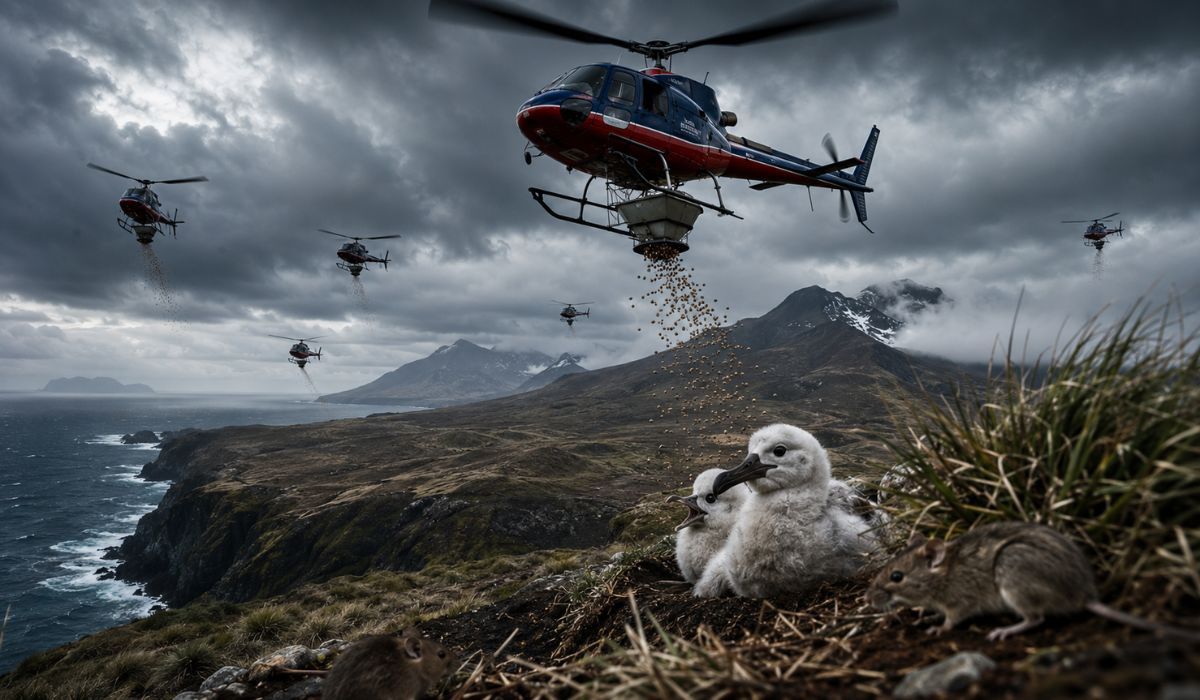

On Marion Island, invasive mice have started attacking live seabirds, leading conservationists to plan an aerial operation with baits, helicopters, and high environmental control.
A subantarctic island managed by South Africa is the target of a large-scale eradication project to remove all mice from Marion Island and reduce the pressure on albatrosses, petrels, penguins, and other seabirds that breed there.
The original plan involves the use of up to six helicopters and hundreds of tons of rodenticide bait, but project updates indicate that the main operation still depends on funding, testing, and authorizations.
The action is conducted by the Mouse-Free Marion project, a partnership between BirdLife South Africa and the Department of Forestry, Fisheries, and the Environment of South Africa.
-
Russia Unveils Poseidon: A 20-Meter Nuclear Torpedo-Drone with 10,000 km Range, 185 km/h Speed, and 100-Ton Capacity Threatening Coastal Cities with Radioactive Waves

-
Brazilian Innovator Converts Old Car into Electric Vehicle Using Laptop Batteries and Forklift Motor, Achieves Nearly 90 km/h in Urban Settings

-
Samsung Unveils Smart Oven with Built-In Camera, AI Food Recognition, and Real-Time Monitoring via Smartphone.
-
Ocean Transformed into Sci-Fi Lab: 87-Meter Structure with Submarines, Deep-Sea Robots, Helicopter, Genetic Labs, and 8K Cameras Unveils Rare Creatures




The island is a special nature reserve, hosts a meteorological and research station, and has no permanent population.
In February 2026, the project reported receiving a donation pledge of US$ 10 million from an international foundation based in Switzerland.
With this financial commitment, the initiative stated it had reached about 60% of the necessary goal to proceed with the next steps.
Before complete eradication, an aerial test is planned between April and May 2027, in an area of approximately 1,000 hectares of Marion Island.
According to a statement published by the Agreement on the Conservation of Albatrosses and Petrels, this phase should use a helicopter and evaluate strategy, equipment, and logistics in conditions considered difficult by the organizers.
Invasive mice on Marion Island
Marion Island is located in the southern Indian Ocean, about 1,900 kilometers from Cape Town, in a cold, wet, and isolated region near Antarctica.
For a long time, this isolation favored the reproduction of seabirds without the presence of terrestrial mammalian predators.
The arrival of the mice occurred in the early 19th century, accidentally, on ships used by seal hunters.
Without sufficient natural predators and faced with birds that had not developed defenses against this type of threat, the rodents spread across the island.
The aspect that draws attention in this case is the behavior recorded in recent decades.
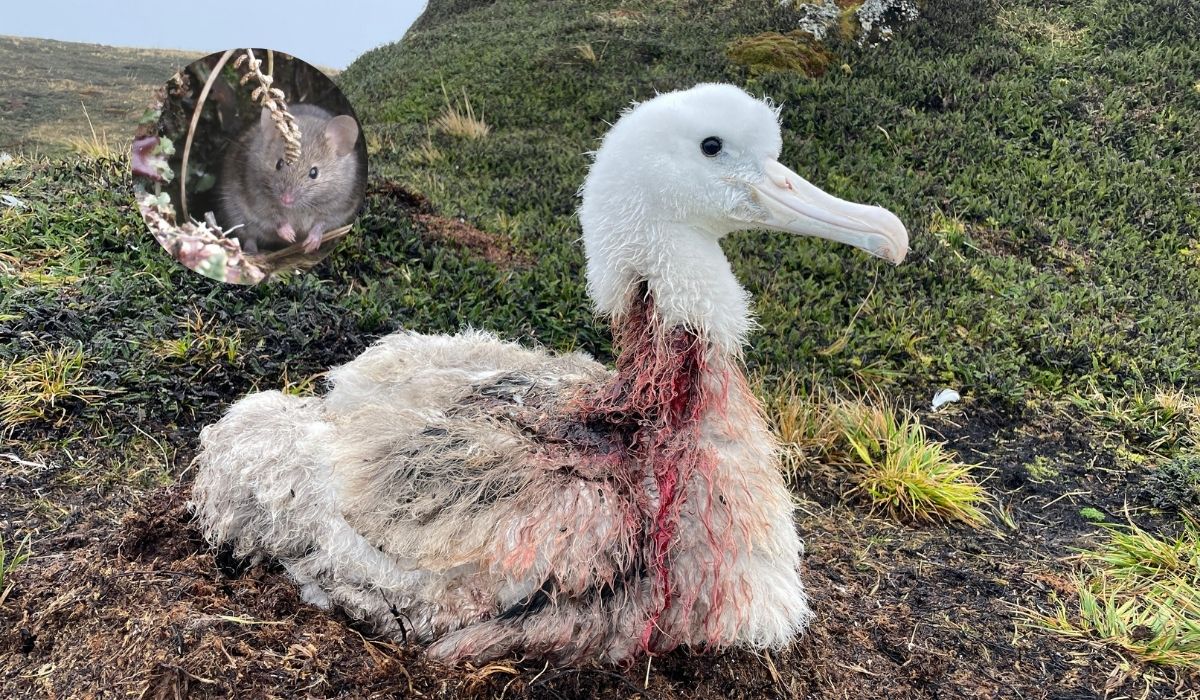
The mice have started to attack live birds, including chicks and adults, in a phenomenon documented by researchers and conservationists in a few places around the world.
Conservation records show rodents feeding on the heads of albatross chicks.
According to the Associated Press, estimates indicated more than a million mice on Marion Island, feeding on invertebrates, seeds, and increasingly on seabirds in nests.
Warming and accelerated reproduction
The growth of the mouse population is also associated with climate change.
Anton Wolfaardt, manager of the Mouse-Free Marion project, told the Associated Press that higher temperatures have made the island less cold, drier, and more favorable for rodent reproduction.
“They are probably one of the most successful animals in the world. They have reached all kinds of places,” said Wolfaardt. Commenting on the situation on Marion Island, he stated that “their breeding season has been extended, and this has resulted in a huge increase in mouse density.”
The reproductive capacity of mice helps explain the speed of their advance.
These animals can start reproducing around 60 days of age, while females can have several litters a year, with seven or eight pups in each.
On an island without permanent residents, with available food and few natural obstacles, this accelerated reproduction turns an accidental introduction into a persistent ecological threat.
For conservationists, the impact has become more visible as attacks on birds have been recorded more frequently.
Albatrosses and defenseless seabirds
Albatrosses and petrels of Marion Island evolved in an environment where they did not need to protect themselves from small mammals attacking their nests at night.
Therefore, according to researchers interviewed by the Associated Press, many chicks remain in place even when they start being bitten by mice.
The situation worries specialists because many seabirds have a slow reproductive cycle.
Albatrosses, for example, take years to reach sexual maturity and usually produce few offspring throughout their lives.
Continuous loss of offspring can affect populations for decades, according to conservation assessments.
The Mouse-Free Marion project states that 19 of the 29 bird species that breed on the island could disappear locally if the mice are not eradicated.
The importance of Marion Island is linked to the island’s role as a breeding area.
Together with neighboring Prince Edward Island, it forms a remote territory used by birds that spend much of their lives at sea and rely on protected islands for nesting.
Operation with helicopters and baits
The eradication strategy involves distributing bait with rodenticide throughout the island.
The goal is to cover all areas occupied by mice, as the survival of a single pregnant female could compromise the operation, according to the project managers.
In the plan described by the Associated Press, four to six helicopters would be used to drop up to 550 tons of bait.
Pilots would follow defined routes while the team would monitor the distribution through GPS mapping.
Subsequent updates indicate that the project has started working on preparatory stages before the main operation.
The aerial test scheduled for 2027 does not correspond to complete eradication but will serve to evaluate equipment, flight routes, logistical coordination, and the method’s response on Marion Island’s terrain.
This care is related to the island’s characteristics.
Marion has about 30,000 hectares, irregular terrain, unstable climate, and remote location, factors that increase operational difficulty and reduce the margin for coverage failures.
According to the South African National Antarctic Program, feasibility studies have identified aerial distribution of bait by GPS-guided helicopters as the recommended method for an island with Marion’s size and topography.
Why poison was included in the plan
The proposal to drop tons of toxic bait in a nature reserve requires caution and environmental control.
According to the project managers, the intervention aims to remove an invasive species introduced by human action and reduce damage to native species.
Wolfaardt told the Associated Press that there is no “perfect solution” in this type of situation.
“There is nothing that simply eliminates mice and nothing else,” he said.
According to the project manager, the bait was designed not to affect the soil or the island’s water sources.
The initiative also states that seabirds, since they feed at sea, should not be the main group directly affected, although organizers acknowledge that some animals may suffer individual impacts.
The Department of Forestry, Fisheries and the Environment of South Africa stated, according to the AP, that the eradication of mice is “essential if the island’s unique biodiversity is to be preserved.”


The previous mistake with cats on the island
Marion Island has already undergone a biological control attempt that resulted in a new ecological imbalance.
In the 1940s, domestic cats were introduced to reduce the presence of mice near the scientific base.
The measure created another problem.
In the 1970s, there were about 2,000 feral cats on the island, associated with the death of hundreds of thousands of seabirds per year, according to reports gathered by the Associated Press.
The elimination of the cats took years and included the introduction of a feline flu virus and hunting of the surviving animals.
The population was removed in the early 1990s, but the mice remained and continued to spread across the island.
This history helps explain the level of planning for the current project.
In isolated ecosystems, the arrival of invasive species can alter entire ecological chains, and attempts to correct without proper control can produce new impacts.
Avian flu and new environmental pressures
In addition to the mice, Marion Island also began to face concern with avian flu.
In March 2025, the South African government confirmed highly pathogenic avian influenza on the island, with deaths recorded among seabirds, including wandering albatross chicks.
The confirmation added another pressure factor on birds that depend on the island to breed.
Avian flu and mouse attacks are different threats, but both affect populations already monitored by researchers and environmental agencies.
For the conservationists involved, the removal of the mice would not eliminate all environmental risks on Marion Island.
The measure, however, would remove a direct and permanent pressure on nests, chicks, and adults.
The project is presented by its organizers as an action of large-scale ecological restoration, and not just as pest control.
The difficulty lies in the precision required by a remote island, with small rodents distributed among rocks, vegetation, and areas of limited access.
The margin of error, according to Mouse-Free Marion, is reduced.
If part of the population survives, the high reproductive capacity of the mice could allow the resumption of population growth and compromise years of planning.