






 Portuguese
  Spanish


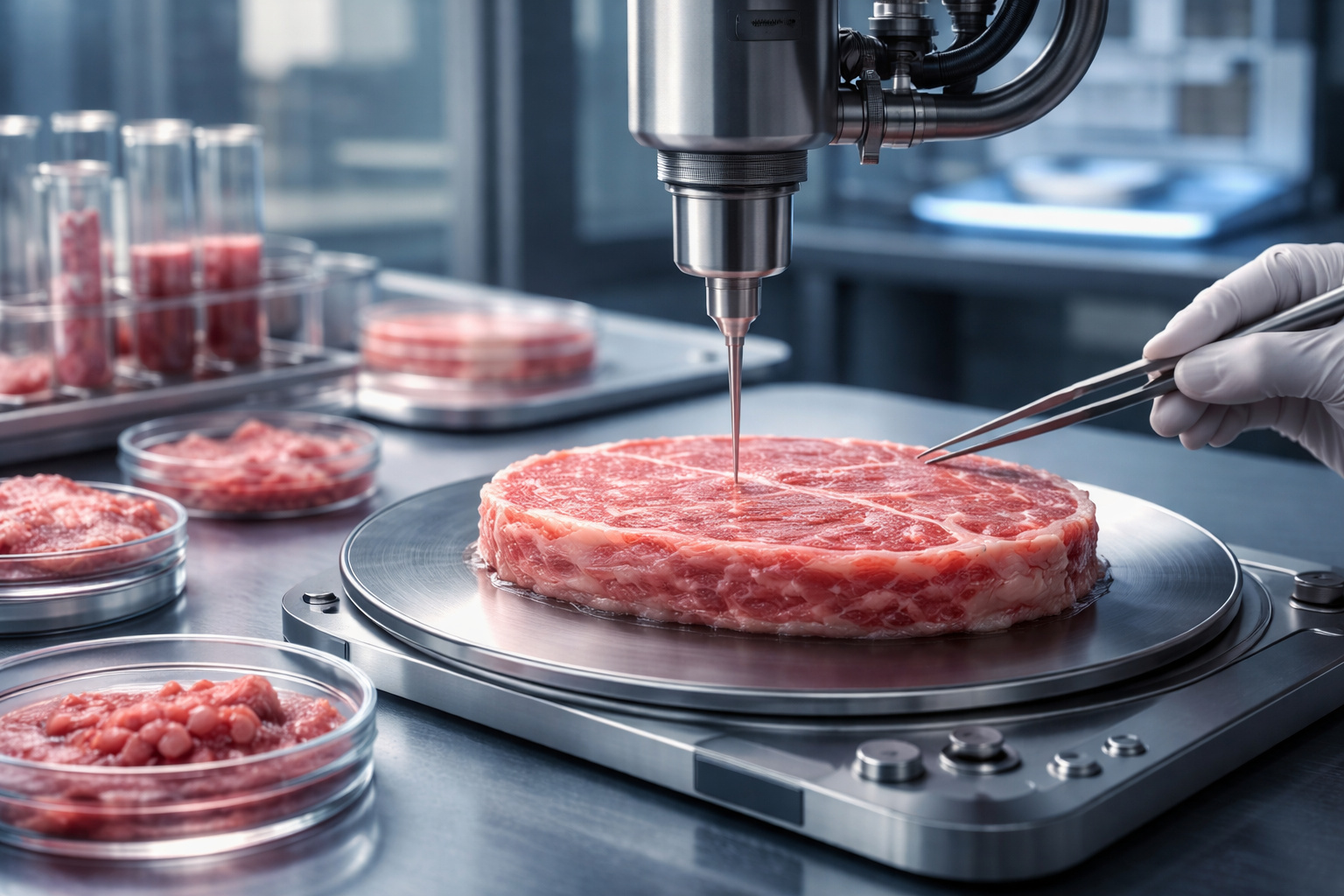


Project Developed by SENAI CIMATEC in Bahia Uses Animal Cells Cultivated in the Laboratory and 3D Bioprinting to Expand Protein Alternatives and Reduce Environmental Impacts
A highly relevant scientific initiative gained national attention by presenting a new approach to food production. Researchers from SENAI CIMATEC in Salvador, Bahia, have been developing a 3D printer-produced meat project for two years, created from animal cells cultivated in the laboratory, without the need for slaughter. The proposal positions Brazil in the global debate on alternative proteins and food innovation.
The project, named CELLMEAT 3D, received recognition in 2025 by winning the Finep Northeast Innovation Award in the Sustainable Agroindustries category. This led to its participation in the national stage of the award, increasing its visibility and reinforcing the role of Brazilian science in the development of cutting-edge technologies.
Cellular Technology Replaces Traditional Production Processes
Unlike conventional meat, the cultivated meat from CELLMEAT 3D originates from animal cells collected through biopsy, thus without animal slaughter or suffering. According to researcher Keina Dourado, who is responsible for the project’s scientific activities, the process occurs in a controlled environment with precise nutrient supply.
-
Digital Transformation Essential in Energy, Oil, and Gas Industries, But IT Infrastructure Often Overlooked

-
Brazilian Students Repurpose Clay Tea Cups to Create Cooler That Lowers Room Temperature by Up to 10°C Without Air Conditioning or Fans
-
353-Year-Old Mystery Deepens as Archaeologist Arrested with Teeth and Bone Fragment Possibly Linked to d’Artagnan, the Real Musketeer Behind Alexandre Dumas’ Inspiration

-
16-Year-Old Invents CoolTowel, a Fitness Towel That Stays Cold for Up to 2 Hours, Wins Global Alibaba Competition with Over 15,000 Participants, Earning $1 Million




Initially, the cells multiply in a monitored manner. Then, they are stimulated to differentiate, originating tissues that can transform into muscle or fat. This technical control allows for the reproduction of essential structures of meat while maintaining biological coherence and predictability in the product’s development.
3D Bioprinting Takes Center Stage to Form Texture and Structure
After the cellular stage, the 3D printer takes a central role in the process. The technology is used to give shape, texture, and structural organization similar to that of traditional meat. After printing, the product still undergoes a maturation period, a phase necessary to consolidate its physical characteristics.
This set of stages demonstrates how 3D bioprinting acts as a link between cellular science and the final food product. Thus, the project aims to bring the cultivated product closer to the references known to consumers, without resorting to traditional livestock production methods.
Expansion of Protein Alternatives Guides the Project
According to Keina Dourado, the goal of CELLMEAT 3D is not to replace conventional meat, but to expand options for protein production. The researcher highlights that global demand for proteins is expected to grow in the coming years, which requires complementary solutions with a lower environmental impact.
Furthermore, the technology opens space for future adjustments in the nutritional composition of meat, allowing adaptations to specific dietary needs. In this way, the project also points towards the possibilities of more personalized foods aligned with health and nutrition demands.
Product Still in Development Phase
Despite advancements and institutional recognition, the product is still not ready for the market. Currently, the project is still in the development phase, without consolidated data on complete nutritional profile or sensory characteristics such as taste and texture. These evaluations are part of the planned next stages.
Even so, studies conducted by international groups indicate that cultivated meat can have a nutritional composition similar to that of conventional meat, as well as good public acceptance. In some countries, this type of product is already marketed on a small scale.
High Cost Remains the Main Challenge
Currently, one of the biggest obstacles to the expansion of cultivated meat is the high cost of technology. This is because many of the inputs used still come from the pharmaceutical industry, which significantly raises production costs.
According to the project team, the development of more accessible inputs is essential to make the product economically viable on a large scale. This technical and industrial challenge is considered decisive for the future of the technology.
Regulation Advances but Requires Adjustments
In the regulatory field, Brazil took an important step in 2024 with the entry into force of Resolution RDC 839/2023 from the National Health Surveillance Agency (Anvisa). The norm modernizes the rules for the safety evaluation and authorization of new foods and ingredients.
Despite this, experts point out that additional definitions are still needed to specifically regulate the production and marketing of laboratory-cultivated meat. The dialogue between researchers and regulatory agencies remains an essential part of this process.
Recognition Reinforces the Role of Brazilian Science
The Finep Northeast Innovation Award 2025 reinforces the importance of applied science and technological innovation developed in Brazil. The recognition strengthens the confidence of partners, industry, and society in the country’s potential to address global challenges related to food and sustainability.
In light of this scientific advancement, do you believe that laboratory-cultivated meat could become a relevant alternative on the Brazilian menu alongside traditional meat in the future?


