






 Portuguese
  Spanish


The structure will retire the ferry that today takes about an hour, suffers from queues, and stops at night. More than connecting two cities, the work creates a paved corridor for agriculture in the north of the state. For now, however, two-thirds of the path have been completed, and delivery still depends on the remainder.
A project awaited for decades by the residents of northern Mato Grosso is beginning to take shape over the waters of the Juruena River. With 1,410 meters in length, the largest bridge in Mato Grosso is being erected over the river and has already reached 66% of the works, promising to replace a ferry crossing that today takes about an hour with a crossing of less than a minute between the municipalities of Cotriguaçu and Nova Bandeirantes.
The project is carried out by the Government of Mato Grosso, through the State Department of Infrastructure and Logistics, Sinfra-MT, with an investment of R$ 293.9 million, and is expected to directly benefit more than 70,000 inhabitants of the region. It is worth noting, however, that the structure is not yet completed: with about two-thirds executed, the promise of an almost instant crossing will only materialize when the bridge is finished and open to traffic. Below, we detail the numbers, what else is being built, and what changes in the lives of those living in the region.
The largest bridge in the state over the Juruena River
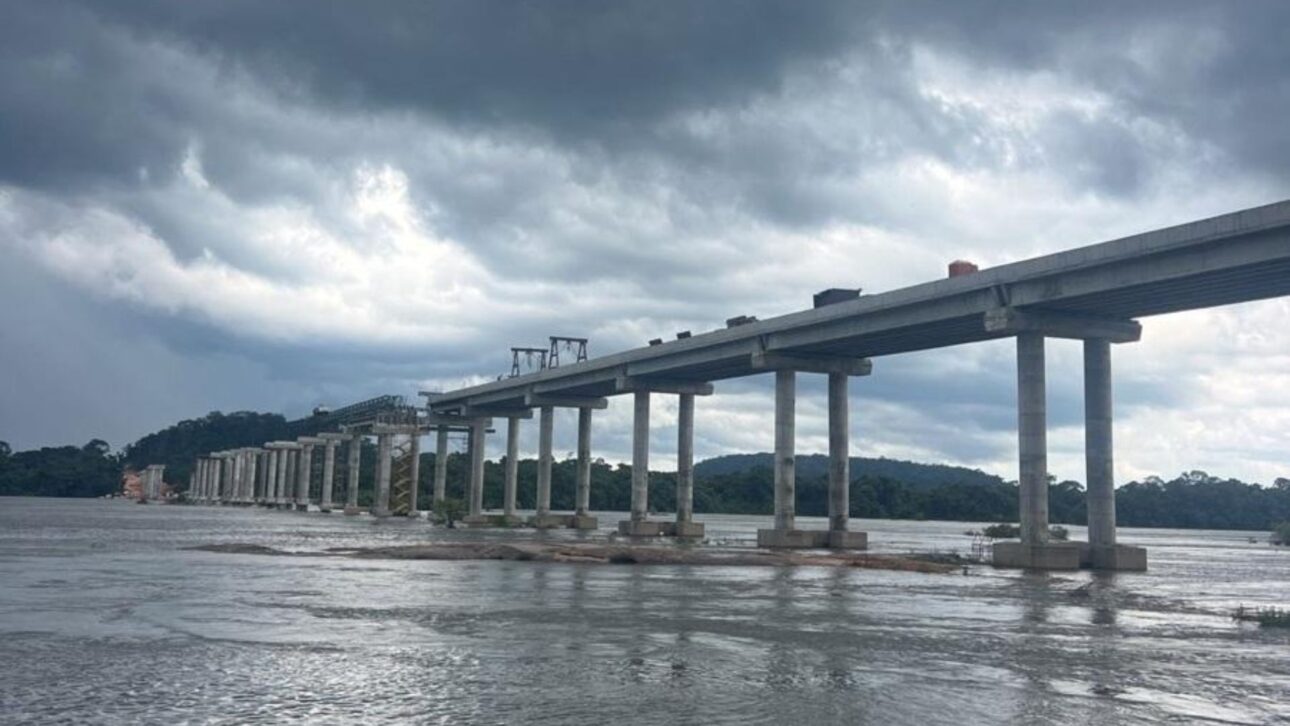
With its 1,410 meters in length, the bridge over the Juruena River will become the largest in the state, easily surpassing the current record holder, the MT-419 bridge, between Carlinda and Novo Mundo, which is about 692 meters, which gives the dimension of the grandeur of the new enterprise in northern Mato Grosso.
-
17-Story Building with 112 Apartments Opens in Australia to House Homeless Population, Offering Fully Equipped Units with Daily On-Site Support

-
81-Meter Bridge Made from Over 7 Tons of Recycled Plastic Connects Isolated Communities in Panama Canal Basin, Allowing Safe Passage for Over 300 Residents
-
Australia’s First Two-Story 3D-Printed House Built in 18 Hours, 22% Cheaper Than Traditional Methods, Uses Concrete That Hardens in 3 Minutes
-
Architect Converts 1955 Grain Silo into 31m² Home with Full Amenities, Including Kitchen, Bathroom, Curved Living Room, and Loft Bedroom



The bridge will directly connect the municipalities of Cotriguaçu and Nova Bandeirantes, passing through the district of Japuranã, along the MT-208 highway.
According to Sinfra-MT, all work fronts have already been initiated, and the project is advancing at a rapid pace, having increased from about 60% at the beginning of 2026 to the current 66% completion.
Engineering technicians remind us that a project of this magnitude requires detailed planning of foundations, logistics, and river flow control.
From the one-hour ferry to the crossing of less than a minute
The biggest impact will be on the time and cost of travel.
Currently, those who need to cross the Juruena River via MT-208 rely on a ferry, which takes on average about an hour, not counting the waiting time in lines, nighttime operation restrictions, and insecurity during flood periods, which increases costs and complicates the routine of residents and producers.
With the bridge completed, according to the State Government, this same journey will take less than a minute, continuously and independently of river conditions.
It is important to emphasize that this is a projection for when the work is completed.
Electrician Jonas Mendes, who provides services in cities in the region, is one of those awaiting the delivery, stating that the bridge should represent savings in time and money for those who currently need to pay for the ferry crossing.
A project that goes beyond the bridge
The project is not limited to the large structure over the river.
In addition to the main bridge, the work contracted by Sinfra-MT includes paving about 59 kilometers of the MT-208 highway, with more than 34 kilometers on the Cotriguaçu side and another 24 kilometers on the Nova Bandeirantes side, as well as the construction of three other smaller bridges, with 25, 30, and 50 meters in length, along the route.
This set of interventions is what will transform the connection into a fully paved corridor.
In practice, it will be possible to travel on paved roads connecting Cotriguaçu, Nova Bandeirantes, and Japuranã, also reaching municipalities like Aripuanã and Colniza and continuing to Guarantã do Norte and BR-163.
This is about the integration between the Northwest region and the entire northern part of Mato Grosso, currently hindered by the lack of a reliable land connection.
The impact on agriculture and the regional economy


For the local economy, the project is seen as a watershed moment.
The new bridge connects two major producing regions that, according to local leaders, were back-to-back due to the lack of an adequate connection, and the expectation is a reduction in logistical costs and strengthening of the flow of agricultural production towards the export corridors.
According to regional authorities, the mere expectation of the project has already been attracting investors, with the arrival of trading companies, the forecast of new warehouses, and the expansion of farming areas, in addition to a significant appreciation of the land, according to reports from the municipal public authority.
These are economic impacts that, although promising, depend on the completion and full operation of the new connection to be confirmed in practice.
The largest bridge in Mato Grosso, built over the Juruena River, represents much more than a record in length: it is the promise of taking a producing region out of isolation that for decades has depended on a slow ferry to connect to the rest of the state.
With 66% of the works completed, the project is progressing, but still requires the completion of the structure and the paved accesses to deliver all the promised benefits.
When this happens, the one-hour crossing will give way to a crossing of a few seconds, changing the routine and economy of more than 70,000 people.
And you, do you know the Juruena River region or have you ever had to face the ferry crossing there? What do you think of this type of infrastructure project for the interior of the country? Leave your comment, share your opinion, and help spread the word about the article to those who follow major projects, logistics, and the development of Brazil’s producing regions.


