Portuguese
  Spanish


Thousands of nuraghes crossed the Bronze Age and remain among the greatest archaeological enigmas of the Mediterranean.
One of the most impressive archaeological landscapes in Europe is located in Sardinia, a Mediterranean island located west of the Italian peninsula.
Thousands of stone towers, called nuraghes or nuraghi, remain standing after about 4,000 years.
These monumental constructions were erected during the Bronze Age and represent the main legacy of the Nuragic civilization.
-
Latin America’s Deepest Subway Station Opens in Brazil, Featuring London-Inspired Trains and a Tunnel Under the Tietê River

-
Katie Stagliano’s 18 kg Cabbage at Age 9 Fed 275 People, Inspired Katie’s Krops, and Led to 100 Community Gardens in 32 U.S. States to Combat Hunger with Fresh Produce

-
Black Granite Sarcophagus Found in Alexandria Reveals Three Skeletons, Strange Liquid, and an Ongoing Archaeological Mystery in Egypt

-
Childhood Psychology: Experts Highlight How Playing Outdoors Until Dusk Boosted Autonomy, Decision-Making, and Resilience in Previous Generations, Influencing Adult Behavior Today



The presence of this people on the island occurred between approximately 1900 BC and 700 BC, according to archaeological records.
Ancient towers resemble castles but are much older
The first impression of the nuraghes of Sardinia can confuse the visitor.
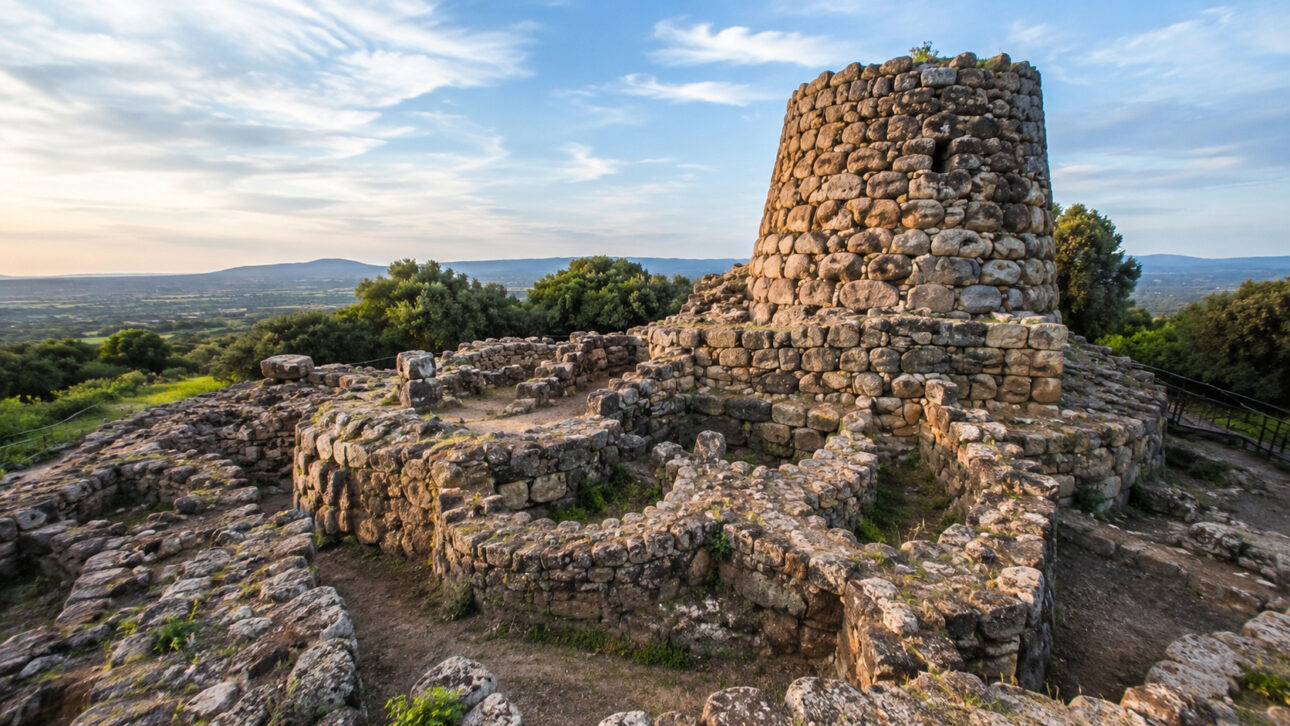
The structures resemble medieval castles because of the thick walls, robust towers, and complexes surrounded by walls.
The difference is striking: these constructions emerged millennia before the Middle Ages.
The preservation of the towers also draws attention, as many have withstood time almost intact.
This result reveals the high technical mastery of the Nuragic builders.
Mortarless engineering intrigues specialists
The nuraghes were constructed with large interlocking stone blocks.
No mortar was used to fix the structures.
The weight of the stones and the precise fit ensured stability for thousands of years.
This technique reinforces the importance of nuraghes within European archaeology.
Function of the towers still divides researchers
About 7,000 nuraghes have already been identified in different areas of Sardinia.
The quantity is impressive, but the exact function of these constructions still lacks consensus.
Researchers debate whether they served as:
- military fortresses;
- residences of important groups;
- administrative centers;
- religious temples;
- spaces with multiple functions at the same time.
The complex of Su Nuraxi di Barumini, recognized by Unesco, is the most well-known example of this type of Bronze Age construction.
Trade, metals, and power in the Nuragic civilization
The strategic position of Sardinia favored trade exchanges and military conflicts.
The Nuragic civilization controlled ports and exploited reserves of copper and lead.
This people also imported tin from other regions of the Mediterranean.
The combination of these metals allowed the production of bronze for weapons, jewelry, human sculptures, animal figures, and miniatures of the towers themselves.

Villages grew around the nuraghes
A large part of the population lived in villages made up of simple houses.
Many of these dwellings were built around the nuraghes.
The Nuragic people left no written records.
All available knowledge about this society depends mainly on the archaeological evidence found on the island.
First models emerged before the large towers
Scholars classify these constructions into three major groups.
The oldest model is the protonuraghe, also known as the corridor nuraghe.
This type was erected between 1700 B.C. and 1500 B.C.
The shape was less circular than that of the later towers.
The structure had narrow corridors and was also built without mortar.
Stairs led to the upper terrace, where wooden structures probably existed.
Mystery remains after thousands of years
The nuraghes of Sardinia remain among the greatest mysteries of Mediterranean archaeology.
Thousands of structures have been studied, but there are still doubts about defense, religion, power, and social organization.
The absence of written texts increases the mystery and makes each ruin an important clue about this ancient civilization.
What do you think these towers actually were: fortresses, temples, or constructions used for various functions at the same time? Leave your opinion!