Portuguese
  Spanish


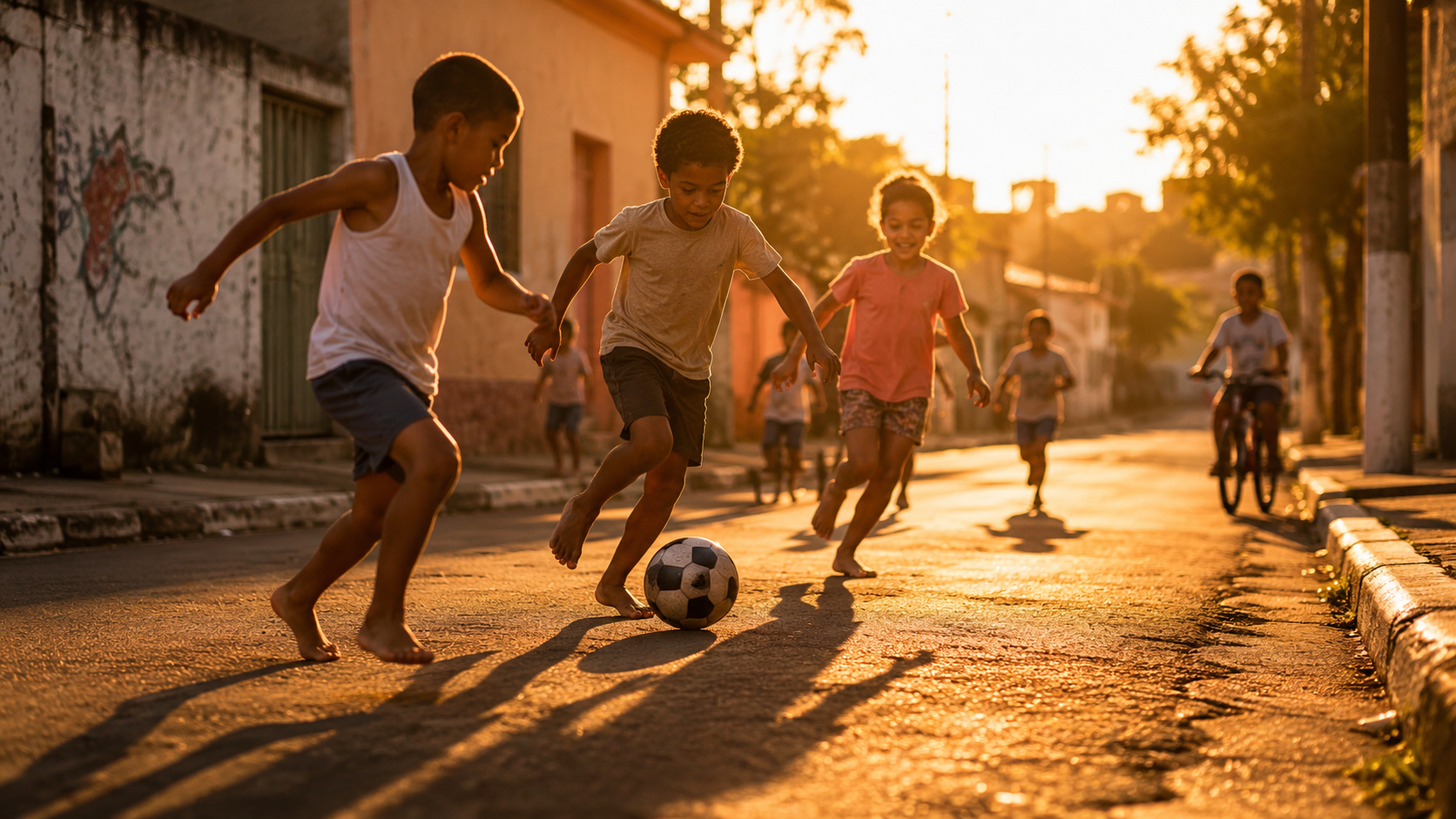

Studies in child psychology show how street play stimulated children’s autonomy, child development, and emotional intelligence from an early age.
Psychologists and experts highlight that the habit of growing up playing in the street until nightfall strengthened autonomy, decision-making, and resilience from childhood. This dynamic common in previous generations continues to influence behavior in adult life.
A study by Springer Nature, republished by Correio Braziliense on July 5, 2026, suggests that free play with calculated risks reduces anxiety in the long term. According to child psychology, in the face of modern confinement generated by screens, rescuing this freedom is vital for healthy psychic evolution.
The practical laboratory of children’s autonomy on the sidewalks
The old maternal call at the end of the afternoon marked the end of a day rich in physical interactions. Away from continuous adult supervision, the urban environment acted as an important space for the maturation of children’s autonomy. Children needed to manage their own time and mediate conflicts on their own.
-
Former Truck Driver from Brazil Builds Logistics Company Aiming for $70 Million Revenue with 11 Branches, 700 Monthly Clients, and $10 Million Fleet Investment

-
World’s First Plasma Dress Turns Fashion Show into Scientific Spectacle with Controlled Electric Discharges and Ionized Gases in Iris Van Herpen’s Groundbreaking Tech-Fashion Creation

-
Phone Falls from Plane at 300 Meters in Rio de Janeiro, Continues Recording for 15 Seconds, Found by Environmentalist Next Day in Unbelievable Twist
-
8-Year-Old Finds 900-Year-Old Viking Bronze Buckle on Swedish Beach While Fossil Hunting




Modern psychology argues that children’s autonomy is built through small experiences of independence throughout growth. By resolving impasses without the interference of a mediator, young people learn to structure their own identity and capacity for agency.


How child psychology explains outdoor play
In the context of child psychology, unstructured play is an important tool for assimilating the world. Unlike activities guided by tutors, outdoor interactions require abstract reasoning and cognitive flexibility.
According to established theses in child psychology, exposure to dynamic environments stimulates executive functions. The act of negotiating rules and accepting healthy social punishments lays the foundations for a balanced and resilient psyche.
The real impact of the decline of street play according to child psychology
In recent decades, street play has been progressively replaced by routines confined to apartments and screens. This deprivation of public space can severely limit the acquisition of practical experiences.
The chronic absence of street play creates a void in the practical learning of cause and effect. Without the physical feedback of the real environment, isolation and excessive monitoring generate insecure and fearful individuals.
- Tolerance to uncertainty: Facing small calculated risks teaches how to manage the unexpected.
- Fear management: Early exposure to natural challenges reduces the chances of future phobias.
- Self-confidence: Overcoming small physical dangers generates a real sense of competence.
Calculated risks and healthy child development
Ensuring full child development requires healthy exposure to real dilemmas. Scraping a knee on a stone or losing a toy were pedagogical elements of everyday life. These experiences taught how to deal with pain without immediate family comfort.
Child development is based on overcoming small obstacles. When parents minimize all potential dangers, they deprive children of building essential emotional defenses for the future.
Sidewalks as a living school of emotional intelligence
Emotional intelligence flourishes in collective and spontaneous experiences. Deciding the rules of the game demands empathy, active listening, and emotional regulation. Sidewalks functioned as a free space where rejection or victory were processed organically.
Developing emotional intelligence in childhood paves the way for more stable careers and relationships in maturity. Adults who decoded the emotions of their peers demonstrate greater ease of leadership and stress control.
Child psychology: four practical legacies of old play
The shared urban space offered fundamental lessons that no book can imitate. Among the main practical learnings acquired in free childhood, the following stand out:
- Peaceful negotiation: Adjusting rules and collective dynamics without resorting to a higher authority.
- Body awareness: Facing small physical dangers with heightened attention.
- Applied creativity: Inventing toys using simple materials, like pieces of wood.
- Community cohesion: Developing a sense of unity and mutual protection with neighborhood peers.
The modern dilemma in promoting child autonomy
With the increased perception of urban insecurity, fostering child autonomy has become a challenge for modern families. Technological isolation prevents the creation of internal defense mechanisms against frustration.
However, it is feasible to apply the essence of child autonomy by adapting it to new times. Allowing small monitored walks or giving freedom of choice within controlled environments are excellent practical substitutes for the old sidewalks.
Raising resilient children according to child psychology
According to contemporary child psychology, the secret to resilient upbringing lies in avoiding systematic overprotection. Controlling every detail of the routine implicitly signals to the child that they are incapable of acting alone.
Recommended practices by child psychology suggest encouraging the independent resolution of small dilemmas. Allowing children to face the natural consequences of their actions strengthens the necessary psychological foundation.
The balance between safety and leisure on sidewalks
Although reviving traditional street games is difficult in large centers, finding a healthy middle ground is the current great challenge. Condominiums and public parks serve as great transitional stages.
Encouraging street games in outdoor environments, even under discreet monitoring, validates the mutual trust between parents and children. These breathing spaces prepare children for the complex challenges of the future.
The effects of robust child development echo throughout adult life. Adults who have consolidated a solid foundation of free exploration may exhibit lower rates of psychological illness and take active stances in crises.
Investing in healthy child development spares families from dealing with overly dependent adults. The emotional foundations structured in childhood serve as a safe harbor against career storms.
How Emotional Intelligence Regulates Stress in Adulthood
In today’s work environment, emotional intelligence is one of the most valued attributes. Professionals with self-regulation skills mimic the patterns learned in childhood when managing conflicts on the sidewalks.
The emotional intelligence built in childhood can directly act as a buffer against burnout. Recalling the personal ability to resolve issues without external support restores the sense of control in moments of extreme pressure.
Reviving the Fearless Spirit for Current Challenges
The memories of scraped knees and barefoot runs are much more than mere nostalgic sentimentality. They represent a valuable psychological asset that shaped the self-confidence of the current generation of adults. The legacy of the sidewalks serves as a biographical reminder that we are capable of overcoming adversities on our own.
For contemporary parents, the challenge lies in translating these fundamental concepts into current parenting, balancing essential protection with real freedom. For adults, it remains to revive this autonomous and firm spirit from childhood to face present challenges with more lightness, resilience, and good humor.