






 Portuguese
  Spanish


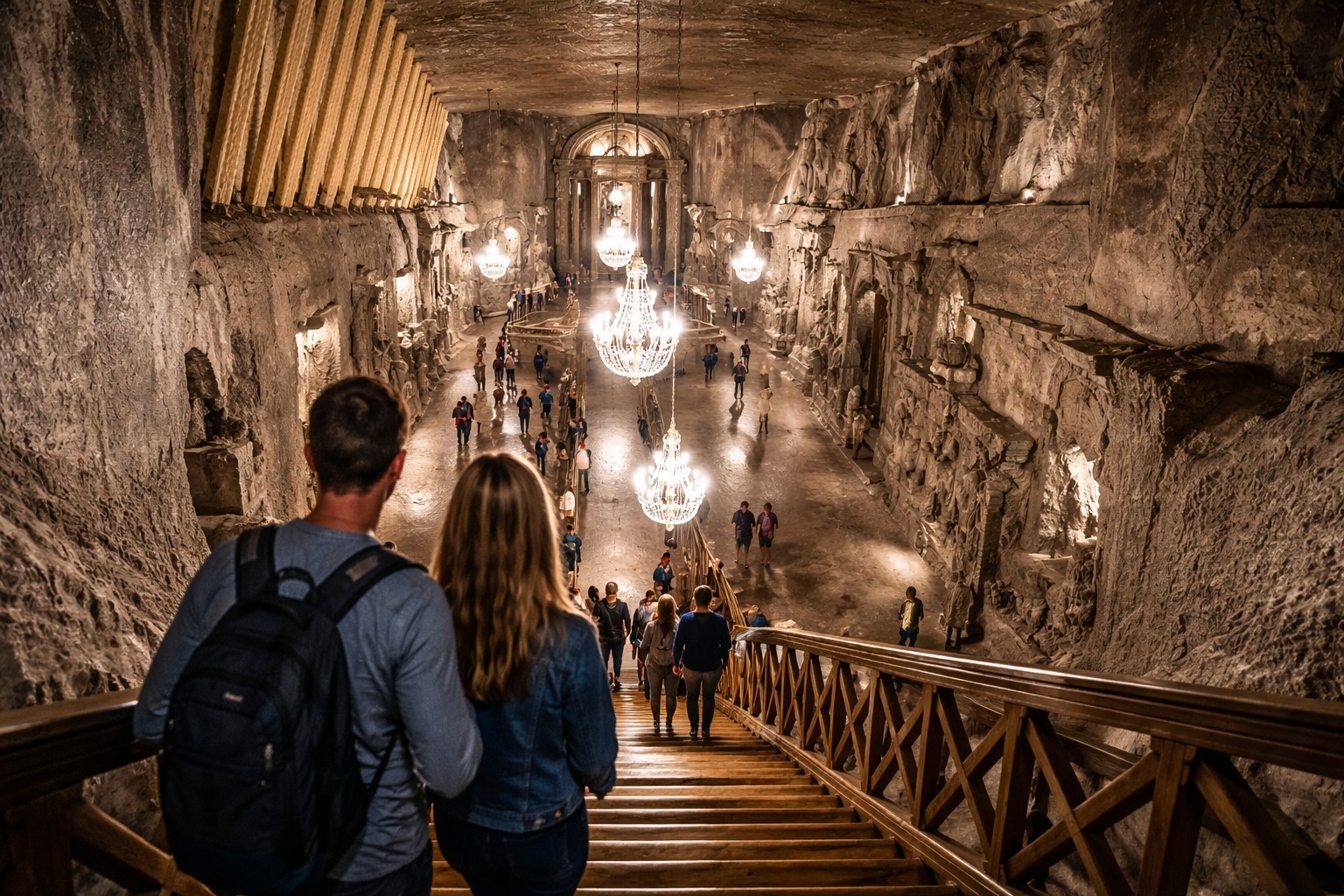


Wieliczka Salt Mine Receives Up to 9,000 Visitors Per Day After 700 Years of Operation, 240 Kilometers of Tunnels, Nine Underground Levels and a Depth of 330 Meters in Poland
After descending 380 steps, visitors arrive at the Wieliczka Salt Mine, southeast of Krakow, Poland, which receives up to 9,000 people per day in a labyrinth with over 240 kilometers of tunnels and 330 meters deep.


Wieliczka Salt Mine Concentrates 240 Kilometers of Tunnels in Nine Underground Levels
Located southeast of Krakow, the Wieliczka Salt Mine combines historical heritage, industrial legacy, and tourism.
Declared a UNESCO World Heritage Site in 1978, it ceased commercial salt extraction in 1996, after about 700 years of continuous operation.
-
Phone Falls from Plane at 300 Meters in Rio de Janeiro, Continues Recording for 15 Seconds, Found by Environmentalist Next Day in Unbelievable Twist

-
8-Year-Old Finds 900-Year-Old Viking Bronze Buckle on Swedish Beach While Fossil Hunting
-
8-Year-Old Who Ran Barefoot Wins Race in Brazil with Shoes Gifted by Famous Athlete, Becomes Symbol of Hope but Family Seeks Support to Sustain Athletic Dream
-
Couple Transforms Abandoned Farm in São Paulo into Major Poultry Operation with 295,000 Birds and Plans for Expansion


Throughout that time, over 240 kilometers of tunnels were excavated across nine levels, reaching 330 meters deep.
Currently, about 2% of the structure is open to the public, while the rest is restricted for maintenance and preservation.
The classic tourist route is just over three kilometers long and takes approximately two hours, ending at a depth of 137 meters.
There is also the miners’ route, which lasts three hours, equipped with a helmet, headlamp, and carbon monoxide absorber.
This second route traverses areas located between 57 and 100 meters below the surface. Access to the complex occurs after descending 380 steps, leading visitors to corridors with gray walls that have a salty taste.
Geological Structure and Extraction Methods Over the Centuries
The chambers were manually excavated over the centuries and now house sculptures, statues, and chandeliers made of salt crystals. The walls are not white because sodium chloride is not pure.
Between 90% and 95% of the rock is salt, while the remainder includes minerals, sand, silt, and clay, responsible for the grayish tone. Despite the impurities, the salt is edible and has been used to preserve food without purification.
The halite deposit, the scientific name for rock salt, is about 13.5 million years old. Tectonic movements in the Carpathians pushed the layers of salt closer to the surface, facilitating exploration.
Until 1743, excavation was done centimeter by centimeter. Then, gunpowder began to be used, and mechanical drills appeared about 150 years later. To avoid collapses, layers of salt were left supporting the chambers.
Today, these structures are reinforced with modern engineering, including fiberglass rods, ensuring greater stability for open and closed areas.
Economic and Historical Role of the Wieliczka Salt Mine
Exploitation began in the late 13th century when wells dug to access brine revealed blocks of rock salt.
In the 14th century, under the reign of Casimir III of Poland, the mine became royal property.
The revenue from salt accounted for up to one-third of the kingdom’s treasury and helped finance the first university in Poland. By the end of the 15th century, annual production ranged between 7,000 and 8,000 tons.
Although considered less dangerous than other mines, the activity was exhausting. Excavating a chamber could take decades.
Among the riskiest jobs were the penitents, responsible for burning the accumulated methane.
Horses introduced in the 16th century to move pulleys lived permanently underground. The routine was marked by continuous effort and constant risk, even as techniques evolved over time.
During World War II, under Nazi occupation, the mine was converted into an underground factory for aircraft components, with forced labor from prisoners of the Płaszów concentration camp. The operation lasted only a few months due to unsuitable conditions for metallurgy.
Tourism, Current Production and Permanent Maintenance
Tourism at the Wieliczka Salt Mine has existed for about 300 years. Among the historical visitors is Nicolaus Copernicus, who is said to have been there in 1493.
One of the main highlights is the Chapel of Saint Kinga, excavated over 67 years and completed in 1964. The space features an altar, biblical reliefs, and salt chandeliers, and still hosts masses and weddings.
The complex also houses event spaces, including a room nearly 37 meters high that has hosted bungee jumping and tethered hot air balloon rides.
There is also a spa at a depth of 137 meters, specializing in respiratory treatments.
Even after the end of commercial mining, over 10,000 tons of salt are produced annually from the brine resulting from water infiltration, which is pumped and evaporated on the surface.
Currently, more than 380 miners work on maintenance and protection against leaks, ensuring the safety and continuous preservation of the Wieliczka Salt Mine, one of the most extensive underground salt complexes in the world, keeping its structure active and accessible.
With information from CNN.


