






 Portuguese
  Spanish


Tesla, Coca-Cola, Nestlé, and eBay requested the American government to exclude Brazilian products from the new taxation under review in the United States. The companies argue that the measure could increase production costs within the American market, affecting everything from technology factories to everyday consumed foods.
The proposal for an additional tariff of 25% on Brazilian products has put large American companies in an unusual position: they have started to advocate for exceptions for Brazilian goods before the measure is applied.
Tesla, Coca-Cola, Nestlé, and eBay sent statements to the Office of the United States Trade Representative, the USTR, requesting that certain items be removed from the list of products subject to the charge.
The move occurred at the final deadline for submitting public comments, on July 1, 2026, within the investigation opened based on Section 301 of American trade law. As reported by UOL, the companies claim that the tariff could raise costs, hinder supply, and harm consumers in the United States.
-
Couple Transforms Abandoned Farm in São Paulo into Major Poultry Operation with 295,000 Birds and Plans for Expansion

-
Off-Duty Firefighter Rescues Three Children Trapped Under Overturned Boat in Brazilian Lake

-
Workers near the Vatican uncover lead pipe revealing Emperor Caligula’s name and site of his opulent garden from nearly 2,000 years ago
-
Workers renovating a playground in northern England uncover 176 World War II bombs buried underground; training artifacts still contained explosives.



The case draws attention because the pressure does not come only from the Brazilian government or national exporters. Part of it comes from companies within the United States, which depend on Brazilian inputs, food, and components in different sectors.
The public hearing on the proposal was scheduled for July 6, 2026, in Washington. The process still includes USTR analysis before any final decision, but the companies’ requests already indicate where the measure might hit first.
The investigation targets Brazil, but companies see risk within the US
The USTR states that the investigation addresses issues such as digital trade, electronic payment services, preferential tariffs, intellectual property, ethanol market access, and illegal deforestation. In the notice published in the Federal Register, the agency said it had determined that certain Brazilian practices would be “actionable” under Section 301 and opened a public consultation on possible trade responses.
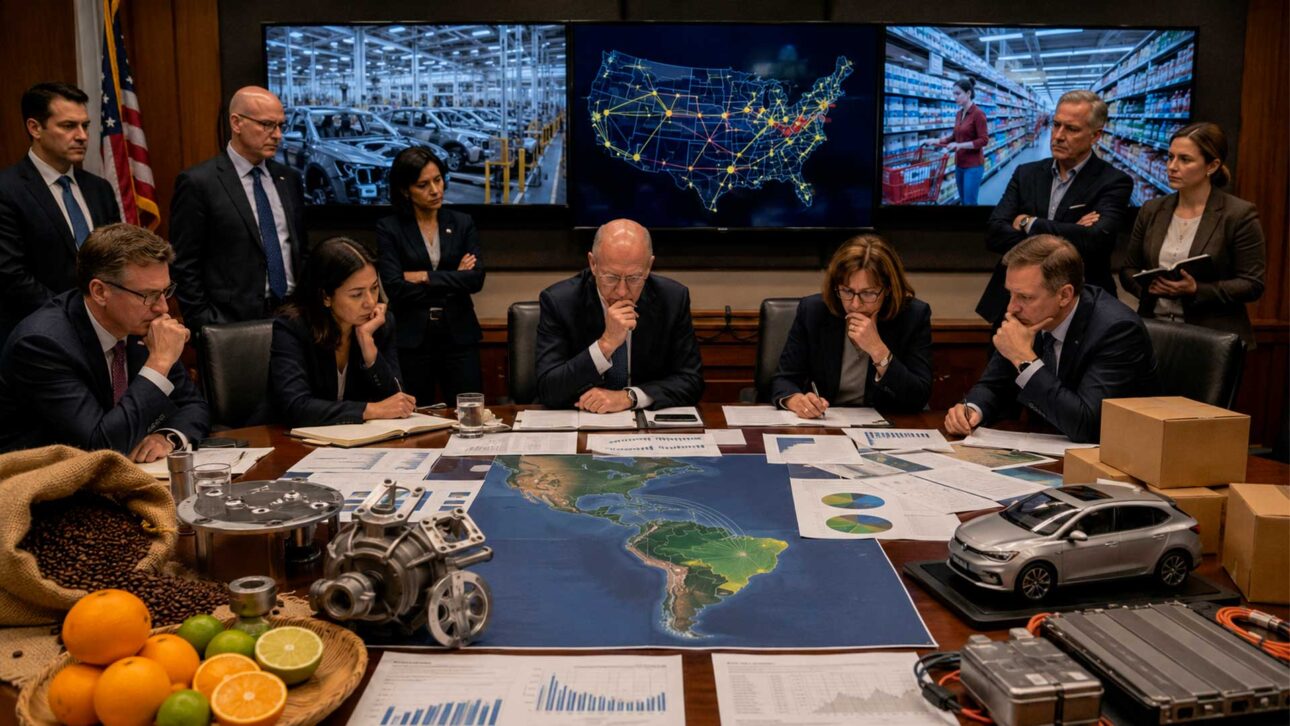
The proposal on the table includes 25% tariffs on Brazilian goods, with some exceptions provided for specific products, items subject to other trade rules, and goods listed in the annex. The USTR itself requested that comments address the availability of alternative suppliers, the risk of supply disruption, and the impact on the American economy.
This is where the companies stepped in. They did not broadly defend Brazilian trade policy but argued that applying the tariff broadly could have the opposite effect of what is intended.
For the companies, replacing Brazil is not as simple as swapping a supplier in a spreadsheet. In some cases, there are requirements for quality, scale, traceability, food safety, and industrial certification.
Tesla tries to protect industrial inputs used in technology chains
Tesla requested that industrial inputs imported from Brazil be exempt from the new tariff. The company argues that it is investing billions of dollars to nationalize and diversify its supply chain in the Americas, but states that this process takes time.
Elon Musk’s automaker maintains that sectors such as electric vehicles, batteries, robotics, and advanced manufacturing still depend on materials that are not produced in the United States at the same scale or quality. The concern is that a tariff imposed too quickly could increase the cost of parts and components before domestic production can fill the gap.
In practice, Tesla is trying to prevent a measure intended to pressure Brazil from also pressuring American factories. The company’s warning is that the tariff could affect workers, consumers, and industrial projects within the United States.
The argument carries weight because the electric car industry depends on long and sensitive supply chains. Changing a supplier may require technical tests, safety validation, and contract adaptation.
Nestlé wants to preserve soluble coffee and bovine collagen imported from Brazil
Nestlé requested the inclusion of two Brazilian products among the exempt items: non-flavored soluble coffee and bovine collagen. The company states that coffee beans cannot be grown on a commercial scale in the continental United States, which limits substitution by local production.
The request also aligns with the company’s own strategy in Brazil. According to Nestlé Brazil, the Araras factory, in the interior of São Paulo, is expected to export more than 20,200 tons of soluble coffee in 2026 and serves international markets from a unit considered strategic for the brand’s global operation.
In the case of bovine collagen, the company points out that Brazil plays a significant role in global supply. This ingredient appears in health, wellness, nutrition, and functional food products, segments that are growing in the American market.
Nestlé also sought to address environmental concerns. According to the text cited in the original source, the company reported that 96.7% of its primary commodity supply chains had already been assessed as deforestation-free by the end of 2025.
Coca-Cola puts the Florida orange crisis at the center of the discussion
Coca-Cola requested that the United States maintain the exemption for Brazilian orange juice and also include lemon and its derivatives in the list of products exempt from charges. The company states that without a transition, the tariff could increase the cost of beverage and concentrate production.
The argument involves the sharp decline in Florida’s citrus industry. According to a forecast released by the USDA Agricultural Statistics Board, the 2025-2026 orange crop in Florida was estimated at 12 million boxes, a volume 2% lower than the previous season.
The comparison used by the company is stark: in the early 2000s, Florida harvested hundreds of millions of boxes per season. Today, local production suffers from diseases, pests, and climatic events, which has made Brazil an essential supplier to maintain part of the supply.
Switching citrus suppliers is not immediate. There are food safety tests, flavor validation, industrial standardization, and already signed contracts.
eBay tries to exempt used products from charges and targets the impact on low-income consumers
eBay requested a categorical exemption for second-hand, used, and pre-owned products. The company argues that these items do not represent new Brazilian industrial production and, therefore, should not be treated as common goods within a trade dispute.
The platform states that a used product has already gone through the first sales cycle. Charging an additional tariff in this case would affect resellers, small businesses, and consumers who turn to cheaper items to save money.
Another problem pointed out is bureaucratic. In used clothing and accessories, for example, there is not always a label with the country of origin, which would make inspection more expensive and less precise.
This point broadens the debate beyond large companies. The tariff, according to the platform, could fall on small sellers who do not have the structure to track each old item put up for sale.
Brazil contests the basis of the measure and tries to avoid a commercial escalation
The Brazilian government also sent a statement to the USTR on July 1, 2026. In the document, Brazil rejects the conclusions of the investigation and states that its policies are not “unreasonable,” discriminatory, or harmful to American trade.
The Brazilian defense argues that Section 301 does not authorize the United States to impose trade action merely for disagreeing with another country’s policy choices. The document requests that the USTR refrain from adopting unilateral measures as a result of the investigation.
For Brazil, a broad 25% surcharge would not resolve the points raised by the Americans and could still create costs for companies and consumers on both sides. Meanwhile, for the USTR, the proposal appears as a response to practices considered harmful to United States trade.
The dispute, therefore, is not restricted to Brasília and Washington. It crosses factories, supermarkets, digital platforms, and food chains that operate with Brazilian products within the American market.
If the tariff advances without new exceptions, the impact may appear far from Brazilian ports. It could reach the price of instant coffee, juice, supplements, industrial components, and even used clothes sold by small merchants in the United States.
What do you think of this pressure by American companies against the tariff on Brazilian products? Does the measure protect the US industry or could it end up making products more expensive for American consumers themselves? Leave your opinion in the comments and join the discussion.





