






 Portuguese
  Spanish


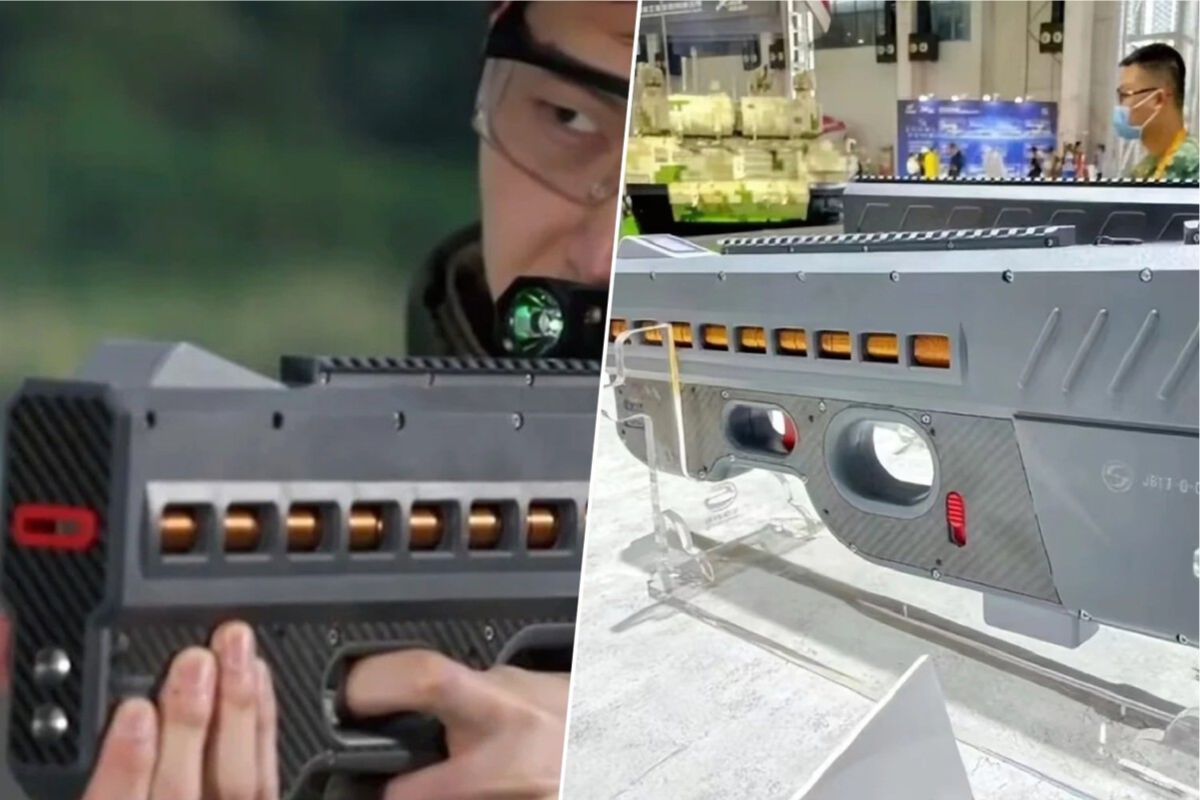


Weapon Created by Chinese Scientists Reaches Speed of 86 m/s and Fires Without Gunpowder. An Innovation That Challenges Everything Known About Light Weapons.
Have you ever thought of a weapon that fires silently, with no recoil, no smoke, and can even shoot 3,000 projectiles per minute? Sounds like something from a movie, right? Well, China made this a reality. A team of scientists from the People’s Liberation Army developed the world’s first coilgun (or electromagnetic gun) that does not require capacitors and operates on high-performance lithium batteries.
This technology not only puts China ahead in the arms race for next-generation weapons but also paves the way for a complete revolution in the concept of portable armament. The project, which has been published in a peer-reviewed study in the technical journal Journal of Gun Launch & Control, is stirring nerves among many in the West.
A Weapon Worthy of Halo, Doom, and Crysis
Gamers will feel right at home. These coilguns, also known as Gauss rifles, are part of the imagery of fictions such as Minority Report, Ghost in the Shell, or even our classic Fallout. They are weapons that accelerate metal projectiles using magnetic fields, eliminating gunpowder explosions. Now, the difference is that this is no longer on screen: it’s undergoing real testing in China.
-
World’s Largest Particle Accelerator Begins Four-Year Hiatus for Magnet Overhaul, Aiming to Hunt Dark Matter by 2030

-
“Sahara Dust Turns Rain Red, Startling Residents Across Europe”
-
Stanford Scientists Develop 20-Cent Paper Centrifuge Inspired by Ancient Toy, Spins at 125,000 RPM Without Electricity, Separates Plasma in 1.5 Minutes, Aiding Diagnostics in Remote Areas

-
World’s Largest Vaccine Manufacturer, Immunizing Two-Thirds of Global Infants, Originated in a Pune Horse Farm





According to the scientists involved in the project, the Chinese prototype can achieve 3,000 shots per minute—a surreal number compared to any conventional weapon. Just to give you an idea, an AK-47 rifle fires around 600 rounds per minute. And the American coilgun GR-1 “Anvil,” which was considered the most advanced until now, barely exceeds 100.
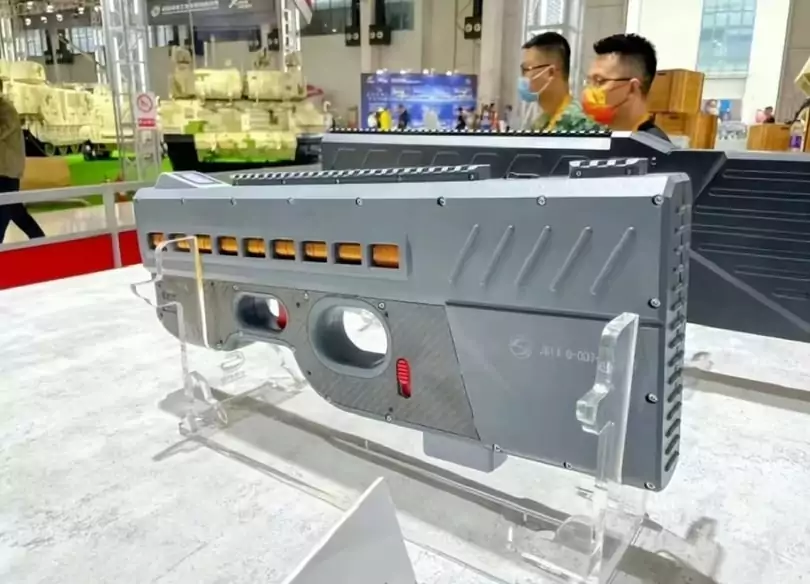
How Does This Futuristic Weapon Work?
The secret to the Chinese performance lies in a complete redesign of the power system. While traditional models rely on capacitors (which need to be charged between each shot), the Chinese opted for lithium battery modules that provide power directly to the 20 25mm copper coils of the gun.
These coils are activated with high precision by sensors that trigger and cut the current in milliseconds. This prevents energy loss and improves efficiency. The result? A projectile accelerated to 86 meters per second, without explosion, sound, or flame. The weapon also has a compact design in the bullpup style, inspired by the famous Belgian P90.
To ensure continuous operation, engineers implemented advanced cooling systems and finite element simulations, which control everything from battery heating to the exact trajectory of shots. A true miracle of military engineering.
But What’s the Practical Use of It All?
In its current state, the Chinese prototype is more geared towards civil disturbance control or special operations. Since it’s silent and leaves no visible trace when firing, it’s perfect for urban actions, covert operations, and environments with high concentrations of people.
Additionally, as the shots are adjustable in power, it can be used to incapacitate or neutralize with lethal force—all without drawing attention. The extremely high firing rate also allows for creating a “barrier” of projectiles against close-range attacks.
But Are There Weaknesses?
Of course there are. Despite all the technology involved, the project still faces two major challenges: accuracy is still behind conventional weapons and the battery recharge time is about one hour. In prolonged combat, this could become a problem. But experts assure that these are surmountable obstacles with more investments in batteries and next-generation semiconductor chips.
A Weapon That Could Change the Game
The big question is: are we on the brink of a new era of portable weapons?
For many analysts, yes. China has not only broken technical barriers with this coilgun but has also shown how the fusion of advanced batteries, power electronics, and control algorithms can redefine modern armament. According to the South China Morning Post, the creators of the project are already working on lethal and long-range versions—something that will surely attract the attention of armed forces around the world.
And What Does Brazil Have to Do with It?
Even though we are far from developing something like this here, China’s advancement could trigger a global technological race, which also includes emerging countries. Brazilian experts in security and military technology are already observing this scenario closely, including institutions like the Strategic Studies Institute of the Federal Fluminense University (INEST/UFF).
The Ministry of Defense, which in recent years has invested in technology projects focusing on Cyber Defense and Electronic Warfare, may eventually consider studies in similar technologies—even in the early stages—for non-lethal use in internal security situations.


Зеркало казино — идеальный вариант на случай перебоев
Aviator game review with deposit bonuses explored
Mikrokredit KZ fast and easy 💳