






 Portuguese
  Spanish


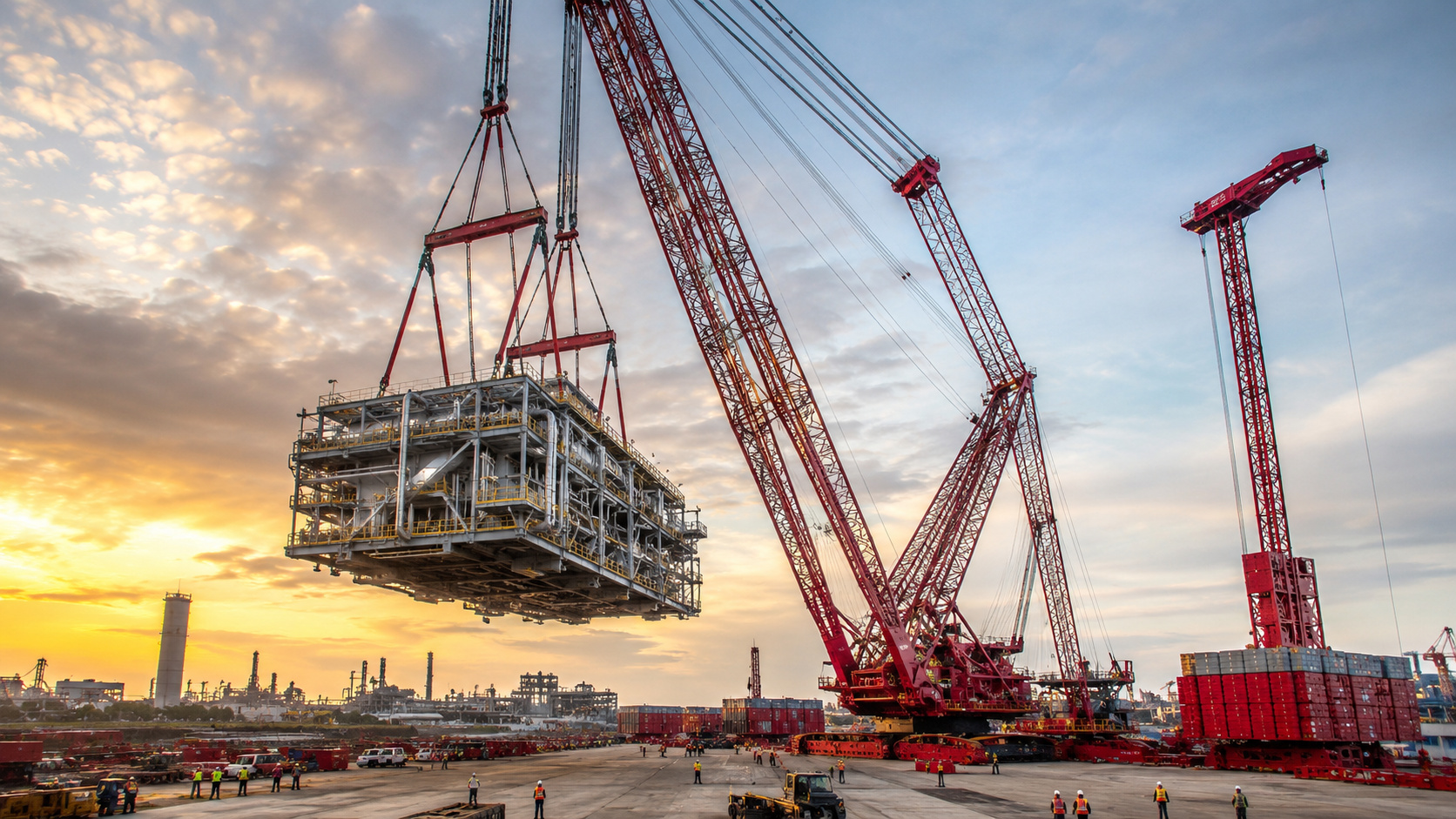


The SK6000 land crane arrives as a new bet for heavy lifting of industrial modules. The capacity of 6,000 tons allows for thinking about larger mega pieces. The effect can appear in plants, platforms, oil, gas, hydrogen, and large industrial plants
The strongest land crane in the world was launched for a mission that goes beyond lifting weight. The SK6000 arrives with 6,000 tons of capacity to lift giant pieces used in industrial works.
The information was released by Mammoet, a global heavy lifting and transport company. The company presented the SK6000 as equipment designed to change the way large projects are assembled.
In practice, this means less reliance on hundreds of small pieces on site. Instead, larger modules can be assembled beforehand and lifted later, which changes the pace of plants, platforms, and industrial plants.
-
Award-Winning Japanese Restaurant Reveals It Has Preserved Part of the Same Frying Oil for 66 Years

-
American Youth Transforms from Severe Obesity to U.S. Air Force Enlistment, Losing 90 Kilograms in Two Years
-
11-Year-Old Entrepreneur Sells 60 Homemade Sweets Daily, Mastering Cost Calculation, Social Media Promotion, and Client Negotiation Since Age 7

-
Peruvian Mountain’s 5,200 Aligned Holes May Unveil Ancient Indigenous Market for Corn and Cotton


SK6000 changes heavy construction by allowing increasingly larger industrial modules
The SK6000 was created to operate in works where common pieces no longer match the size of the projects. Instead of assembling a structure in several smaller parts, the crane allows working with giant industrial modules.


This change is important because large works usually have lengthy stages, with assembly at height, a lot of coordination, and reliance on specialized teams. When a larger part arrives ready, the number of critical operations can decrease.
It’s basically like assembling a large part of the structure beforehand and placing the entire block in place later. The land crane enters exactly at this stage, with heavy lifting of enormous pieces.
Capacity of 6,000 tons places the crane at the center of plants and platforms
The capacity of 6,000 tons is the figure that places the SK6000 at the center of heavy construction. This number allows for thinking about mega pieces that previously would require another type of planning or several smaller assembly stages.
The equipment can serve nuclear energy, oil and gas, hydrogen, offshore platforms, and large industrial plants projects. All these sectors deal with enormous, heavy, and difficult-to-move structures.
With larger modules, the construction can gain a different logic. The focus shifts from assembling piece by piece on site to including the delivery of more complete parts, ready to be positioned by the crane.
Mammoet sees the land crane as a tool to accelerate megaprojects
Mammoet, a global heavy lifting and transport company, introduced the SK6000 as a land crane capable of expanding the use of faster construction methods in the energy sector.
Gavin Kerr, Mammoet’s global services director, stated: “This crane is truly a world-record engineering feat, with a production schedule to match.”
The statement shows that the launch is not just about brute force. The central point is the possibility of reorganizing large projects, reducing complex stages, and allowing important parts to be prepared before the final assembly.
Less assembly at height can make industrial projects simpler to execute
Working at height always requires more care. In industrial projects, this involves equipment, teams, procedures, and time. Therefore, any solution that reduces this stage can directly affect planning.
With larger modules, part of the work can be done before the final installation. Then, the SK6000 land crane performs the lifting of the ready or almost ready piece.
This model can help in projects where the deadline is crucial. Power plants, platforms, and industrial plants depend on well-organized schedules, and the assembly of mega pieces can reduce the number of interventions on site.
Ballast helps the crane maintain stability during heavy lifting
A crane of this size does not rely solely on a large arm. It also needs ballast, which acts as a counterweight to maintain stability during lifting.
This detail is essential when the load is gigantic. The larger the piece, the greater the control of the movement needs to be, so that the operation occurs safely and precisely.
In the case of the SK6000, the use of ballast is part of the necessary engineering to lift mega pieces. In simple terms, it helps the crane stay stable while moving extreme loads.
Oil, gas, hydrogen, and nuclear energy increasingly rely on extreme lifting
Sectors such as oil and gas, hydrogen, and nuclear energy work with large and heavy equipment. Many structures need to be installed in complex locations, with little room for error.
On offshore platforms, for example, larger modules can reduce integration steps. In large industrial plants, pre-assembly can help better organize the arrival of parts on site.
Therefore, extreme lifting has become a strategic part of megaprojects. The crane is no longer just a support machine and starts to influence the very way the project is conceived.
The launch of the SK6000 land crane reinforces a clear trend in heavy construction: using larger industrial modules to reduce difficult assemblies and accelerate critical stages.
With a capacity of 6,000 tons, the equipment shows how plants, platforms, and large industrial sites can increasingly depend less on small parts and more on mega pieces planned before installation.
If giant projects can be assembled with fewer steps at height and increasingly larger modules, do you think this can make megaprojects faster or just more dependent on extreme machines?


