






 Portuguese
  Spanish


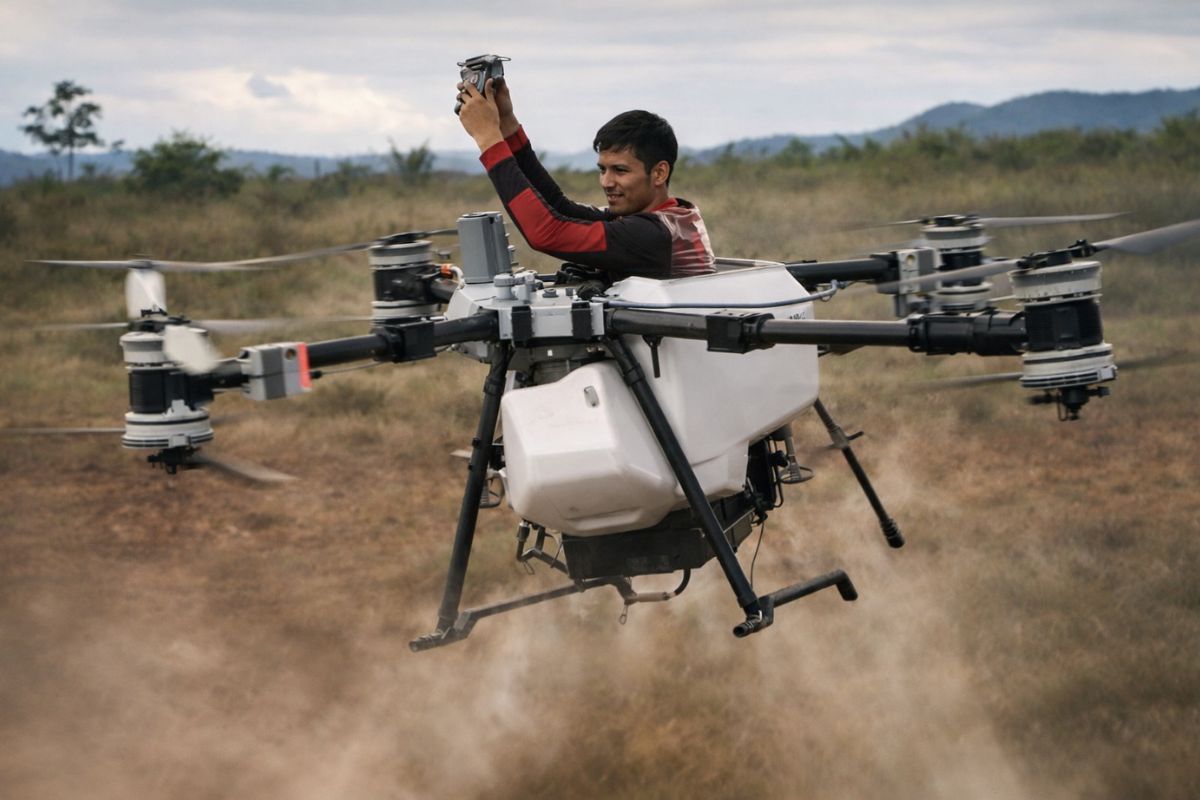


Registration of a Pilot in Pará about an Agricultural Drone Raised Doubts in the Entire Sector about the Safe Use of Unmanned Aircraft. At the Same Time, the DJI Agras T100 Gained the Spotlight: it Carries 100 kg, Sprays up to 34 Hectares per Hour, and Features Sensors to Reduce Risks, Not to Carry People.
The agricultural drone has ceased to be a “curious tool” and has turned into a strategic piece in modern agriculture, especially when the goal is to gain efficiency and precision in the application of inputs. However, the same technology that accelerates the farm also requires clear limits: machines designed to operate without crew do not become human transport just because they seem strong.
The repercussions involving the pilot Hudson Vinicius, in Pará, exposed this clash between spectacle and responsibility. A lack of confirmed information about the location and the safety conditions fueled the debate: how far does creativity go in digital agriculture, and where does the risk that no one should take begin?
When Innovation Becomes Recklessness

There is a central reason for the discomfort of those who work with agricultural drones: this type of aircraft is designed to fulfill repeatable routes, carry inputs, maintain stability, and apply products with precision, not to support human weight.
-
To Aid Mars Missions, 12 Volunteers to Spend 60 Days in Bed Without Getting Up, Earning €18,000 in Study Starting 2026

-
Extreme Heat of 41.3°C Warps Roads in Germany, Causes Autobahn Asphalt to Crack, Injures People, and Forces Snowplows to Cool Down Highways

-
AI Security System in Brazil Aims to Cut False Alarms by Differentiating Pets from Intruders, Enhancing 24/7 Monitoring for Homes and Businesses

-
Archaeologists Discover 1,500-Year-Old Byzantine Mosaic with Greek Biblical Inscription in Israel, Uncover Ruins of 10 Buildings Near Kiryat Gat



Any improvised adaptation completely changes the behavior of the machine in the air, alters its center of gravity, and increases the chance of loss of control.
Furthermore, the impact is not only individual. Inadequate use of an agricultural drone can turn into a negative reference, stimulate imitation, and pressure teams and producers to “do the same” to stand out. In high-risk technology, the problem is not just the error: it is the domino effect.
What the DJI Agras T100 Represents in the Field
The DJI Agras T100 has entered the center of the conversation because it symbolizes a leap in scale. It is not equipment designed for hobby: it is a large agricultural drone, aimed at professional operations in extensive areas with high application demands.
What draws attention is the combination of capacity and pace. In the logic of those who provide services or run a large farm, less refueling means more operational window, especially during critical harvest periods when weather and deadlines are tight.
Capacity and Productivity: Why Numbers Matter
The maximum payload capacity reported for the DJI Agras T100 reaches 100 kg, with mention of 100 liters of liquids for spraying and up to 150 liters in volume for solids like fertilizers and seeds. This changes the work standard: downtime decreases, and yield per cycle tends to increase.
In productivity, the highlight is covering up to 34 hectares per hour. This type of rate positions an agricultural drone as a “industrial-level” solution for certain demands, especially when operations need to be consistent and repeatable, without relying too much on complex maneuvers.
Precision Spraying and Application of Solids
In spraying, the equipment is associated with a set featuring two or four mist sprayers, a flow rate of up to 40 liters per minute, and drops around 50 microns, a size noted as favorable for more uniform coverage.
The more predictable the drop and the flow rate, the more predictable the result on the plant, and this predictability is one of the pillars of precision agriculture.
For solids, the mention is of a spreading system with a screw feeder and a flow rate of up to 400 kg per minute. In practice, this broadens the range of use of the agricultural drone beyond classic spraying, bringing the equipment closer to tasks that previously required other machines or more steps in the field.
Sensors and Navigation: Safety Exists, but It Is Not a License for Exaggeration
In drones of this size, the promise of safety is usually linked to layers of environmental perception.
The model is described with LiDAR and millimeter-wave radar for 360° obstacle detection, in addition to automatic mapping of complex terrains and the ability to operate more confidently near obstacles like power lines.
A color FPV camera with night vision and navigation lights, useful in low light conditions, is also part of the list.
However, it is important to clarify a distinction that many people ignore: the prevention system serves to avoid accidents during the planned mission, not to allow missions that should never exist, such as transporting a person.
Autonomy and Pace: When “Downtime” Becomes the Biggest Enemy
Another point driving the adoption of agricultural drones is energy logistics. The DJI Agras T100 is associated with a smart battery with three duct cooling and an ultrafast charging station of 11.5 kW.
This charging infrastructure sustains a more continuous rhythm. In real operations, it is not only the drone that matters: it is the ecosystem of battery, recharging, crew, input, route planning, and weather window.
How Much It Costs and Who It Makes Sense to Invest
The cited prices vary according to configuration and reseller, with references such as R$ 225,000 and a kit nearing R$ 300,000 (there’s mention of R$ 299,909 in one of the offers). This type of investment tends to make sense for large producers, agricultural groups, and service provision companies, where the cost can be spread out by scale and volume of operations.
Even within this range, the price should not be read as “expensive machine = error-proof machine.” The more power and capacity, the greater the operational responsibility, as any fault usually costs more in losses, risks, and reputation.
The Message That Remained: Technology Requires Professionalization
The central lesson from the episode is straightforward: agricultural drone is not a toy, and improvisation is not innovation. The sector already repeats this as a mantra because the speed of adopting new tools is greater than the speed of technical training and safety culture in some regions.
The most solid path is usually the least flashy: training, clear procedures, use within what the equipment was designed to do, and respect for applicable aeronautical regulations. Digital agriculture grows when confidence grows, and confidence depends on predictability, not “radical” maneuver.
Brazil has fully entered the era of intelligent aviation in the field: automation, sensors, data, and precision are redefining productivity. An agricultural drone like the DJI Agras T100 shows how far technology can take the operation and, at the same time, reminds us that safety is not a “detail,” it is part of the project.
Have you ever seen a case where a “technological hack” became trendy in the agriculture of your region? And, in your opinion, what weighs more today in the adoption of agricultural drone: efficiency gains, lack of labor, or the “everyone is doing it” effect?




Verdade ele deu uma ótima ideia de fuga para presídios…agora um traficante basta comprar um drone….kkkkkk….para tirar um parceiro só sofrimento
A gora todo mundo vai falar que é errado o rapaz é maluco, o Alexandre de Moraes vai mandar prender ele e o fazendeiro, pergunta e se em uma enchente para salvar vidas de crianças , e aí?
Muito bacana. Esse agricultor vai revolucionar a vida do agro.