Portuguese
  Spanish


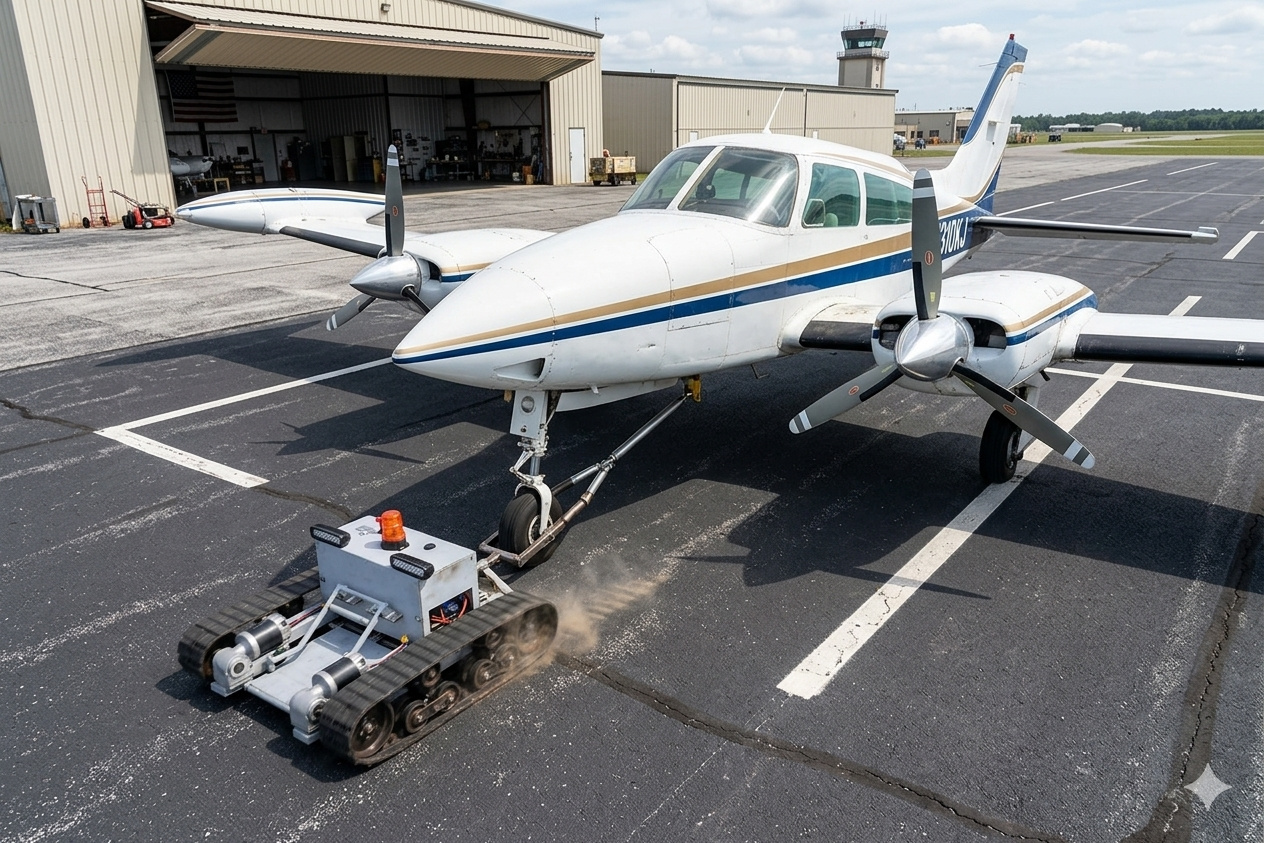

Inventor creates homemade electric tug with wheelchair batteries and Arduino and manages to move a plane over 2 tons.
In 2018, inventor and maker Anthony DiPilato presented a project that broke the traditional logic of airport equipment by building a homemade electric tug controlled by iPhone to move a light aircraft. The experiment was detailed by New Atlas on June 22, 2018, which showed the creation of a compact device, made in a workshop, with repurposed components and a cost target below **US$1,000**, a value much lower than commercial solutions used to maneuver aircraft on the ground.
The project’s target was not symbolic. The tug was developed to pull a Cessna 310 weighing about 5,200 pounds, equivalent to approximately 2,358 kg, an aircraft too heavy to be easily moved manually with just a tow bar. According to the official Arduino blog, on June 12, 2018, the goal was to create a remote system capable of moving this aircraft using a simple architecture, with programmable electronics and wireless control.
What makes the experiment relevant is not just the fact that it worked, but how it was built: with two 12 V wheelchair batteries, repurposed motors, Arduino Mega, Bluetooth HC-08 module, iPhone control, and a mechanical assembly with tracks, a front wheel fitting, and electromagnetic locking. Continue reading to understand how a seemingly simple piece of equipment managed to tackle a task that, under normal conditions, relies on specialized airport ground machines.
-
Brazil Develops Its First Locally-Made 5G Radio Unit, Achieves Over 1.5 Gbps in Lab Tests, Paving the Way for Interoperable Equipment

-
El Niño Intensifies: Over 90% Chance of Persisting Until 2027, Raising Ocean Temperatures and Increasing Severe Weather Risks in Southern Brazil, Warns Federal Report

-
NASA Prepares Trio of Small Satellites to Track Tropical Storms and Capture Rapid Rainfall Development from Above the Clouds
-
$7,999 Isaac 1 Robot Aims to Tackle Household Chaos: Folds Clothes, Makes Beds, and Organizes, but Raises Privacy and Cost Concerns with Camera Reliance and Remote Human Assistance



How an aircraft tug works and why the project is technically daring
At airports, tugs are used to move aircraft on the ground without using the plane’s own engines. This reduces fuel consumption, mechanical wear, and operational risks. These vehicles are designed to generate high torque at low speed, an essential characteristic for moving large masses with precise control.
Anthony DiPilato’s project replicates this logic on a reduced scale. Instead of brute power, he relies on efficient transmission and force distribution. **The device acts directly on the landing gear wheel, using grip and torque to initiate movement.**
**The critical point is not just moving the plane, but overcoming initial inertia**, which requires significantly more force than that needed to maintain displacement. This makes the achievement even more relevant from a technical standpoint.
Electrical structure with wheelchair batteries shows focus on torque, not speed
The tug’s energy system was based on two 12 V batteries used in electric wheelchairs. This type of battery is designed to provide high current for extended periods, ideal for applications requiring continuous power.

Unlike projects focused on speed, the goal here was torque. **The electric motor needed to generate enough force to move a mass exceeding two tons without compromising stability or control.**
The choice of these batteries also reduces cost and increases the project’s viability for makers, as they are relatively accessible and widely available components on the market.
Control via Arduino and Bluetooth transforms the tug into a functional remote system
One of the most interesting elements of the project is the control system. Anthony DiPilato integrated an Arduino microcontroller into the assembly, allowing precise electronic control of the motor.


Furthermore, the tug was equipped with Bluetooth connectivity, enabling remote operation via smartphone. This detail is not just an additional feature, but a practical solution for safe operator positioning during aircraft movement.
The remote control eliminates the need for the operator to be close to the wheels, reducing risks and increasing precision during maneuvers in confined spaces, such as hangars.
Project evolution included replacing wheels with tracks to increase traction
During initial tests, one of the main challenges identified was traction. Conventional tires did not offer sufficient grip to transmit all the force generated by the motor to the ground, especially on smooth surfaces.

To solve this, the project evolved to use tracks, a common solution in vehicles operating in low-grip conditions. Tracks increase the contact area with the ground and better distribute the weight, allowing for greater torque transfer.
This modification was decisive for the success of the experiment, as without adequate traction, even a powerful motor cannot move heavy loads.
Cost below US$ 1,000 contrasts with professional equipment costing tens of thousands
One of the most impactful aspects of the project is the estimated cost. While professional tugs can easily exceed the US$ 20,000 to US$ 50,000 range, the model developed by Anthony DiPilato was designed to cost less than US$ 1,000.
This difference does not mean that the two pieces of equipment are equivalent in terms of robustness, durability, or certification, but it highlights the potential of independent engineering to create functional solutions on a reduced budget.
The project demonstrates that, under certain conditions, simple solutions can fulfill functions traditionally associated with complex and expensive machines.