Portuguese
  Spanish


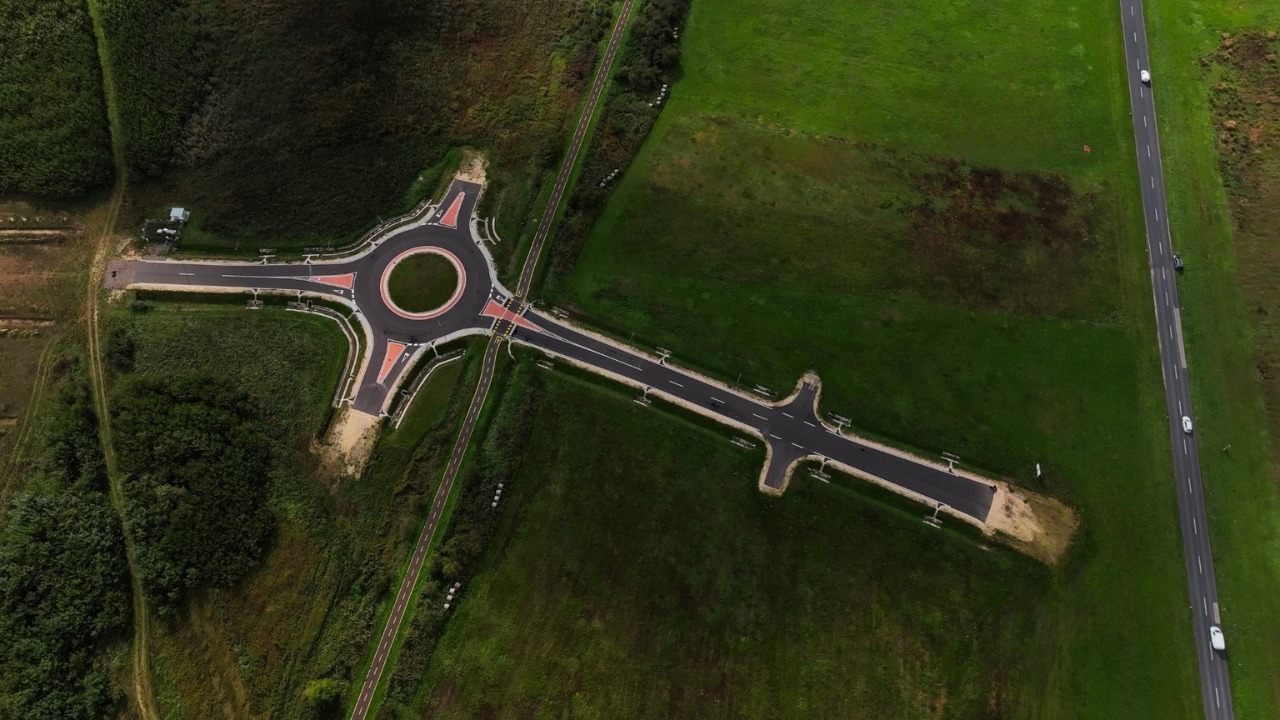

In the middle of an apparently ordinary field, between Zalaegerszeg and Zalaszentiván, in western Hungary, there is a scene that seems straight out of a political satire: a brand new roundabout, built with European public money, surrounded by dirt, weeds, and promises that never materialized.
Viewed from above, it looks like an infrastructure anomaly. There’s no intense car traffic, no functioning terminal, no trucks entering and exiting. Just a perfectly designed circular structure, waiting for a future that, so far, hasn’t arrived.
The project has become a symbol of a much larger problem: million-dollar projects announced with fanfare, financed with European Union money, but stalled by delays, bureaucracy, and unfulfilled government promises.
-
15-Year-Old Entrepreneur Malu Lira Publishes 20 Children’s Books on Financial Education, Earns $500,000, and Expands Her Project to the Amazon Rainforest

-
Entrepreneur Turns Rio Cemetery Canteen into a Successful Snack Chain Generating $4.9 Million Annually and Expanding to Metro Stations

-
Rare fox feared “extinct” found alive on Caribbean island after over two decades without official sightings

-
21-Year-Old Brazilian Student Turns Homemade Popsicle Hobby into $100,000-a-Month Business





A roundabout built for a megaproject that doesn’t exist yet

The story begins in 2021, when a major logistics plan was announced to transform the region into a strategic cargo transport hub in Central Europe. The company Metrans, a giant in the railway and intermodal sector, intended to build a new logistics center with a container terminal there.
The idea made sense on paper. The terminal would allow cargo arriving by train from the Adriatic Sea to travel more quickly through Hungary towards countries like Slovakia, the Czech Republic, and Poland, without necessarily having to pass through Budapest.
According to HHLA itself, Metrans’ parent company, the project envisioned an investment of over 40 million euros, with the expectation of creating around 120 jobs and commencing operations in the following years.
But there was a crucial detail: for the terminal to function, it needed an adequate railway connection. And it was precisely this part that stalled everything.
The money arrived, the roundabout was completed… and the rest disappeared
While the logistics center remained on paper, the local municipality proceeded with the construction of the access road and the famous roundabout. According to the investigative portal Átlátszó, the work cost around 500 million Hungarian forints, approximately 1.25 million euros, using non-reimbursable funds from the European Union.
The problem is that by the time the roundabout was finished, the container terminal hadn’t even begun to break ground.
The result is a powerful and embarrassing image: a million-dollar roundabout in the middle of nowhere, built to serve trucks, trains, and containers that simply haven’t arrived. The structure exists, but its practical function does not yet.
For residents, journalists, and government critics, it has become a perfect portrait of the poor coordination between public works and private investments. First, the access was built. Then, no one delivered the destination.
The missing piece: a promised and delayed railway line


The real bottleneck of the project is a railway connection known as the delta track, planned to allow freight trains to circulate more efficiently through the Zalaszentiván region. Without this structure, the Metrans terminal loses much of its operational logic.
According to the Hungarian newspaper Telex, this railway work was still in the tender phase, without a concrete start date. Even after the responsible company is chosen, construction could take more than two years.
In practice, this means that the railway might only become operational around 2029, in the most optimistic scenario. Until then, the roundabout remains idle, like a kind of circular monument to delay.
Metrans, in turn, reportedly indicated that it makes no sense to proceed with the terminal without the promised rail connection. In other words, private investment depends on a public work that continues to be delayed.
From Logistics Promise to Bizarre Attraction
The most curious thing is that the roundabout was not conceived as an absurd project. It was part of a real plan, with clear economic objectives. The problem was the sequence of events: one part of the project was delivered, while essential structures remained stuck in promises and administrative processes.
Today, the roundabout has become a kind of involuntary attraction. Aerial images show the isolated structure in the field, creating the impression that someone designed a major roadwork and then abandoned everything around it.
This aesthetic of abandonment helped the case gain international repercussion. The press began to treat the construction as an almost perfect example of infrastructure without a destination, a project ready for a future that never arrives.
In practice, it became more than just a roundabout. It became a visual symbol, easy to understand and hard to forget.
The Symbol of an Economy Full of Broken Promises
The story also gained traction because it touches on a delicate topic: the use of European funds in Hungary. CNN described the roundabout as an emblematic example of an economy marked by grand announcements, disconnected projects, and initiatives that fail to deliver the promised impact.
The case appears amidst broader criticism of Viktor Orbán’s government, frequently accused by opponents and European institutions of issues related to transparency, public procurement, and the use of community resources.
According to Daily News Hungary, billions of euros in funds allocated to Hungary remain blocked by the European Union due to concerns involving rule of law, corruption, and judicial independence.
In this context, the small roundabout in the field ceased to be merely a local curiosity. It came to represent an uncomfortable question: how many projects are inaugurated even before there is a complete plan to make them work?
A Useful Future or a Permanent Shame?
There is still a possibility that everything could change. If the railway line is finally built and the Metrans terminal comes to fruition, the roundabout could gain the traffic for which it was designed. Trucks, cargo, and trains could transform that isolated spot into an important piece of regional logistics.
But, for now, the reality is different. The project remains there, connected to almost nothing, surrounded by frustrated expectation and silence.
Metrans’ own page still presents the Zalaegerszeg hub as part of its strategic plans, but the originally disclosed deadlines already seem completely surpassed by delays.
In the end, the Hungarian roundabout became one of those images that say more than any speech. It shows how a project can be technically correct, visually impeccable, and, at the same time, totally useless when real planning is lacking.
For now, it remains there: a ghost roundabout, millionaire, isolated, and waiting for someone to finally build the path to where it should lead.