






 Portuguese
  Spanish
  4 min of reading
  0 comments


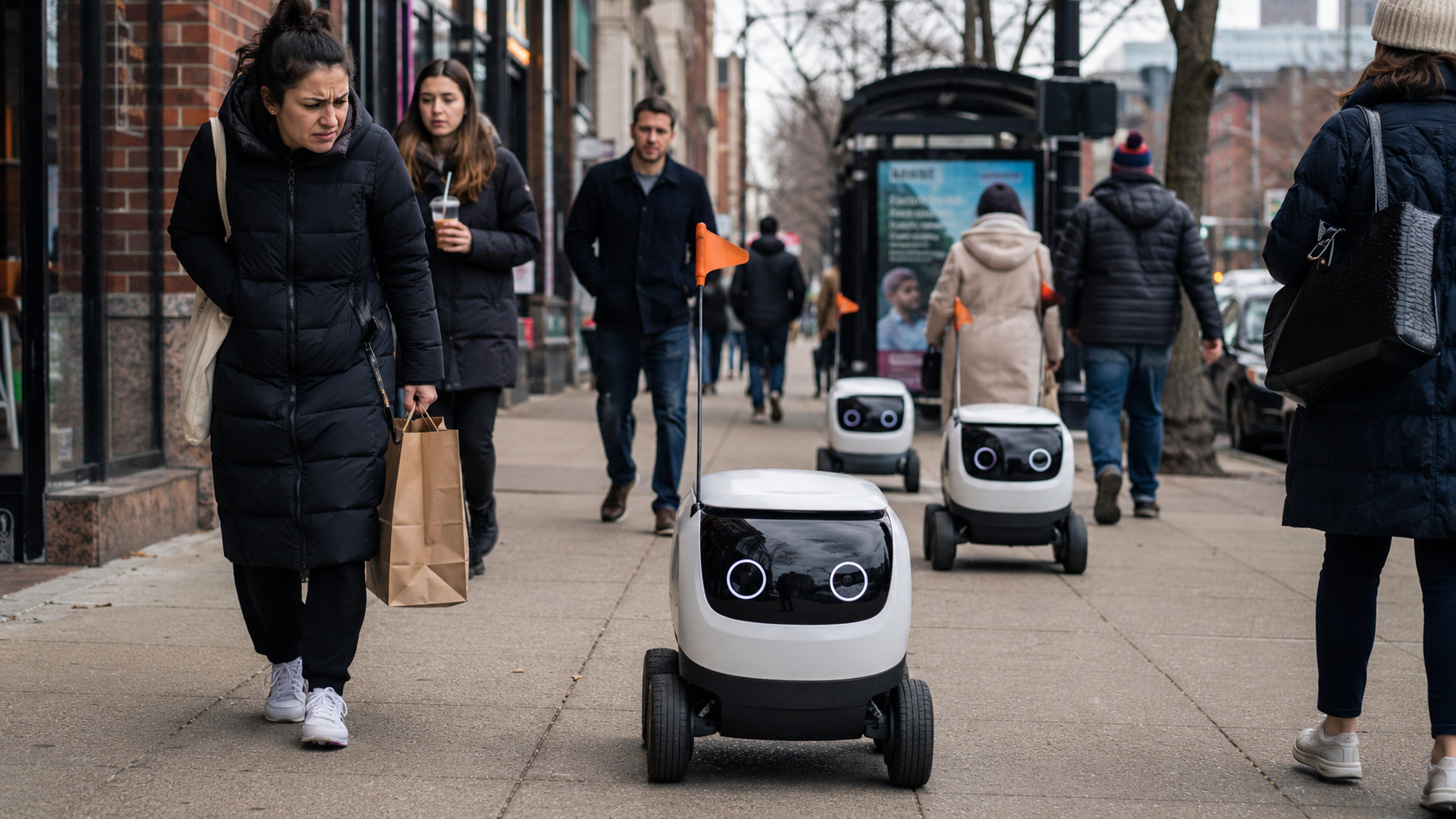
Delivery robots in Chicago went from curious novelty to a reason for complaints on sidewalks, with Lakeview residents demanding more safety, more transparency, and respect for public space used by pedestrians every day
Food delivery robots started circulating on Chicago sidewalks and became a source of outrage in Lakeview. What seemed like an urban novelty ended up generating fear, resident complaints, and a popular petition with over 800 signatures.
The investigation was published by CBS News Chicago, a local news station in the United States. The case involves delivery robots in Chicago, pedestrian safety, accessibility, and the use of public sidewalks by machines linked to private deliveries.
The detail that drew the most attention was the contrast between appearance and reaction. The robots had friendly names and an amiable look, but they came to be seen by some of the neighborhood as urban intruders.
-
Helicopter Drops 180 Tons of Sand and Gravel on Swedish River to Revive Ecosystem Damaged by Decades of Exploitation

-
Brazilian Company Launches Retro Smartphone with 48 MP Camera, T9 Keyboard, and Privacy Features for Social Media-Free Use

-
Self-Taught Chinese Farmer Builds 5-Ton Submarine from Scrap, Launches It in Anhui River
-
Invisible Induction Technology Enables Wireless Power for Blenders, Coffee Makers, and Air Fryers, Reducing Countertop Cables




Delivery robots in Chicago put Lakeview residents on alert
Food delivery robots began circulating on sidewalks in neighborhoods like Lakeview, on Chicago’s North Side. The proposal was to use small wheeled machines to deliver orders to customers.


The idea seemed modern, practical, and even fun. However, coexisting with pedestrians opened up a direct problem: sidewalks are used by people, not just by delivery services.
The discomfort grew as residents began to report risks along the way. The concern involves children, the elderly, people with disabilities, and anyone who relies on a clear sidewalk to walk safely.
The question at the heart of the controversy is simple: should the sidewalk primarily serve urban life or automated logistics?
Popular petition with over 800 signatures calls for a pause in the pilot project
The reaction turned into mobilization. Over 800 people signed a petition calling for a pause in the delivery robot pilot project.
CBS News Chicago, a local news station in the United States, detailed residents’ pressure against the circulation of machines on sidewalks. The demands involve safety, accessibility, and lack of transparency.
Josh Robertson, the petition’s creator, said his initial reaction was curiosity. Afterward, his perception changed. Robertson also stated that sidewalks need to be safe for everyone.
Cute appearance did not prevent the little robots from becoming urban intruders
The robots received names like Roland, Sully, and Stacey. This detail helped give the machines a friendly air and drew attention to the case outside the neighborhood.
But the friendly appearance wasn’t enough. For many residents, the problem wasn’t the robot’s name, but the space it occupied.
When a machine stops in the middle of the path, changes direction, or passes too close to someone, the feeling stops being curiosity and turns into discomfort. On a busy sidewalk, this type of situation can be alarming.
Therefore, the little robots came to symbolize something bigger: the entry of automation into spaces where only people used to circulate.
Pedestrian safety became the most sensitive point of the dispute
Safety became one of the main complaints. Subsequent reports mentioned collisions with bus shelters and situations where robots bumped into pedestrians.
Anthony Jonas reported hitting a robot when leaving home. He mentioned emergency care and stitches after the incident.

This type of report increased pressure on the project. For those who walk every day, a small machine may seem harmless, but it can still cause fright, a fall, or injury.
The debate also involves accessibility. A sidewalk with obstacles particularly hinders those who use wheelchairs, canes, crutches, walkers, or have difficulty moving.
Companies defend the robots, but residents demand clear rules
The companies involved stated that they monitor safety issues and follow city rules. They also informed that the robots do not exceed 5 miles per hour and reduce speed near pedestrians.
Even so, the reaction of the residents shows that low speed does not end the discussion. The problem also involves occupation of public space, transparency, and responsibility when something goes wrong.
The sidewalk is a shared space. When a company uses this space for deliveries, an important question arises: who should have priority on the path.
For the residents who signed the petition, the advancement of technology needs to respect the routine of those who live in the neighborhood. Innovation can help, but it should not turn pedestrians’ paths into a testing area.
Case in Chicago shows how automation can encounter resistance on the streets
The episode in Chicago shows that automation does not only face technical challenges. It also needs to deal with the real life of cities, where there is haste, children, elderly people, corners, bus shelters, and narrow sidewalks.
The delivery robots arrived with a friendly appearance, cute names, and a promise of convenience. However, in Lakeview, they ended up becoming a symbol of a larger dispute between technological convenience and urban safety.
The petition with more than 800 signatures showed that residents want to participate in decisions about the use of sidewalks. The case reinforces that public space cannot be treated merely as a corridor for delivery.
In the end, the revolt against the delivery robots in Chicago reveals a simple and important concern: new technology needs to work without compromising the safety of those walking in the city.
Do you think it’s fair for companies to use public sidewalks to test delivery robots, even when residents say it disrupts pedestrian safety? Share your opinion in the comments.





Be the first to react!