





 Portuguese
  English
  Spanish
  6 min of reading
  0 comments


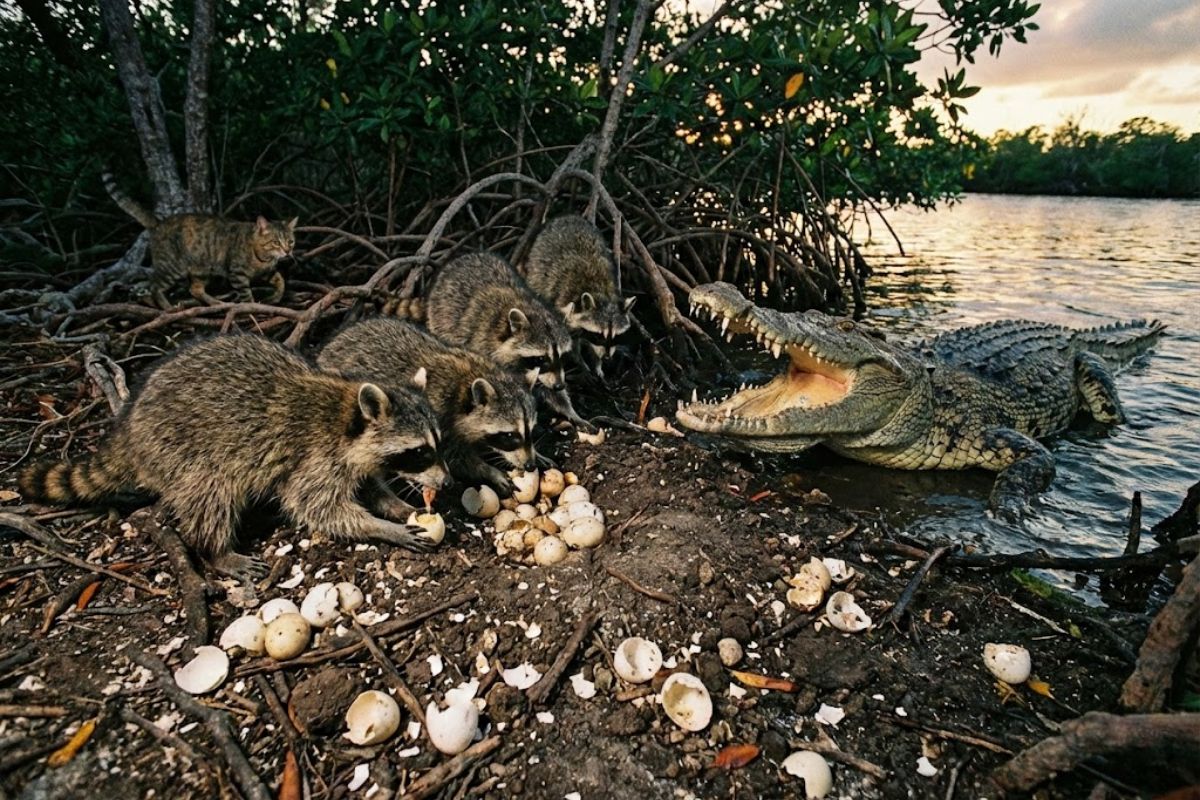
On Nesting Beaches, American Crocodiles Stop Protecting Eggs for Minutes, and Raccoons Take Advantage in Nighttime Attacks That Result in Up to 70 Eggs. Researchers Found, in 2025, a Link Between Boldness and Toxoplasma, a Parasite Associated with 1 to 3 Million Feral Cats. With Nesting Sites Decimated, Biologists Discuss Intervention as a Last Resort.
In the Florida Keys, American crocodiles are losing nests sequentially to raccoons, in a pattern described as “decimating” eggs and threatening the recovery of a species that is slowly bouncing back. The alert gained momentum after a study published in March 2025 linked the abnormal boldness of raccoons to the parasite Toxoplasma gondii.
The backdrop makes the case even more sensitive: after dropping to only a few hundred individuals in the late 1960s, the American crocodile was put under protection in 1975 and, after decades of recovery, was reclassified from “endangered” to “threatened” in 2007. Now, the pressure on nests reignites the debate on what to do, and how far to go.
Why American Crocodile Nests Became the Weak Point

American crocodiles live along the coast and tolerate saltwater better than alligators, with narrower snouts and slimmer bodies.
-
While electric cars die in four hours, the British Hydromax aims to be the fastest hydrogen car in the world with 1,600 hp and a target of 563 km/h.

-
With R$ 29.5 million, the Army, Petrobras, and Finep aim to transform petroleum pitch into high-value carbon fiber and pave the way for a strategic national technology for defense, rockets, aircraft, and industry.

-
While American dams have gone decades without turbines, Oak Ridge is 3D printing turbines to unlock up to 29 GW stalled in the US.
-
While nuclear explosions go unnoticed at 1,000 km, the loudest sound in history was heard at 4,800 km and circled the planet four times.




They can reach over 3.8 meters, live up to 70 years, and maintain a form that has been “almost unchanged” for over 200 million years.
Still, vulnerability appears during reproduction. American crocodiles lay eggs on land, usually between 30 and 70 eggs per nest.
Females protect the nests but cannot stay 24 hours a day, 7 days a week: they need to leave to hunt, regulate temperature, avoid dehydration, and maintain energy.
These absences last from a few minutes to several tens of minutes, creating a window that raccoons know how to exploit.
How Raccoons Attack and Why It Is So Effective
An adult raccoon weighs on average 6 to 9 kg, with rare cases reaching about 12 kg.
In contrast, an adult American crocodile typically measures 2.5 to 3.5 meters and weighs between 200 and 400 kg. In a direct confrontation, the crocodile has the advantage, which is why raccoons do not attack adults.
The strategy is different: avoid confrontation and target eggs and hatchlings. The pattern described in the material is methodical: raccoons observe, remember, and wait, typically approaching at night.
If the female is nearby, they retreat; if she leaves, they return, digging precisely where the eggs are, removing one by one and moving away.
It is quick, silent, and efficient, and depends precisely on those minutes when the female is not over the nest.
The Detail That Changed: “Reaction Time” and Unusual Boldness
For a long time, this type of raiding when the crocodile was away was known. What raised the alarm was a behavior repeatedly seen in the analyzed footage: some raccoons did not retreat early when the crocodile approached.
They stayed longer, dug deeper, and only left when the female was very close.
To measure this, researchers used a direct metric: reaction time.
Some individuals retreated with 8 seconds to spare, others with 6 seconds, some with 4 seconds. And there was an exceptional case: 0 seconds, retreating at the last possible moment, just avoiding a direct attack.
The problem is that the most reckless do not “learn” and disappear.
The cameras recorded these raccoons returning, sometimes just a few nights later, and then the nest would be completely decimated, with all 30 to 70 eggs disappearing in one attack. For a species with a slow reproductive rate, this represents a severe blow to a single generation.
Toxoplasma Gondii: The Parasite That Intrigues Fear and Risk
In March 2025, a study pointed to the “real culprit” for this abnormal boldness: Toxoplasma gondii, a protozoan parasite. It does not kill the host immediately.
Instead, it can migrate to the brain and nervous tissue, forming parasitic cysts that can persist for a lifetime.
The text highlights that these cysts do not cause pain or obvious symptoms of inflammation and are difficult for the immune system to eliminate completely.
In terms of mechanism, neuroscience research cited in the material indicates an effect on the dopaminergic system, linked to motivation, reward, and risk assessment.
The result would not be “madness,” but a misjudgment of danger, with reduced fear responses and increased risk-taking.
The key point for conservation is the following: infected raccoons remain intelligent, able to observe and plan, but when choosing between retreating safely or staying a few seconds longer, they choose incorrectly.
Why 1 to 3 Million Feral Cats Are Central to the Story
The cycle of Toxoplasma has a crucial element: only cats are definitive hosts, where the parasite reproduces sexually and produces durable cysts released into the environment through feces.
The material describes a dimension that explains the scale of the problem: conservation estimates suggest that Florida has between 1 and 3 million feral and stray cats, living in colonies around canals, landfills, residential areas, parks, and especially near wetland areas like the Everglades.
A single infected cat can shed millions of cysts per day and, in one to two weeks, contaminate a habitat area of several hectares.
The concern grows because these cysts can survive for months or over a year in moist soil, tolerate brackish water, are not completely destroyed by chlorine, and can pass through standard treatment systems.
In an interconnected environment of wet soil, brackish water, and swamps, they accumulate over time.
In this scenario, raccoons enter as ideal intermediate hosts: they live close to humans, eat almost anything, and roam widely.
When infected, the described effect is clear: they do not become less intelligent, but become more prone to misjudging risk, repeating attacks, and insisting on seconds that could be fatal.
What Is at Stake Beyond Nests: Conservation and Domino Effect
The text describes the American crocodile as a keystone species in the Everglades ecosystem. Its central role lies not only in predation but in digging water holes during the dry season.
These burrows often reach 1 to 2 meters deep, retaining water when surrounding areas dry out. Field research cited indicates that, in the dry season, the density of fish and aquatic life around these burrows can be 3 to 5 times higher than in areas without crocodiles.
The cascade logic is as follows: fish survive the drought, birds have food, colonies sustain themselves, and the swamp preserves part of its stability.
The risk pointed out is that even a modest decline in American crocodiles could trigger difficult-to-reverse changes, with loss of aquatic refuges, worsening biodiversity, and imbalance in the system.
The Reaction That Divides Opinions and Why It Seems “Last Resort”
The controversy, as described in the base, arises because the chain of consequences connects humans, cats, water, and wildlife.
The material points out the decisive factor as the practice of keeping cats outdoors, allowing uncontrolled breeding, urban expansion encroaching upon wetland areas, and wastewater systems that are not entirely effective.
For this reason, any response tends to touch on sensitive points: interfering with feral cat populations, reducing sources of environmental contamination, and protecting critical nesting areas of American crocodiles.
Do you think conservation should prioritize measures focused on feral cats, or is directly protecting nests of American crocodiles the more realistic path right now?





-

-

-

-

-

-

33 people reacted to this.