Portuguese
  Spanish


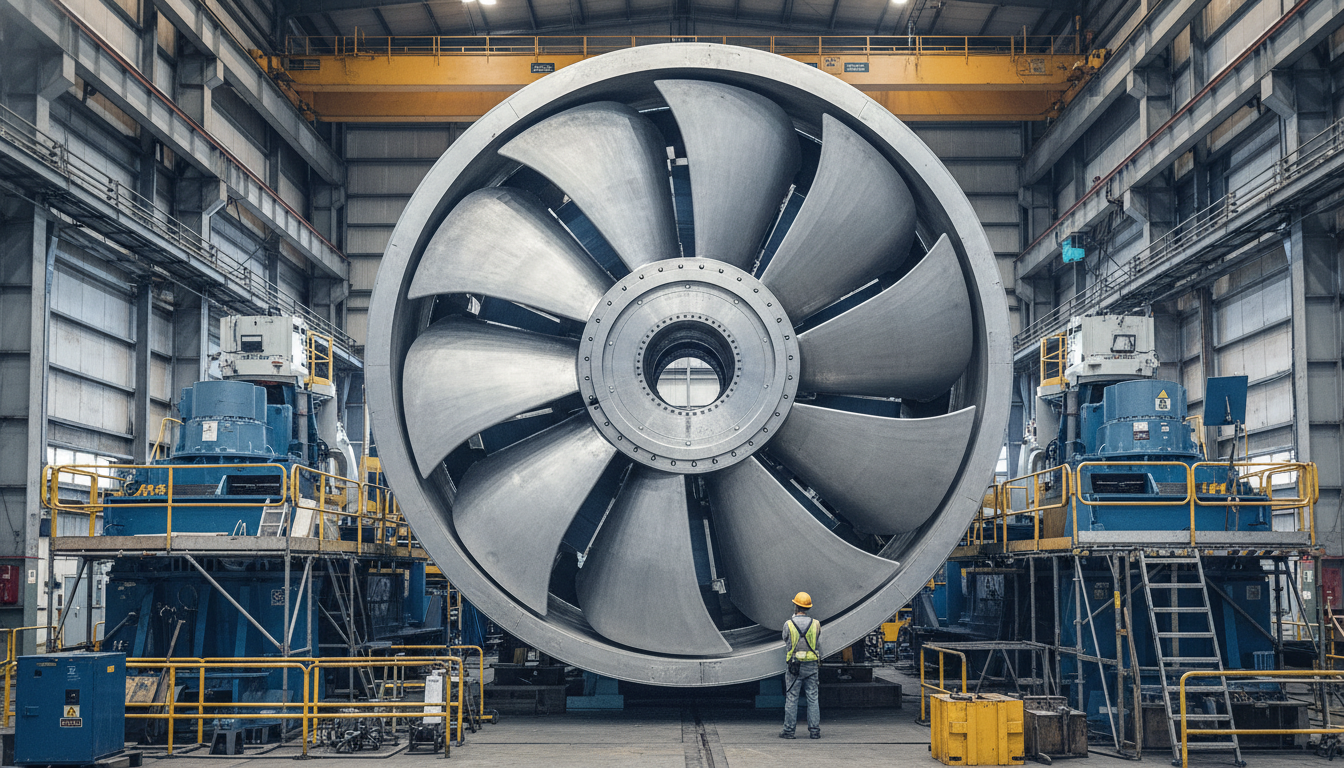

Oak Ridge National Laboratory develops BAAM additive manufacturing turbines to enable generation in up to 80,000 American dams currently without installed turbines.
In 80,000 dams spread across the United States, only 3% have turbines installed to generate electricity. The 3D printed turbines from Oak Ridge National Laboratory could change this historical statistic.
The movement is detailed in a report by Interesting Engineering. According to the publication, the technology has already left the laboratory.
According to the publication, the partnership involves ORNL, the company Cadens Hydro, and the U.S. Department of Energy. The goal is to unlock tens of gigawatts currently idle.
-
Farmer in Ireland Discovers Intact Bronze Age Tomb While Moving Stone on His Land

-
AI Deciphers 1.4 Meters of Text from a 2,000-Year-Old Scroll Carbonized by Mount Vesuvius Without Unrolling It
-
Ferrari, BMW, Tesla, and Chinese Automakers Shift from Copper to Aluminum Wiring to Reduce Weight and Costs in Electric Vehicles
-
Brazilian Researcher Unveils Innovative Intraocular Lens for Cataract Treatment with High-Precision Optics, Enhancing Vision at Multiple Distances and Reducing Unwanted Visual Effects




The number cited by sectoral analyses reaches 29 GW. Therefore, the project has a clear ambition.
According to the DOE officially, the conservative potential is 12 GW in existing dams without generation. The 29 GW also includes modernizations.
In other words, it is more than the total capacity of the Itaipu hydroelectric plant, which delivers 14 GW. Just by reusing existing infrastructure.

What are the 3D printed turbines from ORNL
ORNL operates the Manufacturing Demonstration Facility (MDF), one of the world’s leading hubs for large-format additive manufacturing. According to the laboratory itself, the central technology is BAAM.
BAAM stands for Big Area Additive Manufacturing. It is a giant industrial 3D printer capable of printing parts several meters long. The deposition rate reaches dozens of kilograms of material per hour.
Therefore, the technology allows two main approaches:
- Direct printing of non-critical components — casings, ducts, prototypes, and turbines for low heads
- Printing of molds for casting — drastically reduces the manufacturing time of metal parts
- Thermoplastic composites — ABS or nylon reinforced with carbon or glass fiber
- Typical diameters of 1 to 3 meters for small hydropower plants and dam modernization
According to DOE documents, the strategy is to “standardize, modularize and digitize” the small hydropower project chain. In Portuguese: padronizar, modularizar e digitalizar.
Why 29 GW are idle in the USA
According to a DOE study titled “An Assessment of Energy Potential at Non-Powered Dams,” there are about 80,000 dams in the USA. On the other hand, only 3% of them generate electricity.

In other words, there are 77,600 concrete structures erected for other purposes. Flood control, irrigation, or navigation are common examples. The official potential is 12 GW conservatively.
Therefore, the number of 29 GW cited in industry analyses broadens the scenario. It includes modernization of existing plants and new low-impact hydroelectric plants.
According to the National Hydropower Association, the historical bottleneck for these projects is the cost of turbines.
How 3D printed turbines reduce costs
According to DOE and industry reports, turbines are one of the most expensive items in small hydropower plants. Custom engineering, casting, and machining add up to barriers.
With the adoption of large-scale additive manufacturing, the objectives are:
- Reduce component costs by 20% to 40%, depending on the route
- Decrease total project costs for small hydropower by 10% to 20%
- Shorten lead times from weeks to days in mold manufacturing
- Enable distributed production near the dams
Therefore, the approach is classified by the DOE as a path to “reduce time to market.” In other words, it shortens the time between project and commercial operation.
Direct quote from ORNL researcher
Brian Post, an ORNL researcher in the area of additive manufacturing, summarizes the bet. In a statement available on the laboratory’s portal, he states:
“Large-scale additive manufacturing lets us produce complex energy components faster and at lower cost, enabling designs that would be impractical with traditional methods.”

According to researchers associated with the DOE’s Water Power Technologies Office, the gain is twofold. On the other hand, the technology opens doors to previously impossible geometries.
In other words, designs that would require heavy tooling and complex machining can now be printed. The flexibility opens space for new projects.
What this means for Brazil
Brazil is a global hydroelectric power. According to data from EPE and ONS, the country has about 190 GW of installed capacity. Hydroelectricity accounts for 55-60% of the electricity matrix.

Therefore, Itaipu (14 GW, binational) and Belo Monte (11 GW) are among the largest in the world. In the USA, hydroelectricity represents only 6-7% of electricity generation.
Still, Brazil has remaining potential in small hydropower plants (PCHs) and CGHs. Thousands of megawatts are mapped in medium-sized rivers.
According to the ABRAPCH, the Brazilian logic is similar to the American one. Custom turbines for PCHs are expensive and take time to be ready.
Application in Brazilian PCHs and modernizations
In other words, large-scale 3D printing could reduce costs for the national industry. Therefore, it would facilitate prototyping of Kaplan-type turbines, Bulb turbines, or solutions for low heads.
Similarly, it would shorten construction schedules. According to sector analysts, long deadlines have historically deterred investors from PCHs in Brazil.
In large plants like Itaipu, the immediate role is more indirect. On the other hand, the technology would serve for mold production, hydraulic models, and spare parts.
The limits of 3D printed turbines
Despite the enthusiasm, there are important caveats. Firstly, most BAAM projects for turbines are in the technological demonstration phase.
According to the DOE documentation, there is no commercial fleet in the USA operating exclusively with structurally printed turbines. The path begins with auxiliary parts.
Therefore, critical materials need rigorous qualification. Components that work under high stresses and long cycles require structural certification.
The near future of printed hydroelectricity
According to ORNL’s technical documentation, the short-term strategy focuses on pilots and modernization of small plants. Therefore, the marginal impact is easier to measure.
In the medium term, with process and material qualification, the technology migrates to components of greater responsibility. Still, it will require years of validation.
It is worth remembering that the goal of “unlocking 29 GW” should be read as a broad scenario. It includes several public policy instruments, not just 3D printing.
In other words, additive manufacturing is one of the tools. On the other hand, success depends on federal funding and a robust industrial chain.
According to Brazilian energy coverage on modernization of the electric sector, the American case serves as a mirror. The lessons on cost and time apply to the Brazilian PCH market.
However, a final caveat is necessary. The technology still faces limitations in critical structural parts. However, the pace of advancement has accelerated in the last five years.
Will Brazil take advantage of this wave of additive manufacturing to unlock its own stalled hydroelectric potential, or will it just watch from the sidelines as the new industrial revolution in the sector unfolds?