





 Portuguese
  English
  Spanish
  3 min of reading
  0 comments


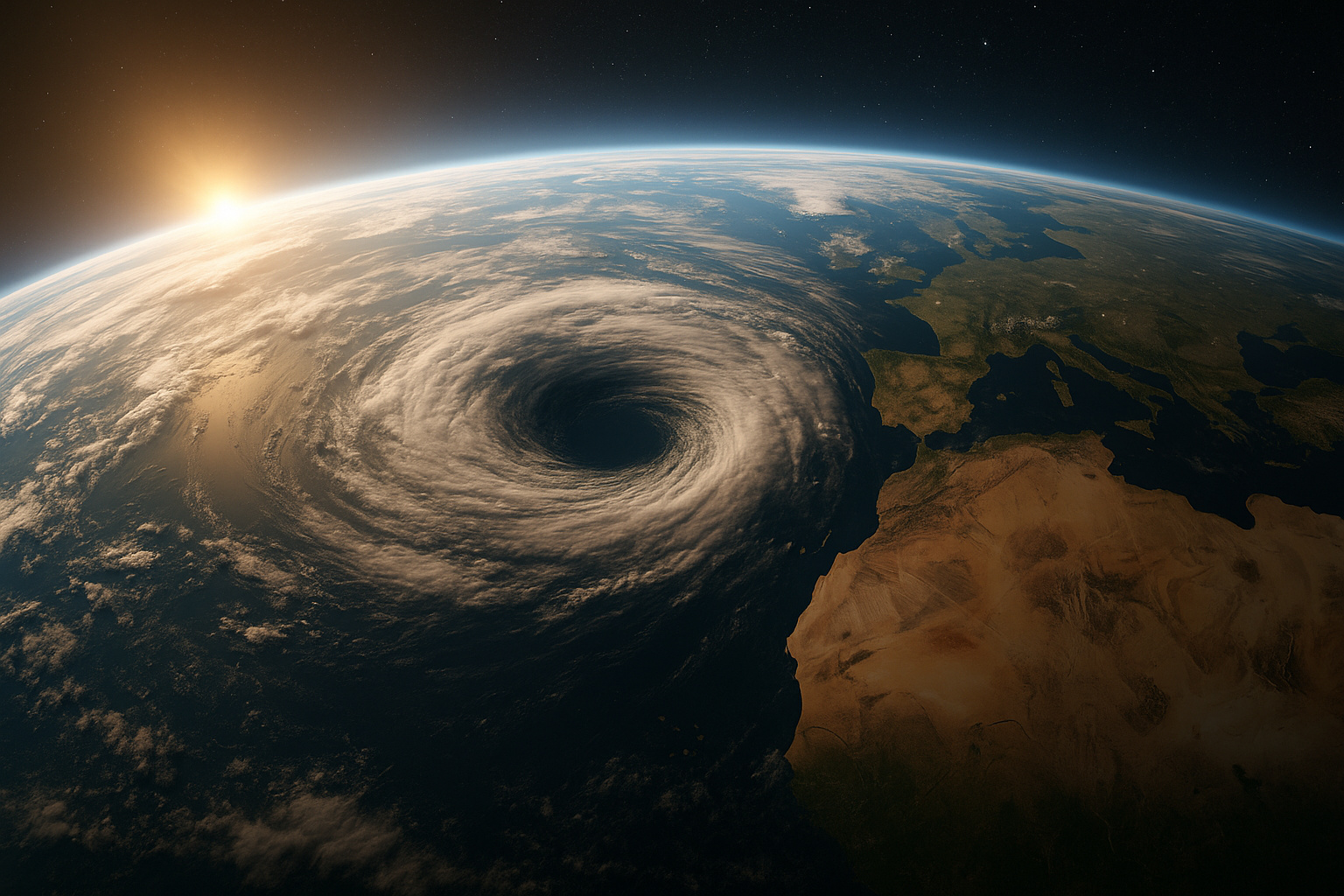
Phenomenon Detected Over the Atlantic Intrigues Scientists
In 2007, satellites from the GRACE mission, from NASA and the German Aerospace Center (DLR), detected an anomaly in Earth’s gravity over the eastern Atlantic Ocean. Although the phenomenon went unnoticed at the surface, it intrigued scientists around the world for nearly two decades. Now, in 2025, French researchers have finally presented a convincing explanation, supported by spatial data and models of the planet’s internal dynamics.
The Event That Shook Earth’s Gravitational Field
Between 2006 and 2008, the instruments of the GRACE mission recorded intense changes in Earth’s gravitational field. These fluctuations peaked in January 2007, when a band over 7,000 kilometers displayed anomalous behavior. While initial hypotheses pointed to ocean movements or tides, none withstood detailed analysis. Consequently, the mystery remained alive, generating new theories each year.
However, as the data was reviewed, it became clear that the anomaly was fundamentally different from any surface event previously documented. Therefore, scientists needed to look deeper—literally.
-
2 scientists analyzed in a new study whether the construction of a mega dam in the Bering Strait could be the last barrier against climate collapse, to protect one of the world’s most important ocean currents.

-
Compound extracted from the leaves of the red copaiba, a tree from the Atlantic Forest, inhibits entry, replication, and proteins of SARS-CoV-2 on various fronts and reinforces the potential of Brazilian biodiversity in the search for new drugs against Covid-19.

-
Lab-grown meat has become the target of bans and moral panic because lawmakers compare the technology to Frankenstein, while experts try to contain rumors that protect conventional livestock and may delay the only animal protein created to reduce carbon, water, and land use.

-
Butterfly robots, giant bees, and even a mechanical serpent are attracting attention in Germany and show how industry is copying nature to create faster and smarter machines.






The Scientific Twist Came from Inside the Planet
In 2025, a team from the National Geographic Institute of France (IGN), with support from the National Center for Space Studies (CNES), decided to reopen the case. They cross-referenced the original GRACE data with new computational models that simulate the behavior of Earth’s lower mantle. This layer, located between 660 and 2,900 kilometers deep, is where extreme temperatures and pressures transform minerals into new structures.
It was there that the key element emerged: the mineral bridgmanite, part of the perovskite family. Under specific conditions, it alters its crystal structure and changes density, redistributing mass around it. Thus, this change would be sufficient to modify the gravitational field globally. This hypothesis, led by geophysicist Charlotte Gaugne Gouranton, is the first to link the 2007 phenomenon to an internal Earth’s process.
Furthermore, the study shows that micromovements underground can produce global effects perceptible by satellites. Therefore, this research represents a paradigm shift in understanding Earth’s gravity.
Timeline of the Phenomenon and Its Discoveries
- 2002: The GRACE mission is launched by NASA and DLR, aiming to map gravitational variations in real-time.
- 2006–2008: Earth’s gravitational field experiences an anomaly detected over the Eastern Atlantic, peaking in January 2007.
- 2017: The mission concludes, but its data continues to be analyzed by universities and global research centers.
- 2025: Researchers from IGN and CNES publish a study in Geophysical Research Letters identifying bridgmanite as the cause of the anomaly.
This sequence of events proves how science evolves based on continuous revisions. Each new generation of scientists adds layers of understanding that reconstruct the history of the planet.
The Impact of the Discovery on Modern Geophysics
According to experts from NASA and IGN, this discovery alters the way the world understands Earth’s internal dynamics. Besides solving an old mystery, the study reinforces that Earth’s gravity is sensitive to microscopic processes. Thus, it paves the way for future observation missions, such as GRACE-FO (Follow-On), which continues to monitor global gravitational equilibrium.
Consequently, this revelation has direct implications for areas such as climate change, ocean monitoring, and seismic predictions. After all, if Earth’s interior can alter the gravitational field, it can also influence other natural phenomena on a global scale.
What the Future Holds for Gravity Science
The explanation for the 2007 event closes one of the most intriguing chapters of modern geophysics. However, it also opens new questions: how many other anomalies still hide secrets in the depths of the planet? And how does bridgmanite react under different pressure and temperature conditions over millions of years?
While these answers are yet to come, scientists celebrate a remarkable achievement. After 18 years of uncertainty, Earth’s gravitational mystery has finally been solved. But, inevitably, each discovery also reveals how much more there is to understand about the force that holds everything in place.


-

-

2 people reacted to this.