






 Portuguese
  Spanish


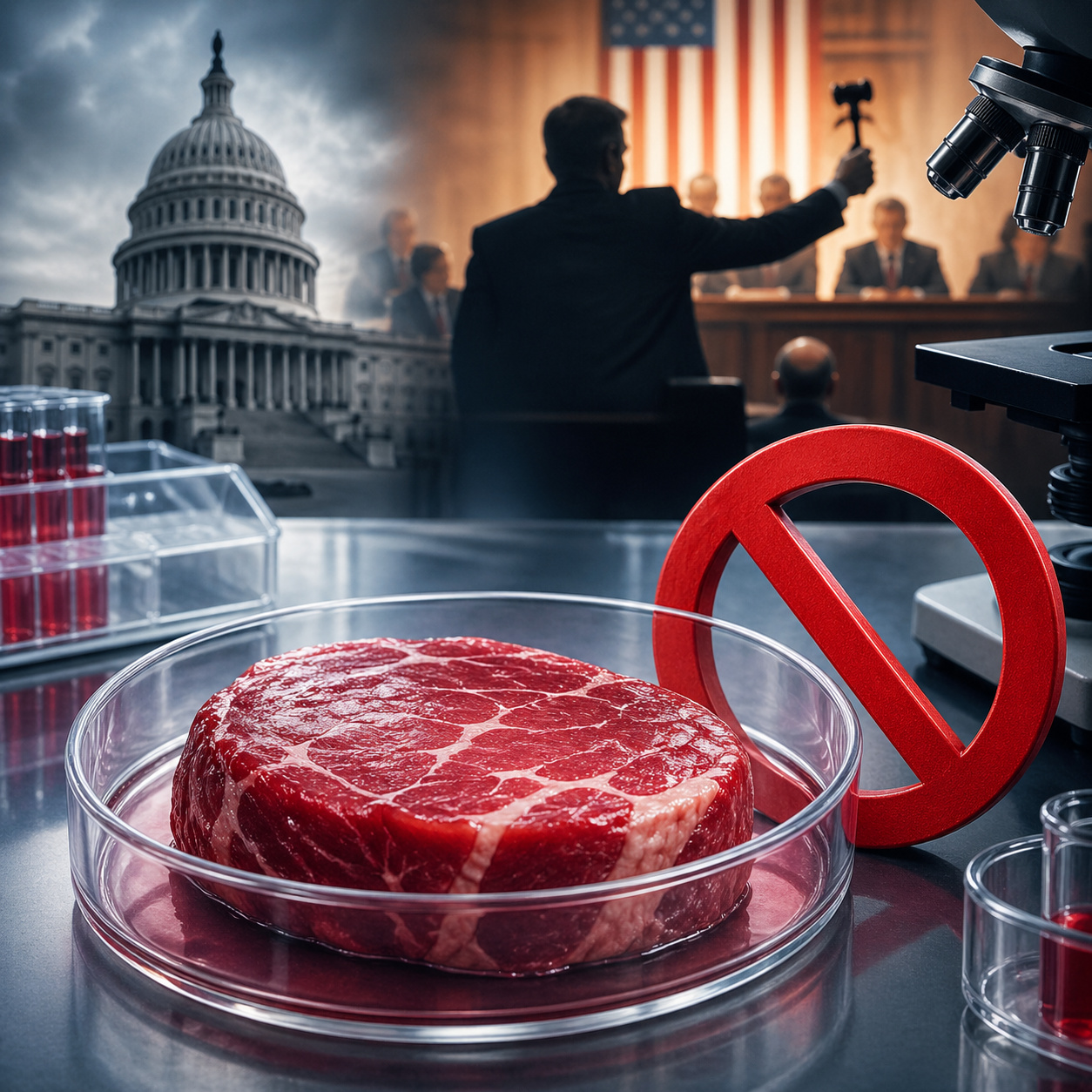

Cultivated meat grows globally with billions in investments, but faces bans and misinformation before reaching the market.
According to the Good Food Institute, the cultivated meat industry grew from four companies in 2015 to over 140 companies spread across six continents by 2025, amassing more than US$ 3.4 billion in investments. In at least 30 different countries, scientists are working in bioreactors developing technology capable of reducing greenhouse gas emissions associated with animal protein production by up to 92% and land use by up to 90% compared to conventional livestock. It is one of the most funded technological bets of the last decade to tackle the challenge of feeding a projected global population of 10 billion people without expanding ecosystem destruction.
Despite this progress, the technology has been banned in at least four U.S. states before any product reached supermarket shelves. Lawmakers compared bioreactors to Frankenstein experiments, while misinformation campaigns circulated manipulated images and narratives without scientific basis, influencing political decisions in regions where the technology has not even been tested.
Cultivated meat is real animal tissue produced by cells and not a plant substitute or artificial synthetic food
To understand the disconnect between political discourse and technical reality, it is essential to understand what cultivated meat is.
-
What is a red flashlight used for, after all? See why it is so commonly used at night.

-
He has never read a line of code, but he already knows how to work: the French company UMA presented in Paris the Northstar, its first AI-powered humanoid robot designed for factories and warehouses, capable of copying tasks just by observing an employee in action.

-
A young Kenyan engineer collects plastic waste from the streets and transforms it into robots that translate physics lessons into sign language in real-time, a machine made with old bottles that teaches what was missing to deaf children left out of science.
-
What is the dark substance found in the sand of Ipanema Beach? Civil Police conduct an examination, collect samples of the material, and initiate an investigation to identify the composition, clarify the origin, and verify if there was an environmental crime.




Cultivated meat is real meat. It is not plant protein, processed insects, or algae. It is muscle and fat tissue produced from animal cells cultivated outside the organism, in a controlled environment.
From a molecular standpoint, it is chemically identical to meat obtained by conventional slaughter. The difference lies solely in the production process.


The process begins with the collection of stem cells through a minimally invasive biopsy, which does not kill or significantly harm the animal. These cells are inserted into a culture medium that replicates the organism’s internal environment and transferred to bioreactors that control temperature, pH, oxygen, and pressure.
Over two to eight weeks, the cells multiply and differentiate into muscle fibers and fat, forming structures equivalent to conventional meat.
Global companies are already producing cultivated chicken, beef, pork, and even fish on a pilot scale
Several companies are already operating with this technology. The Dutch company Meatable produces beef and pork from pluripotent cells, forming burgers in as little as 12 days. The American UPSIDE Foods produced cultivated chicken approved by the FDA in 2023. The Israeli Aleph Farms is developing cultivated steak from the cells of a cow named Lucy. Meanwhile, Wildtype cultivates salmon.
The technological scope already covers virtually all major animal proteins consumed globally.
The first cultivated burger cost 325,000 euros and marked the beginning of an exponential cost reduction
In August 2013, scientist Mark Post from Maastricht University presented the first lab-grown burger.
The cost was 325,000 euros, funded by Google’s co-founder Sergey Brin. The product was prepared live and tested by food critics.

In the following years, there was an accelerated cost reduction, similar to what was observed in the evolution of computing. By 2025, the cost per kilo dropped to about US$ 10 to US$ 20 in pilot environments.
Companies using artificial intelligence in the process report additional cost reductions of up to 40%, with optimization of cell growth and nutrient use.
Political bans in the United States occur before market arrival and without proven scientific basis
In 2024, Florida Governor Ron DeSantis signed a law prohibiting the production and sale of cultivated meat.
Other states, such as Alabama, Tennessee, and Arizona, have moved forward with similar proposals, often based on arguments without scientific backing.
Claims such as the presence of modified genetic material, use of hormones, or the possibility of producing human meat have no technical basis.
Reports from the Good Food Institute and the Sabin Center for Climate Change Law have shown that dozens of common claims about the technology are not supported by peer-reviewed scientific literature.
Resistance to cultivated meat is linked to economic interests of the traditional livestock industry
Opposition to cultivated meat follows a pattern identified in other sectors, such as renewable energy.
Groups that appear to be local have funding linked to livestock industry associations and think tanks connected to traditional agribusiness.
Conventional livestock generates about $800 billion per year in the United States. Technologies that drastically reduce land use and emissions represent a direct threat to this economic model. Blocking the technology at the regulatory stage is cheaper than competing with it after it reaches scale.
Conventional livestock accounts for 14.5% of global emissions and occupies 70% of the planet’s agricultural land
Traditional meat production has significant environmental impacts. Livestock accounts for approximately 14.5% of global greenhouse gas emissions, according to widely used data from the FAO. It occupies about 70% of agricultural land and is one of the main drivers of deforestation in tropical regions, including the Amazon.
Additionally, it consumes large volumes of water and contributes to antimicrobial resistance due to the intensive use of antibiotics.
Cultivated meat emerges as the only alternative that maintains the sensory experience of meat with a lower environmental impact
Among existing alternatives, cultivated meat presents a central characteristic: it maintains the sensory experience of traditional meat.
Being biologically meat, it preserves texture, flavor, and composition, while reducing environmental impacts.

Studies indicate a reduction of up to 92% in emissions, 90% in land use, and elimination of systemic antibiotic use. It also allows for nutritional control of the final product.
Now we want to know: will cultivated meat reach the market before being blocked by political decisions?
Technological advancement indicates that production at scale is a matter of time.
In your view, will cultivated meat be able to overcome political barriers and reach the consumer, or will it be halted before competing with traditional livestock?


