






 Portuguese
  Spanish


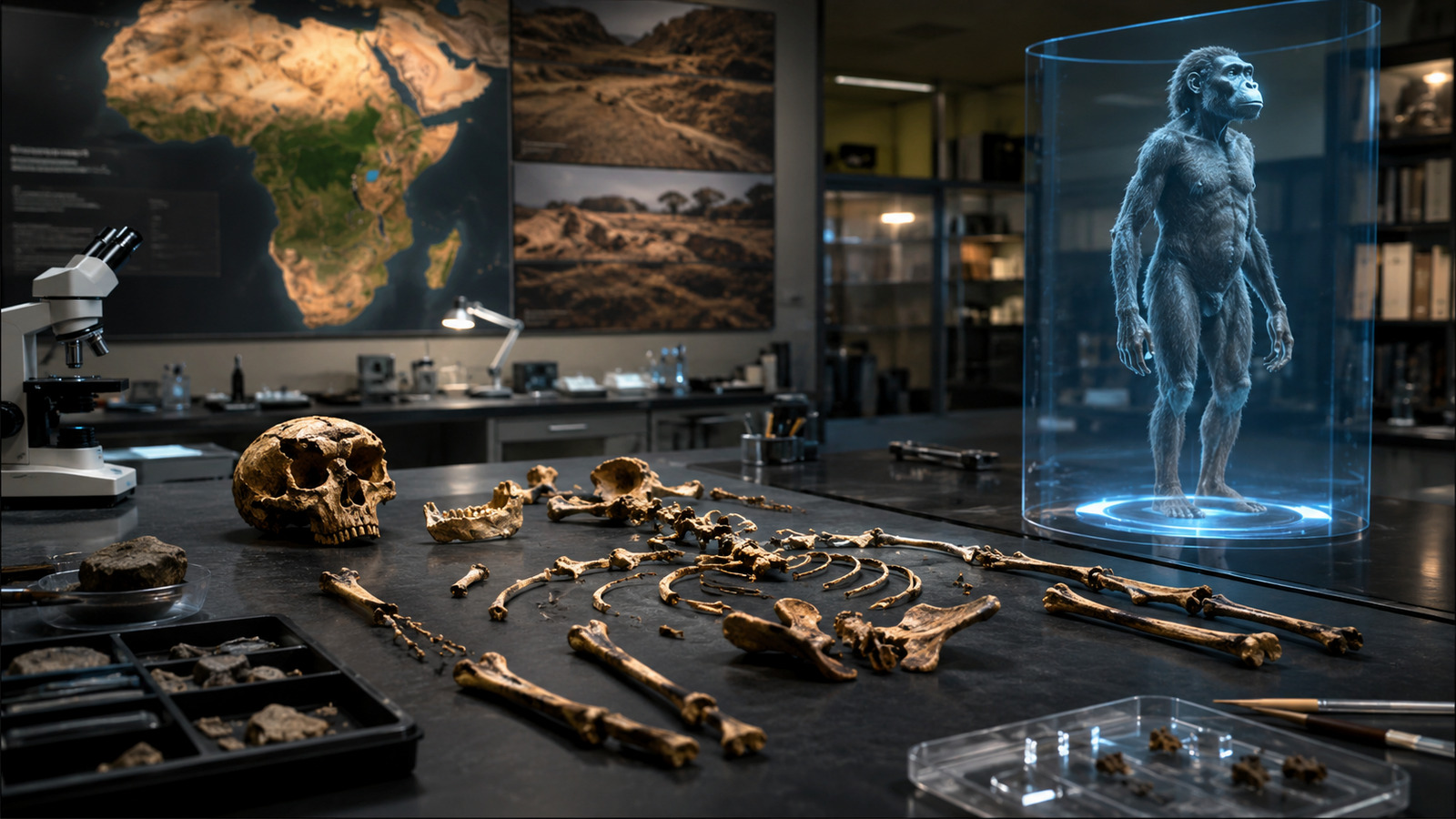


Discovered in 1974 in Ethiopia, the fossil Lucy revealed that human ancestors were already walking on two legs before brain enlargement, changing scientific hypotheses about human evolution
The discovery of Lucy, a fossil approximately 3.2 million years old found in 1974 in the Hadar region of Ethiopia, changed paleoanthropology by revealing that human ancestors were already walking bipedally before the significant increase in brain size in the human lineage.


Lucy was found in Ethiopia and preserved about 40% of the skeleton
The fossil was discovered by a team led by paleoanthropologist Donald Johanson. The remains belonged to a female of the species Australopithecus afarensis, one of the most important for the study of human evolution.
The preservation of about 40% of the skeleton made Lucy a rare find. This level of conservation allowed researchers to analyze anatomical details related to locomotion, posture, and body structure of a hominid that lived millions of years ago.
-
China Develops Custom 140-Ton Electric Mining Truck with 770 kWh Swappable Battery, Deploys 290 Units in Xinjiang’s Largest Zinc Mine

-
Meta to Launch Arena, a New Prediction App Targeting 3.56 Billion Users, Competing with Polymarket and Kalshi

-
Scientist Challenges Famous Human Evolution Theory, Argues Homo Sapiens Evolved Gradually Over Thousands of Years
-
15-Year-Old American Builds Ocean Generator with PVC Pipe and 3D-Printed Propeller for $12, Wins National Prize, Presents at White House, and Makes Forbes 30 Under 30 List




The most important data from the fossil is not just its age, but what it revealed about the order of evolutionary changes. Lucy showed that walking on two legs came before the development of larger brains.
Lucy’s anatomy revealed an efficient bipedal gait
The analysis of the pelvis, femur, and spine indicated that Lucy walked upright efficiently. This information was crucial to understanding when bipedalism appeared in the human lineage.
The short and wide pelvis indicated adaptation to movement on two legs. The inward-angled femur favored balance during walking. These elements helped scientists identify a well-established form of locomotion.
At the same time, Lucy retained characteristics indicating climbing ability. The relatively long arms showed that this human ancestor still maintained a connection with environments where climbing trees could be part of locomotor behavior.
The small skull was also a central piece of evidence. It demonstrated that brain enlargement occurred after bipedalism, contradicting the idea that larger brains would have emerged before upright walking.

Discovery changed hypotheses about human evolution
Before Lucy, many scientists argued that brain growth would have been a stage prior to bipedal locomotion. The fossil found in Ethiopia helped to reverse this interpretation.
Following the discovery, new research began to pay more attention to African fossils from the Pliocene period. Comparative studies between primitive hominids also increased, using digital and biomechanical reconstructions.
The discovery also reinforced the importance of East Africa in studies on the origin of human ancestors. Subsequent excavations in the same region found other relevant fossils, expanding knowledge about the genus Australopithecus.
Lucy remains a symbol of human origin
Decades after her discovery, Lucy continues to be one of the most well-known references in paleontology. The fossil made the connection between modern humans and very ancient ancestors more concrete.
Besides the scientific impact, Lucy helped bring the public closer to the evidence of human evolution. Her skeleton remains a central piece for universities, museums, and researchers studying the trajectory of hominids.
This article was prepared based on information from the provided source material and the video from the @Zoomundo channel, with data, numbers, and statements preserved as per the consulted material.






