






 Portuguese
  Spanish
  6 min of reading
  0 comments


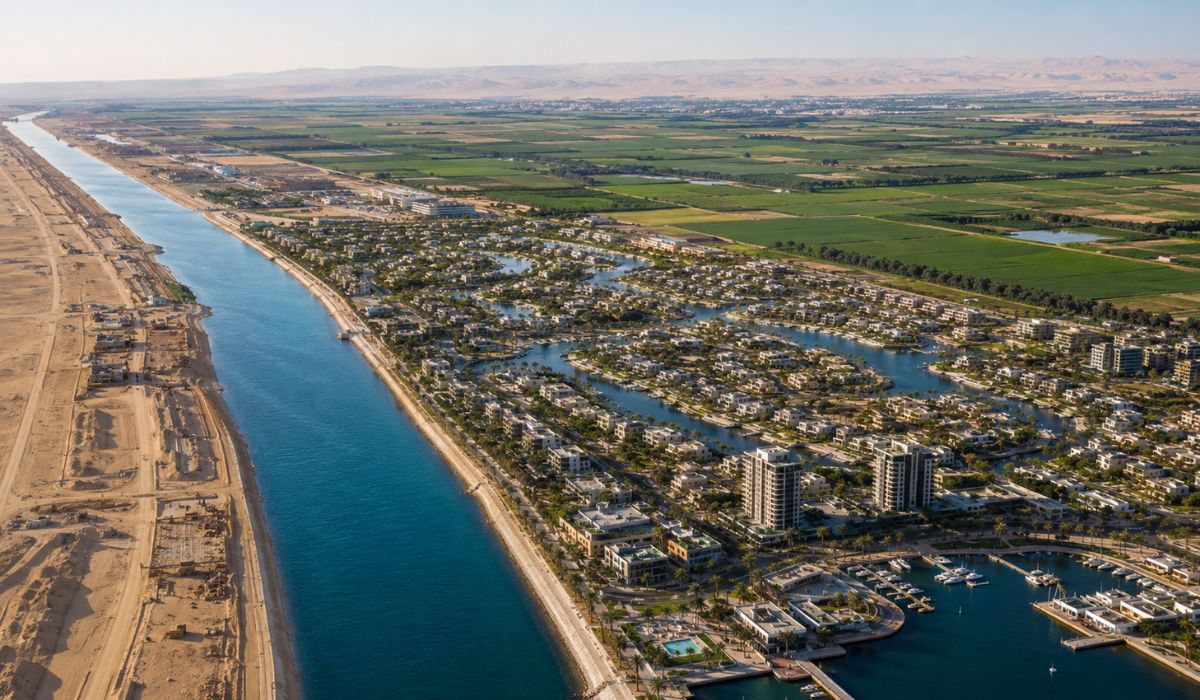
Megaproject in the Egyptian desert combines planned city, agricultural irrigation, and intensive use of Nile water, in an initiative that advances over arid areas and expands the debate on water scarcity in the country.
On June 1, 2025, Egypt presented a plan to build Jirian, a planned city in a desert area west of Cairo, with a projected supply of about 10 million cubic meters of Nile water per day.
The volume is expected to pass through the new urban development and continue to the New Delta agricultural project, which aims to irrigate approximately 2.28 million acres outside the traditional areas of the river valley.
The announcement was made by the government of Prime Minister Mostafa Madbouly amid water restrictions, energy limitations, and economic difficulties faced by the country.
-
Brazilian military personnel spend weeks in extreme training in the Amazon and receive a badge reserved for Jungle Warriors during the celebration of the 60th anniversary of one of the most demanding and respected courses in the world.

-
After the divorce, a woman spent four years building a studio apartment with skylights, mirrors, a bathtub hidden under the sofa, and family mementos for a fresh start.

-
The “Rei do Bolão” of Fortaleza made 100 people millionaires at once in the Mega-Sena: the lottery office in Aldeota divided R$ 168 million in a pool and delivers a bet from São Paulo to Dubai.
-
After swapping sewing for cement, a woman from Paraná became a mason, spent 12 years on construction sites, started building her own house, and even gained fame for restoring old Opalas.



In a statement about the project, Madbouly stated that the initiative seeks to increase the value of state assets and boost land prices through “non-traditional and innovative ideas,” according to Reuters.


City of Jirian advances over desert area near Cairo
The city of Jirian was presented for an area of 6.8 million square meters, located 42 kilometers from downtown Cairo.
The project is located on the Sheikh Zayed axis, in the 6th of October region, one of the urban expansion fronts of the Egyptian capital.
The plan released by the developers includes residential units, commercial areas, a yacht marina, and a free economic zone.
The signing of the agreement involved three private developers and the Egyptian state, represented by Mostakbal Misr for Sustainable Development, an agency linked to the country’s Armed Forces, as reported by Reuters.
The proposal combines real estate development, water infrastructure, and agricultural expansion.
According to the official project description, the water is expected to pass through the urban area before continuing to the cultivable lands associated with the New Delta, an initiative created to expand agricultural production in desert zones.
This configuration places Jirian within a broader strategy of the Egyptian government.
Instead of concentrating new projects only in the Nile Valley and Delta, the country is trying to create urban and agricultural hubs in regions far from the historically occupied corridor along the river.
Nile Water Sustains the Debate on the Megaproject
The volume planned to supply Jirian and support the New Delta is equivalent, according to Reuters, to about 7% of Egypt’s annual Nile water quota.
The daily figure of 10 million cubic meters corresponds to approximately 3.65 billion cubic meters per year if maintained continuously.
The dependence on the Nile makes the project relevant to the water debate in the country.
The United Nations Food and Agriculture Organization, FAO, states that the river represents more than 90% of Egypt’s water resources.
The same entity classifies the country as a nation under water stress, with about 500 cubic meters of renewable resources per person per year.
Data released in February 2026 by the Egyptian State Information Service also point to severe water scarcity.
At the time, the Minister of Water Resources and Irrigation, Hani Swelim, stated that the annual availability per inhabitant was around 500 cubic meters, below the reference limit used by the United Nations to characterize water scarcity.
The allocation of this volume to a new city and agricultural areas in the desert occurs in a context of increasing water demand, population growth, and the need to expand food production.
The Egyptian government presents the New Delta as one of the responses to this scenario.
New Delta Entered a New Phase in 2026
On May 17, 2026, President Abdel Fattah el-Sisi inaugurated the New Delta Development Project in the Sheikh Zayed axis, in Giza, according to the Egyptian State Information Service.
The enterprise was presented as one of the country’s main agricultural initiatives to expand the cultivated area outside the Nile Valley.
The Egyptian cabinet’s media center reported in May 2026 that the New Delta covers 2.2 million feddans and has infrastructure investments estimated at 800 billion Egyptian pounds.
According to the state newspaper Ahram Online, the government associates the project with agricultural production, food security, and the creation of new economic areas.
NASA also recorded, through satellite images, the expansion of green areas in sections of the provinces of Alexandria and Beheira between November 2018 and November 2024.
According to the American space agency, the New Delta uses recycled water, pumped groundwater, and water from a canal connected to the Rosetta branch of the Nile, but NASA itself emphasizes that recycled water does not meet all the demand of the plantations.
The combination of these sources shows that the project does not rely on a single source of supply.
Even so, the participation of Nile water remains central to the viability of the agricultural and urban expansion planned by the government.
Project combines irrigation, planned city, and land appreciation
Besides the agricultural function, Jirian has an explicit real estate component.
Palm Hills, one of the developers associated with the venture, describes the city as a new hub on the Sheikh Zayed axis, with housing, urban services, and areas aimed at social interaction by the water.
Reuters reported that the government intends to use the project to increase the value of public assets and boost land prices.
This approach transforms water infrastructure into part of an urban development and real estate appreciation strategy, according to the official justification presented in the announcement.
In the released design, water has different functions within the same project.
It appears as an input for irrigation, an element of urban supply, and a landscape component in residential and commercial areas.
This combination requires large-scale transport, pumping, and distribution works.
For the Egyptian government, expansion into the desert is part of a policy to open new areas for housing and agricultural production.
For water resource specialists consulted in international analyses on the subject, projects of this type usually depend on high technical planning, constant energy consumption, and strict management of available water.
Water infrastructure depends on canals, pumps, and energy
The infrastructure of the New Delta includes canals, pumping stations, and support networks to bring water to areas that would not naturally receive irrigation.
According to the Egyptian government, cited by Ahram Online, 28 main pumping stations, 150 kilometers of water routes, 18 electrical stations, and 12,000 kilometers of support roads have been built.
The Anadolu agency reported that the project also involves 19 large pumping stations and an allocation of 2,000 megawatts of electrical capacity.
These data indicate that the operation depends on permanent infrastructure to move water and maintain agricultural production in desert areas.
The scale of the works helps explain why the New Delta appears in official documents as an agricultural, urban, logistical, and economic project.
The government’s stated goal is to increase production capacity and reduce external dependence on food, especially in strategic crops.
The execution, however, takes place in a country that is already facing strong pressure on its water resources.
Therefore, the debate around Jirian and the New Delta is not limited to the construction of a new city, but involves how Egypt intends to distribute water among urban consumption, agriculture, land appreciation, and food security.
By taking part of the Nile’s water to a planned city in the desert and to new agricultural areas, Egypt expands a policy of occupation outside the traditional river valley.




Be the first to react!