Portuguese
  Spanish


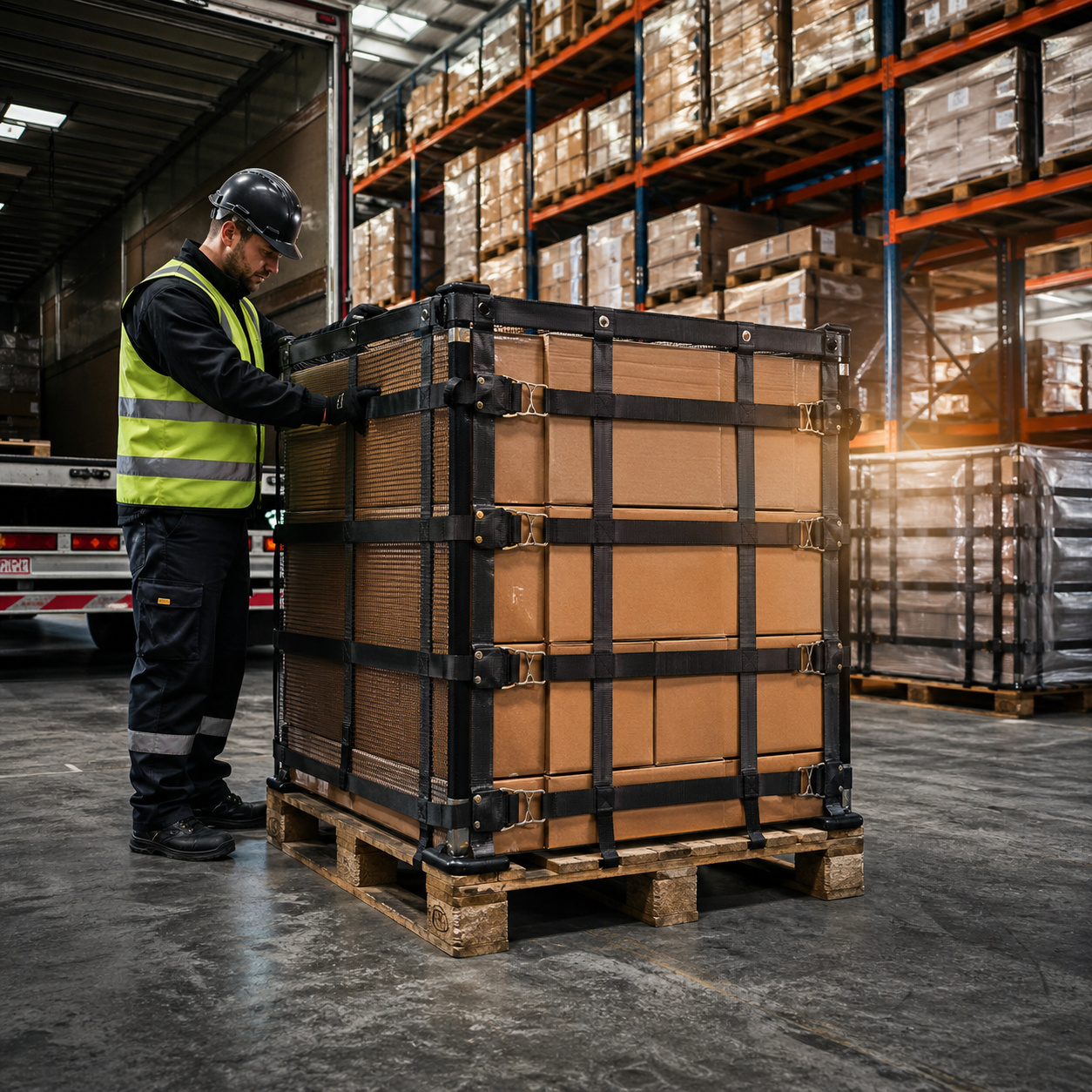

AgilFix technology replaces plastic film with reusable system, reduces waste and improves logistical efficiency in cargo transport.
In 2026, a solution developed in Brazil began to gain traction in the logistics sector by proposing a direct change in one of the most used inputs in cargo transport: disposable plastic. The company AgilFix, based in Santa Catarina, developed a system based on reusable cargo lashing straps, designed to replace the traditional stretch film used in palletizing and protecting goods.
The technology emerges at a time of increasing pressure to reduce plastic waste and increase operational efficiency in supply chains. According to the company’s institutional information, the proposal is to transform a disposable input, with continuous consumption, into a reusable asset within the logistics operation.
Continue reading below to understand how this technology works, what impacts it can generate in logistics, and why this type of solution is starting to gain relevance in Brazil.
-
AI Video Generator Automatically Creates Subtitles and Animated Captions

-
São Paulo Unveils Latin America’s Largest Underground Reservoir, Holding 900 Million Liters, in the Greater São Paulo Area

-
Chinese Teen Wins Gold in Germany for Invention Turning Air Moisture into Underground Irrigation in Drought-Stricken Areas

-
Desertification Threatens Brazil’s Caatinga: 85% of Semi-Arid Region Affected, 30 Million at Risk, and Efforts Underway to Restore 10 Million Hectares by 2045



System replaces stretch film with reusable straps and changes the logic of logistical consumption
The traditional cargo transport model uses plastic stretch film to wrap pallets, ensuring stability during transport. This material is disposable and needs to be reapplied with each new operation.


AgilFix’s solution proposes to replace this process with a system of reusable straps combined with corner protectors and accessories, capable of securely fastening the load without the need for plastic.
In practice, this alters the logic of logistical consumption: instead of continuously buying a disposable input, the company starts using equipment that can be reused multiple times.
This model is often described as a transition from recurring variable cost to investment in a reusable asset.
Plastic waste reduction becomes one of the main differentials of the technology
One of the central points of the proposal is waste reduction. Stretch film, widely used in the sector, generates a large volume of plastic waste over time, especially in high-turnover logistics operations.
The replacement with reusable straps significantly reduces this volume, contributing to environmental goals and corporate sustainability strategies.
According to the company, the proposal is aligned with the concept of eco-efficiency, which seeks to combine operational performance with reduced environmental impact. This factor has gained relevance in companies that need to meet ESG goals or reduce costs associated with waste management.
Operational efficiency is highlighted as an advantage in palletizing processes
In addition to the environmental impact, the technology is also positioned as an operational gain. The application of stretch film requires time, equipment, and constant repetition of the process. The strap system, on the other hand, allows for faster fastening, with the potential to reduce cargo preparation time.
The company highlights that the method can make palletizing more agile, standardized, and predictable, critical factors in distribution centers and industrial operations.
This can directly impact indicators such as productivity, dispatch time, and labor utilization.
Cargo security during transport is one of the critical points of the solution
One of the challenges in replacing plastic film is ensuring the same level of load stability. In this context, the AgilFix system uses resistant materials and fastening mechanisms that keep volumes firm during transport.
According to institutional descriptions, the products are developed with a focus on resistance, durability, and safety in high-intensity operations.
Reliability in this aspect is essential for companies to adopt the technology on a large scale, especially in sectors with high added value or risk of damage.
Model reduces dependence on petroleum-linked inputs
Another relevant point is the relationship with the raw materials market. Stretch film is derived from polymers, whose production is directly linked to petroleum. This makes its cost sensitive to variations in the international energy market.
By replacing this input with a reusable system, the company reduces exposure to this volatility, transforming a recurring cost into a more predictable investment.
This argument gains strength in scenarios of rising oil prices or instability in the global supply chain.
Technology developed in Brazil and operates nationwide
AgilFix operates in the transport and storage sector with a focus on logistics innovation, having been founded in 2016 and operating nationwide.
The company develops and markets solutions such as lashing straps, corner protectors, and accessories aimed at cargo containment.
The local development of the technology reinforces the potential of Brazilian solutions in the industrial and logistics sector, especially in niches that require adaptation to specific operational realities.
Brazilian logistics begins to incorporate solutions that combine cost, sustainability, and productivity
The advancement of solutions like those proposed by AgilFix reflects a broader trend within logistics. Companies are seeking alternatives that combine three main factors:
- reduction of operational costs,
- efficiency gains,
- lower environmental impact.
The replacement of disposable materials with reusable systems appears as one of the most direct strategies to achieve these objectives simultaneously.
However, large-scale adoption still depends on factors such as initial cost, process adaptation, and validation in different types of operations.
Solution points to structural change in material use in the logistics chain
The replacement of plastic film with reusable systems is not just a specific innovation, but an indication of structural transformation.
Modern logistics is beginning to incorporate concepts of circularity, efficiency, and waste reduction as a central part of its operation. In this scenario, solutions like AgilFix’s emerge as a direct response to a growing demand for efficiency combined with sustainability.
Now, the question that begins to guide the sector is direct: will the disposable plastic-based model remain dominant due to its simplicity and low initial cost, or will reusable technologies manage to scale up and definitively transform logistics in Brazil?