






 Portuguese
  Spanish
  3 min of reading
  0 comments



Start of Thorium Reactor Construction in 2024: A Historic Milestone for Sustainable Nuclear Energy in China!
The Shanghai Institute of Applied Physics (SINAP), of the Chinese Academy of Sciences, will begin construction of a thorium molten salt nuclear reactor with a capacity of 10 MW in 2024.
This project is a significant milestone, as the pilot reactor began operations in 2021.
With the success of the pilot project, China is preparing to establish a network of thorium reactors.
-
Space technology used to search for water on Mars is now hunting for invisible leaks under the streets of São Paulo, using satellites, AI, and chlorine signals to help Sabesp recover up to 6.7 billion liters of water.

-
Japan sends ship to extract mud rich in rare earths at nearly 6,000 meters deep in the Pacific, attempts to lift 350 tons per day from the seabed, and transforms sediments near Minamitori Island into a strategic weapon to reduce dependence on China.
-
Venus Aerospace promises a rotating detonation hypersonic engine that takes the Stargazer to Mach 9 and crosses oceans in 1 hour, but the flight that made history barely surpassed the speed of sound.

-
Brazilian student creates a cheap formula that makes plants grow up to 90% faster and wins an award in a global scientific competition.





This will enable a nation and other countries to become less dependent on uranium fuel.
While uranium reserves may only last for 500 years, thorium is abundant and can be used for hundreds of years.
Advantages of Thorium and Rare Earth Waste
Thorium is not only a sustainable alternative, but it is also available in large quantities in the waste from mining rare earth metals.
China is a leader in processing these minerals and has accumulated a significant amount of waste for use. This approach promotes sustainability and helps resolve the problem of industrial waste.
Challenges in Thorium Conversion
One of the challenges of using thorium is that it does not undergo nuclear fission directly. For this to occur, thorium-232 must be converted into a suitable isotope of uranium.
During this process, thorium-232 is placed in a molten salt reactor, transforming into thorium-233. This isotope has a half-life of about 20 minutes, decaying into protactinium-233, which converts into uranium-233.
Future Projects and Capacity Expansion
The pilot project was implemented in the Gobi Desert, where a 2 MW molten salt reactor was built.
SINAP assessed the project as promising and plans to construct a 60 MW reactor by 2025, with an electrical power of 10 MW.
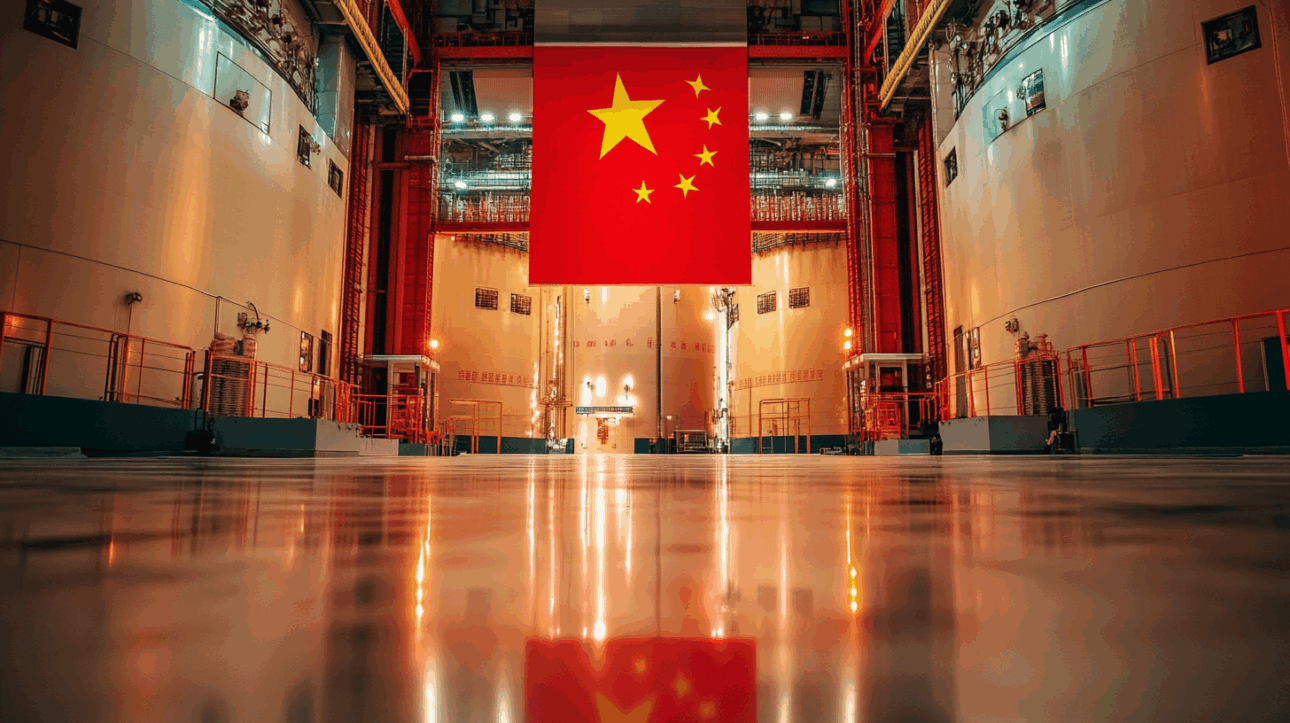
If the project is successful, China could increase capacity to up to 100 MW by 2030.
The Revival of Thorium Reactors
Before the China initiative, the only existing thorium reactor was at the Oak Ridge National Laboratory, in the USA, which was shut down in 1969.
Interest in molten salt reactors has resurfaced not only in China, but in various nations. Countries like United States, Japan, India and members of the European Union are considering these reactors as a safer alternative to traditional nuclear power plants.
Challenges and Concerns
While new technologies are being developed, there are concerns about handling radioactive fuel, which may need to remain out of the reactor for some time.
This raises questions about material safety and control. Some proposals aim to ensure that protactinium stays in the reactor, directly forming uranium in the core.
China at the Forefront of Nuclear Energy
China has stated that the construction of thorium reactors is a viable path and intends to maintain its leadership position in this sector.
While other countries are still in the planning stage, China is confidently moving forward, establishing itself as a model to follow.


-

-

-

-

6 people reacted to this.