






 Portuguese
  Spanish


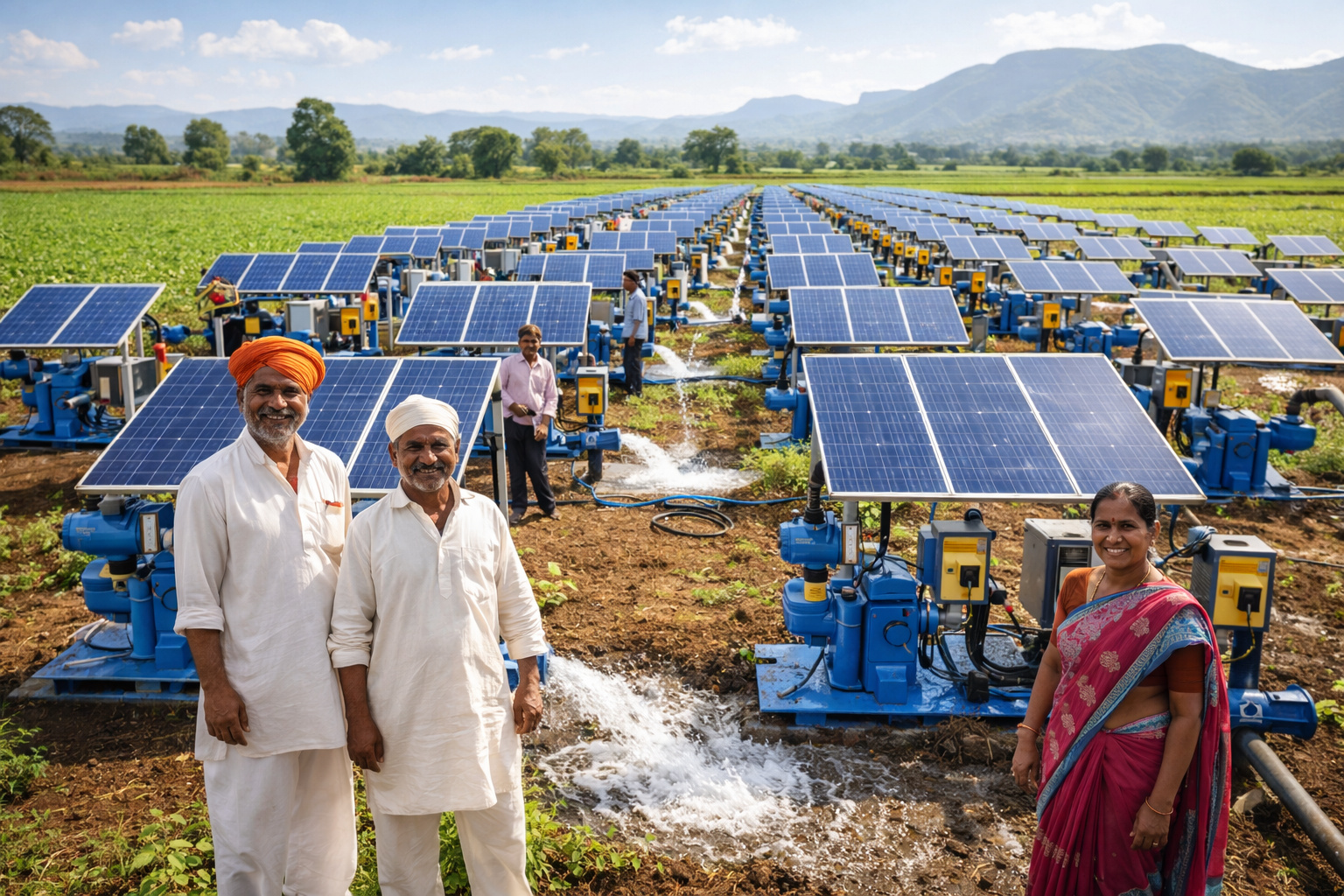


India installs 45,911 solar pumps in 30 days and accelerates rural irrigation with clean energy at record scale.
In December 2025, the state of Maharashtra, India, recorded an unusual advance in rural electrification by installing 45,911 agricultural solar pumps in just one month under the Magel Tyala Saur Krushi Pump Yojana program. The information was released by All India Radio on December 4, 2025, which cited the state-owned Maharashtra State Electricity Distribution Company Limited (MSEDCL) and reported that the achievement was recognized by Guinness World Records. According to pv magazine on December 8, 2025, the audited period for the record attempt occurred between October 27 and November 25, with installations carried out in various districts of the state.
The scale drew attention not only for the absolute number of equipment but also for the pace of the operation. Instead of relying solely on the expansion of the conventional power grid, the program prioritized off-grid solar pumps to enhance access to daytime irrigation and reduce dependence on traditional energy in rural properties. The simultaneous installation in different regions of Maharashtra transformed the project into one of the largest recent examples of accelerated solar energy deployment applied to agriculture.
The result was the transformation of a traditionally slow process into a large-scale industrial operation, completed in just one month.
-
Award-Winning Japanese Restaurant Reveals It Has Preserved Part of the Same Frying Oil for 66 Years

-
American Youth Transforms from Severe Obesity to U.S. Air Force Enlistment, Losing 90 Kilograms in Two Years
-
11-Year-Old Entrepreneur Sells 60 Homemade Sweets Daily, Mastering Cost Calculation, Social Media Promotion, and Client Negotiation Since Age 7

-
Peruvian Mountain’s 5,200 Aligned Holes May Unveil Ancient Indigenous Market for Corn and Cotton


How the agricultural solar pump works and why it changes the logic of irrigation in Maharashtra
Agricultural solar pumps are systems that use photovoltaic panels to generate electricity and power motors responsible for water extraction and distribution for irrigation.
Unlike conventional electric pumps, which depend on the power grid or diesel generators, these devices operate autonomously, harnessing solar energy.


This model presents a series of structural advantages. The main one is independence from rural electrical infrastructure, which in many regions is limited, unstable, or nonexistent. Additionally, the use of solar energy reduces operational costs over time, as it eliminates expenses with fuel or energy tariffs.
By installing thousands of these systems in a short period, the Indian program directly altered the way irrigation is carried out on a large scale in the field.
Another relevant point is operational predictability. Since solar energy production occurs mainly during the day, it coincides with the period when irrigation usually takes place, creating a natural integration between energy generation and agricultural use.
The scale of the operation required logistical coordination comparable to large industrial projects
The installation of 45,911 pumps in just 30 days cannot be interpreted as a simple or isolated process. It is an operation that required complex logistical planning, involving supply chain, transportation, technical teams, and regional coordination.
To understand the magnitude of this number, it is necessary to consider that each system involves multiple components, such as solar panels, support structures, inverters, pumping systems, and hydraulic connections. Each installation also requires site assessment, adaptation to soil type, and access to water sources, such as wells or reservoirs.
The simultaneous execution at thousands of distinct points indicates the existence of an organizational structure capable of operating on a massive scale, similar to large infrastructure projects.
Furthermore, the program involved the mobilization of technicians, engineers, and field teams distributed across various regions of the state, reinforcing the industrial nature of the operation.
Magel Tyala Saur Krushi Pump Yojana program integrates public policy with energy technology
The program responsible for the installation of solar pumps was created by the Maharashtra government with the aim of expanding access to irrigation and reducing dependence on conventional energy in the agricultural sector.

The initiative provides subsidies for farmers, facilitating the adoption of technology and accelerating its dissemination. Instead of relying solely on the expansion of the electrical grid, the program invests in decentralized solutions, allowing each rural property to have its own energy generation system.
This approach alters the traditional model of rural development, replacing centralized infrastructure with distributed and autonomous systems.
Another important aspect is the integration between public policy and technological innovation. By encouraging the use of solar energy in the field, the program contributes to emission reduction and the modernization of agriculture.
Solar irrigation reduces dependence on diesel and conventional electricity
Before the widespread adoption of solar pumps, many farmers relied on diesel generators to operate irrigation systems, especially in regions with limited access to the electrical grid.
This model has several limitations, including high fuel costs, frequent maintenance, and significant environmental impact. Additionally, the volatility of diesel prices can directly affect the economic viability of agricultural activities.

With the introduction of solar systems, this dependency is reduced. The energy generated by the panels allows for the continuous operation of pumps without the need for fuel, lowering operational costs over time.
This change not only improves the economic efficiency of rural properties but also contributes to the sustainability of the agricultural sector.
Comparison with other countries shows differences in the speed of implementation
In many countries, the expansion of irrigation systems depends on infrastructure projects that involve the construction of electrical grids, transmission lines, and water distribution systems. These projects can take years to complete due to factors such as bureaucracy, financing, and technical complexity.
In the case of Maharashtra, the adoption of decentralized solar systems allowed for circumventing these limitations. Instead of waiting for the expansion of the electrical grid, farmers began to rely on independent solutions installed directly on their properties.
This approach drastically reduced the time required to implement irrigation systems, transforming a process that used to take years into an operation that takes weeks.
The comparison highlights how different technological models can directly impact the speed of public policy implementation.
Direct impact on agricultural productivity and water security
Access to irrigation is one of the most important factors for agricultural productivity, especially in regions subject to climatic variations and periods of drought.
With the installation of thousands of solar pumps, farmers gain greater control over water usage, allowing them to irrigate their crops more efficiently and predictably. This reduces dependence on rainfall and increases the resilience of crops, contributing to food security.
Furthermore, the availability of irrigation systems can enable crop diversification, expanding economic opportunities for producers.
45,911 solar agricultural pumps and international recognition reinforces the relevance of the operation
The record achieved by the Maharashtra program was recognized by Guinness World Records, highlighting the significance of the achievement on a global scale.
This recognition is not limited to the number of installations but also to the speed at which they were carried out. In an international scenario where agricultural infrastructure projects often face delays, execution in 30 days stands out as an exceptional case.
The official record reinforces the importance of the project as a reference for other countries seeking to accelerate the modernization of the agricultural sector.
The model can be replicated in other regions with similar challenges
The experience of Maharashtra raises the possibility of replication in other regions of the world, especially in countries with large rural populations and energy access challenges.
The combination of solar energy, incentive policies, and large-scale execution can be adapted to different contexts, as long as there is logistical structure and coordination capacity.
However, replication depends on factors such as financing, availability of technology, and institutional capacity. Each country would need to adapt the model to its specific conditions.
Solar energy consolidates as a strategic tool for agriculture
The adoption of solar systems in the agricultural sector has grown in recent years, driven by the reduction in equipment costs and the search for more sustainable solutions.
In the case of India, the massive installation of solar pumps represents an important step in the integration between agriculture and renewable energy.
This trend indicates that the future of irrigation may increasingly be linked to autonomous and decentralized systems. In addition to reducing costs, these systems contribute to emission reductions and energy transition.
The case of Maharashtra demonstrates that when there is alignment between planning, technology, and execution, it is possible to achieve results in significantly shorter timeframes than those traditionally observed.
The installation of nearly 46,000 systems in a single month shows that public policies can be implemented on an industrial scale, provided there is adequate coordination. This type of operation redefines expectations about the time needed to transform entire sectors of the economy.
Do you believe that projects of this kind could be implemented in Brazil on a similar scale?
The Indian experience raises a relevant question for countries with great agricultural potential, such as Brazil. With vast areas, climatic diversity, and a growing need for water efficiency, the adoption of solar systems for irrigation could represent a significant change in the sector.
In light of this, a reflection arises: is it possible to replicate an operation of this scale and speed in other countries, or does this type of mobilization still depend on very specific conditions?


I would like to inform that state level Agency of J and K is not bothered about the complaint of malfunctioning solar water pump as I am continuously lodging complaint for the lost two months.