Portuguese
  Spanish


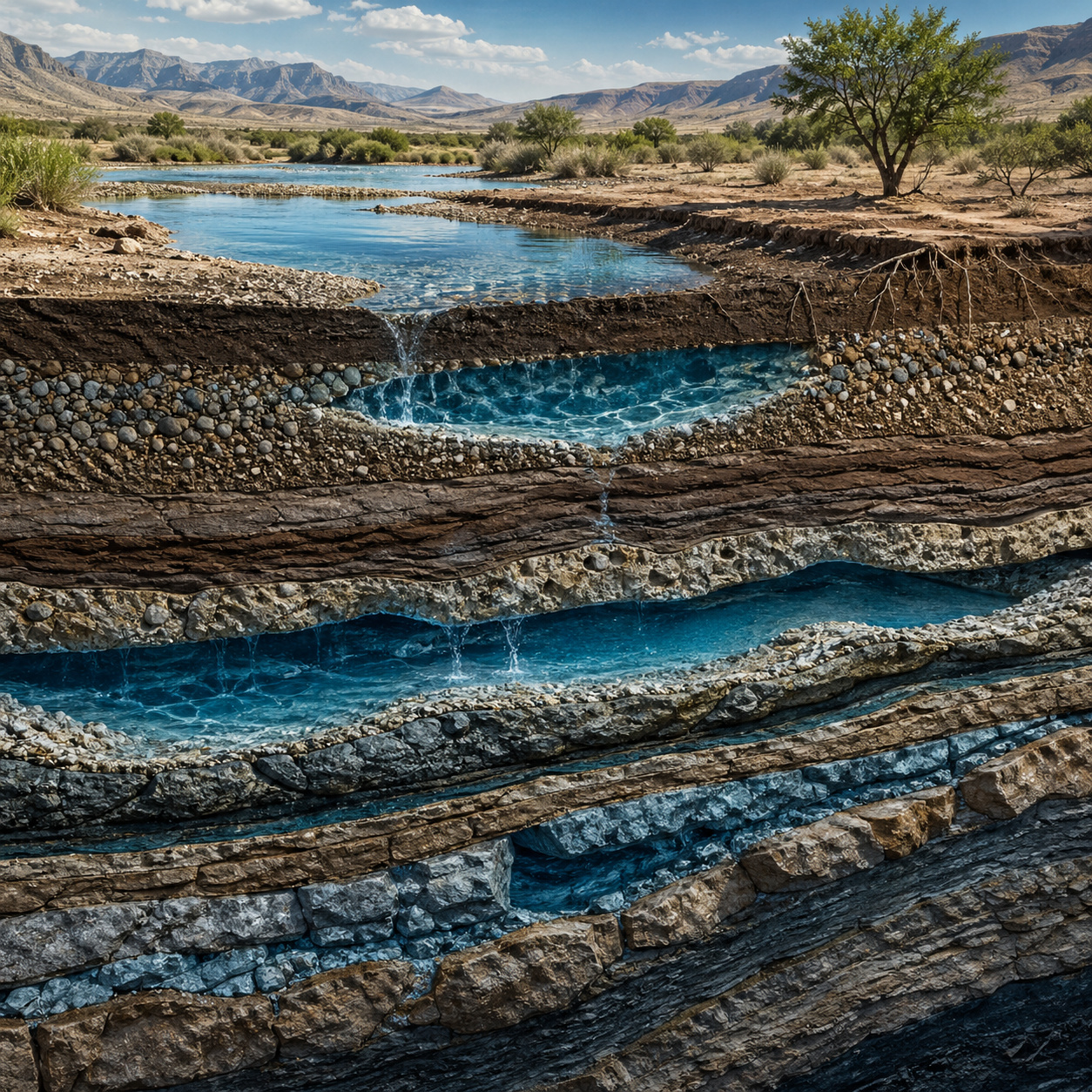

Study points out that more than half of the rivers in Brazil may be losing water to the subsoil, with impact on supply and ecosystems.
In 2024, a group of 8 Brazilian and international researchers, linked to institutions such as University of São Paulo, Federal University of Mato Grosso do Sul, São Paulo State University, University of California in Santa Barbara, and Rutgers University, published in Nature Communications, on November 25, a study that raises a direct alert about the water dynamics in Brazil: rivers that traditionally helped sustain aquifers and ecosystems may, in many regions, be doing the opposite, losing water to the subsoil.
The research analyzed data from 17,972 wells located up to 1 km from rivers in Brazil, crossing this information with the elevation of the surface of nearby watercourses. The goal was to understand, on a national scale, the relationship between groundwater levels and the surface of rivers, an interaction considered essential for water availability, environmental flows, and the functioning of river ecosystems.
The result was significant: 55% of the analyzed wells showed groundwater levels below the surface of nearby rivers, a condition that indicates potential downward flow. In practical terms, this means that part of the water from the rivers may be infiltrating into the subsoil and feeding aquifers, instead of receiving groundwater as occurs in river systems traditionally classified as gaining.
-
She spent 73 years breathing inside an iron lung, survived the aftereffects of polio, and became the last woman in the United States dependent on the equipment before dying at 78 years old.

-
Brazilian students created a $1 filter using pine bark, cotton, and 3D-printed parts to clean cassava wastewater, reduce the toxicity of a hazardous waste, and transform contaminated water into biofertilizer.

-
Astronaut from Artemis II steps down after mission to the Moon and decision surprises after a record of 406,771 km, a historic 10-day journey, and an unprecedented achievement for Canada.

-
A fossil kept for years in a small museum in Montreal concealed 450-million-year-old soft tissue, a discovery that has only happened once before in history.


This phenomenon, invisible to the naked eye, can completely alter the way the water system functions in various regions of the country.
Rivers may be stopping being sources to become areas of water loss
In natural conditions, many rivers function as systems that feed aquifers, especially during flood periods. However, when the groundwater level drops, this relationship can reverse.
In these cases, the river begins to act as a recharge point for the aquifer, losing part of its flow to the subsoil.


This type of river is known as a losing river, in contrast to the so-called gaining rivers, which receive water from the subsoil.
The change in behavior not only alters the local flow but can reduce the volume of water available along the entire course of the river.
Pumping of groundwater is pointed out as the main factor of change
The study identifies the main cause of this inversion as the intensive use of groundwater, especially in agricultural and urban areas.
The continuous withdrawal of water through wells lowers the level of aquifers. When this level falls below the surface of the rivers, a gradient is created that favors the infiltration of surface water.
This process is more common in areas with:
- intensive irrigated agriculture
- high urban use of groundwater
- low natural recharge of the aquifer
The pressure on groundwater resources alters the natural balance between rivers and aquifers, creating an increasingly extraction-dependent system.
More than half of the evaluated rivers may be under this type of pressure
By analyzing rivers with at least one well located every 100 kilometers, the researchers identified that 56.4% of them showed conditions favorable to the loss of water to the subsoil.
This data expands the scale of the problem, showing that the phenomenon is not localized but potentially widespread in different regions of the country.

The impact is not restricted to a single biome or watershed but can affect extensive areas of Brazilian territory.
Consequences affect supply, agriculture, and aquatic ecosystems
The reduction of river flow can generate a series of chain effects. In urban supply, lower availability of surface water may increase dependence on reservoirs and alternative systems. In agriculture, rivers with lower flow may compromise irrigation systems.
Furthermore, aquatic ecosystems depend on minimum water levels to maintain biological balance. The decrease in flow can affect species, water quality, and sediment dynamics.
The loss of water from rivers to the underground transforms a visible resource into an invisible process, with broad and difficult-to-monitor consequences.
Phenomenon is difficult to detect without detailed technical data
One of the central challenges of this problem is its invisibility. Unlike droughts or floods, the loss of water to the underground does not generate immediate perceptible signs. The river level may seem stable at certain times, even with continuous loss.

The identification of this process depends on precise measurements, such as monitoring of wells and analysis of geospatial data. Without this type of information, the phenomenon may progress unnoticed for years.
Water management needs to consider the interaction between surface and underground
The study reinforces that water management cannot treat rivers and aquifers as independent systems. In practice, both are part of the same integrated hydrological cycle. Changes in one component directly affect the other.
This requires public policies that consider:
- control of underground water pumping
- integrated monitoring of water resources
- planning of water use by sector
The separation between surface and underground water is no longer viable in light of scientific evidence.
Agricultural and urban regions concentrate the greatest risk of imbalance
Areas with intensive water use are the most susceptible to flow reversal between rivers and aquifers. Regions with large-scale irrigated agriculture, such as parts of the Midwest and Southeast, exert greater pressure on underground resources.
Urban areas with high population density also contribute to the reduction of aquifer levels. The problem tends to intensify in places where the demand for water grows faster than the capacity for natural replenishment.
Trend may worsen with increased water demand
Population growth, agricultural expansion, and increased industrial demand point to a scenario of greater pressure on water resources.
Without changes in management practices, the trend is that aquifer levels will continue to decline, increasing the number of rivers that begin to lose water to the underground. The phenomenon may cease to be an exception and become the norm in various regions of the country.
With more than half of the evaluated rivers showing potential for water loss to aquifers, the study reveals a silent transformation in the national water system.
What was once a predictable flow between surface and underground now presents new dynamics, directly influenced by human action.
The question that arises is direct: will Brazil be able to balance the use of its water resources or is it heading toward a scenario where rivers cease to be sources and become points of water loss in the system?