






 Portuguese
  Spanish


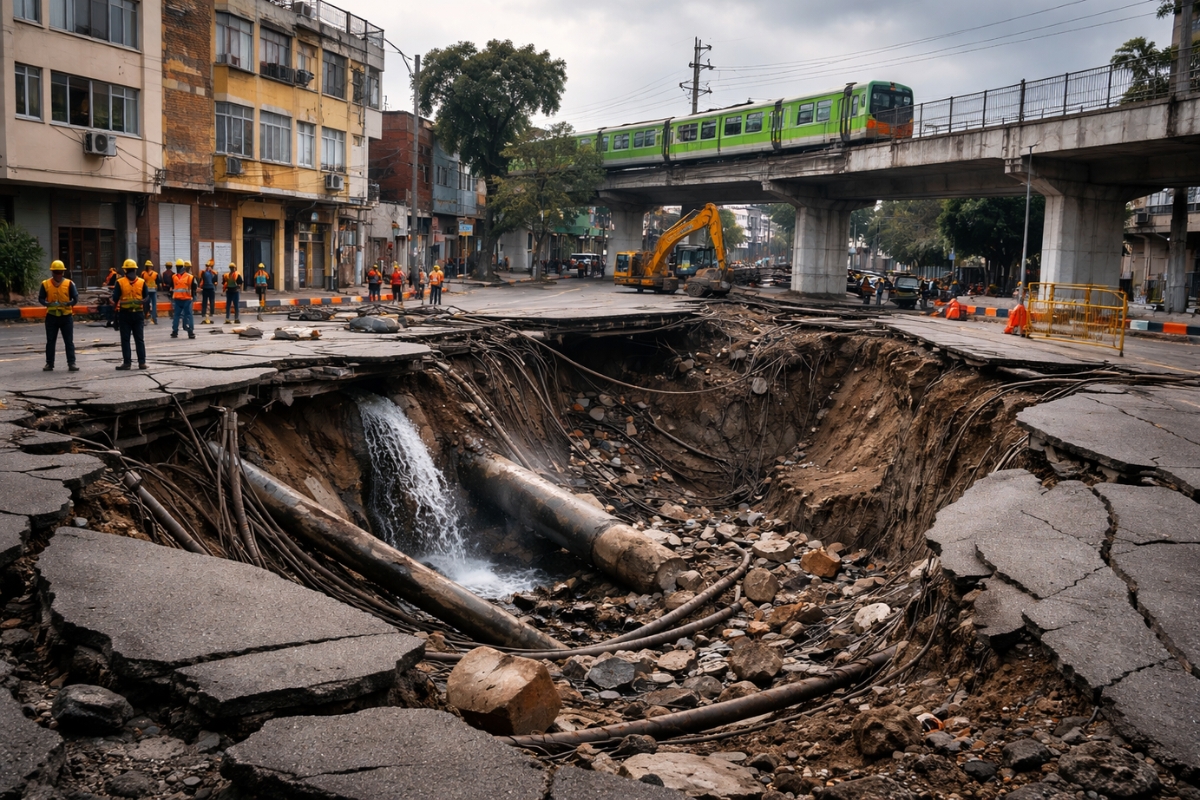


An Aquifer Provides 60 to 70% of the Metropolitan Water, but the Price Appears on the Surface: Cracks, Unevenness, and a Drainage System That Stops Functioning as Before
Mexico City sits atop soft sediments from an ancient lake system, and groundwater has become the main source to supply the metropolis.
With decades of extraction, the ground began to subside. The result is evident daily with deformed streets, pressurized pipelines, and structures requiring constant adjustments.
The situation has become one of the most extreme cases on the planet of urban subsidence related to the intensive use of groundwater, as the supply almost entirely depends on this invisible reservoir.
-
How to Prevent Brown Recluse Spider Bites: Common Hiding Spots and Free Tips to Reduce Risks

-
Natto: The Unusual Japanese Superfood Gaining Popularity on Social Media and Driving Record Exports
-
Brazilian Mayor Goes Undercover as Homeless for 24 Hours to Assess Public Services

-
15-Year-Old Entrepreneur Malu Lira Publishes 20 Children’s Books on Financial Education, Earns $500,000, and Expands Her Project to the Amazon Rainforest




The Soil of the Valley of Mexico is Made of Clays That Compress Like a Sponge
The Mexican capital was built on layers of highly compressible clays and silts deposited when the region was a vast lake area.
When the volume of water decreases, these layers easily compact. In a large and heavy city, the pressure on the surface amplifies the problem.
According to the research article by Chaussard et al. (2021), published in the Journal of Geophysical Research: Solid Earth, the aquifer plays a central role in the consumption of the metropolitan area, with an estimated contribution of 60 to 70% of the supply.

Wells of Up to 3,000 M Show How the Search for Water Has Gone Deeper
Urban growth throughout the 20th century increased the withdrawal of groundwater. More powerful pumps maintained the supply but pushed the system into prolonged imbalance.
There are records of wells reaching depths of 3,000 m in some areas, a sign that the city needed to look for water in layers increasingly below the traditional level.
Over time, extraction began to exceed natural recharge. This paved the way for continuous subsidence, with rising costs to keep the city functioning.
Subsidence Was Visible Between 1920 and 1950, with Leaning Buildings
Between 1920 and 1950, there were already differential subsidence capable of tilting significant buildings, including the Metropolitan Cathedral.
This process also necessitated interventions to manage drainage, as parts of the city fell below the natural flow level.
The problem ceased to be isolated and became a cumulative effect intensified by the increasing demand for water.

Satellites Detected Areas Sinking 30 to 40 cm Per Year in Recent Decades
In more recent periods, measurements by satellites using InSAR technology identified areas of the Valley of Mexico sinking 30 to 40 cm per year.
In a few decades, this translates to accumulated meters. Every centimeter alters the inclination of roads, changes the behavior of water, and requires corrections in urban networks.
This pattern reinforces the scale of the challenge, as subsidence does not occur uniformly throughout the city.
As Water Pressure Fades, The Soil Collapses and The Damage Can Be Irreversible
In confined aquifers beneath clays, water helps to support the internal structure of the soil. When pressure decreases due to pumping, grains settle, layers compact, and the surface sinks.
Much of this process is irreversible. Compacted clays do not fully recover their original volume, even if extraction decreases.
In the Valley of Mexico, the combination of fine lacustrine clays, extraction above recharge, and the presence of a dense city makes subsidence chronic and hard to slow.
Almost Half of The Elevated Segments of The Subway Suffer From Differential Subsidence
Subsidence does not occur uniformly. Neighborhoods and thoroughfares sink at different rates, creating unevenness that opens cracks in the asphalt and overloads pipelines.
This mismatch also complicates drainage, increases flooding points, and raises risks in areas that were previously considered safe.
There are indications that nearly half of the elevated sections of the subway face significant differential subsidence, requiring reinforcements, adjustments in inclination, and structural changes in viaducts and collectors.

Compaction Can Continue for Decades, Even With Extraction Stabilized
Over-exploitation can maintain compaction for decades, even if extraction stabilizes. In such scenarios, entire areas progressively become lower than surrounding channels and rivers.
This increases maintenance costs and heightens the risk of flooding and structural failures, especially in areas where the unevenness grows rapidly.
The impact affects a megacity with over 15 million inhabitants in the metropolitan area, elevating the weight of the problem for services and infrastructure.
Reducing Pumping and Recharging The Aquifer Becomes The Way To Contain The Crisis
A set of actions usually appears as a risk reduction pathway: decreasing aquifer pumping, increasing the use of surface sources and inter-basin collectors, promoting artificial recharge with rainwater and treated water.
The idea of redesigning the city as a sponge also comes into play, increasing infiltration and reducing losses.
Since part of the damage is permanent, the priority shifts to managing subsidence safely, reducing impacts on infrastructure, and preventing supply dependent on this invisible reservoir from accelerating a new urban crisis.
Mexico City is already feeling the effects of relying on an aquifer exploited beyond its limit, and subsidence has become a daily factor for maintenance and risk.
The response involves reducing pressure on groundwater and adapting networks and projects to the new terrain, as the ground continues to change and the city needs to keep pace.








Que complicado, vão ter colher a agua da chuva 100 por cento e injetar em poços desativados, e dar um geito até de pegar agua do mar e injetar, se conseguir tirar o sal antes de injetar sera melhor caso contrário vai ter que ser com sal….vao ter que pegar agua de rios mesmo que fiquem a centenas de km
Essas imagens geradas por IA na chamadas das matérias são infantis, desnecessárias. Parem com isso.